
Cortex 2.0: Giving Industrial Robots the Power of Foresight
Cortex 2.0: Grounding World Models in Real-World Industrial Deployment
Cortex 2.0 is a general-purpose Vision-Language-Action (VLA) model designed for industrial manipulation. It introduces a visual-latent world model and a Process-Reward Operator (PRO) to transform reactive control into a "plan-and-act" pipeline, achieving state-of-the-art results in tasks like shoebox unpacking and screw sorting.
Executive Summary
TL;DR: Sereact's Cortex 2.0 marks a significant shift from reactive robotics to proactive planning. By integrating a visual-latent world model and a multi-criteria scoring system (PRO), the model "imagines" potential futures before moving, effectively eliminating the compounding errors that plague current Vision-Language-Action (VLA) systems.
Background: While models like RT-2 and π0 have mastered task generalization, they often fail in "messy" real-world factories. Cortex 2.0 moves the needle from "pattern matching" to "reasoned execution," setting a new SOTA for industrial autonomy.
The Problem: The "Blind" Reactive Trap
Most modern robots act like high-speed reflex agents. They see a frame, predict an action, and repeat. While fast, this approach is fundamentally flawed for long-horizon tasks:
- Irreversibility: A slipped grasp or a slight collision in step 2 might make step 20 impossible.
- Compounding Errors: Small errors in reactive policies accumulate until the robot enters a "deadlock" (oscillating without progress).
- Lack of Risk Awareness: Reactive models don't know they are about to perform a risky maneuver until they have already started it.
Methodology: The Architecture of Imagination
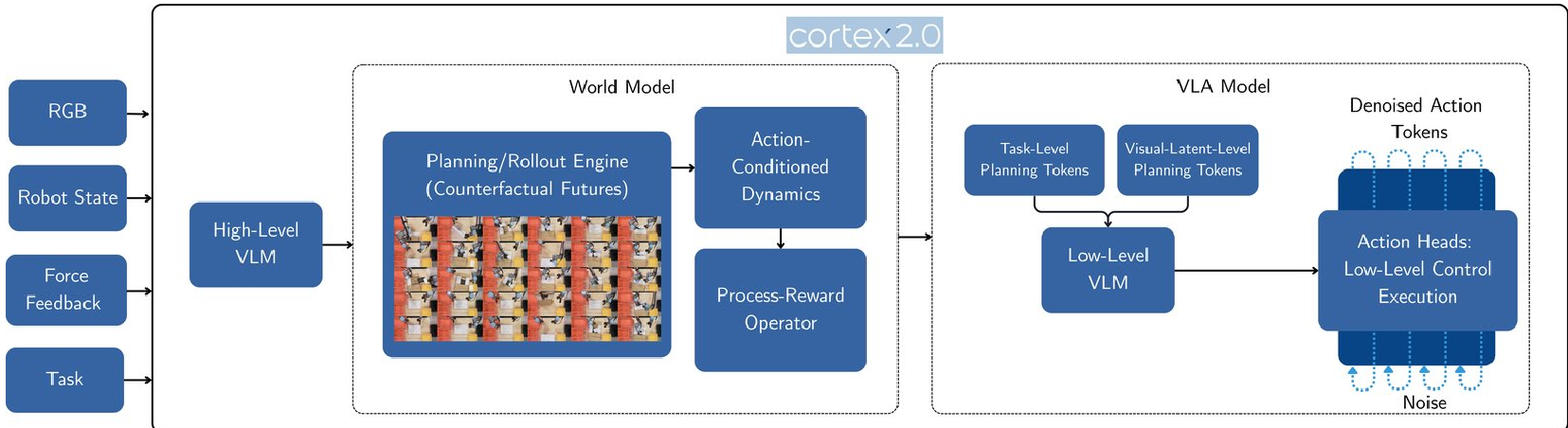
Cortex 2.0 solves this by implementing a "Look Before You Leap" philosophy. The architecture consists of four distinct layers:
1. High-Level Task Context
A VLM encodes the scene and task instructions (e.g., "unpack the shoebox") into a structured embedding.
2. The World Model (The Dreamer)
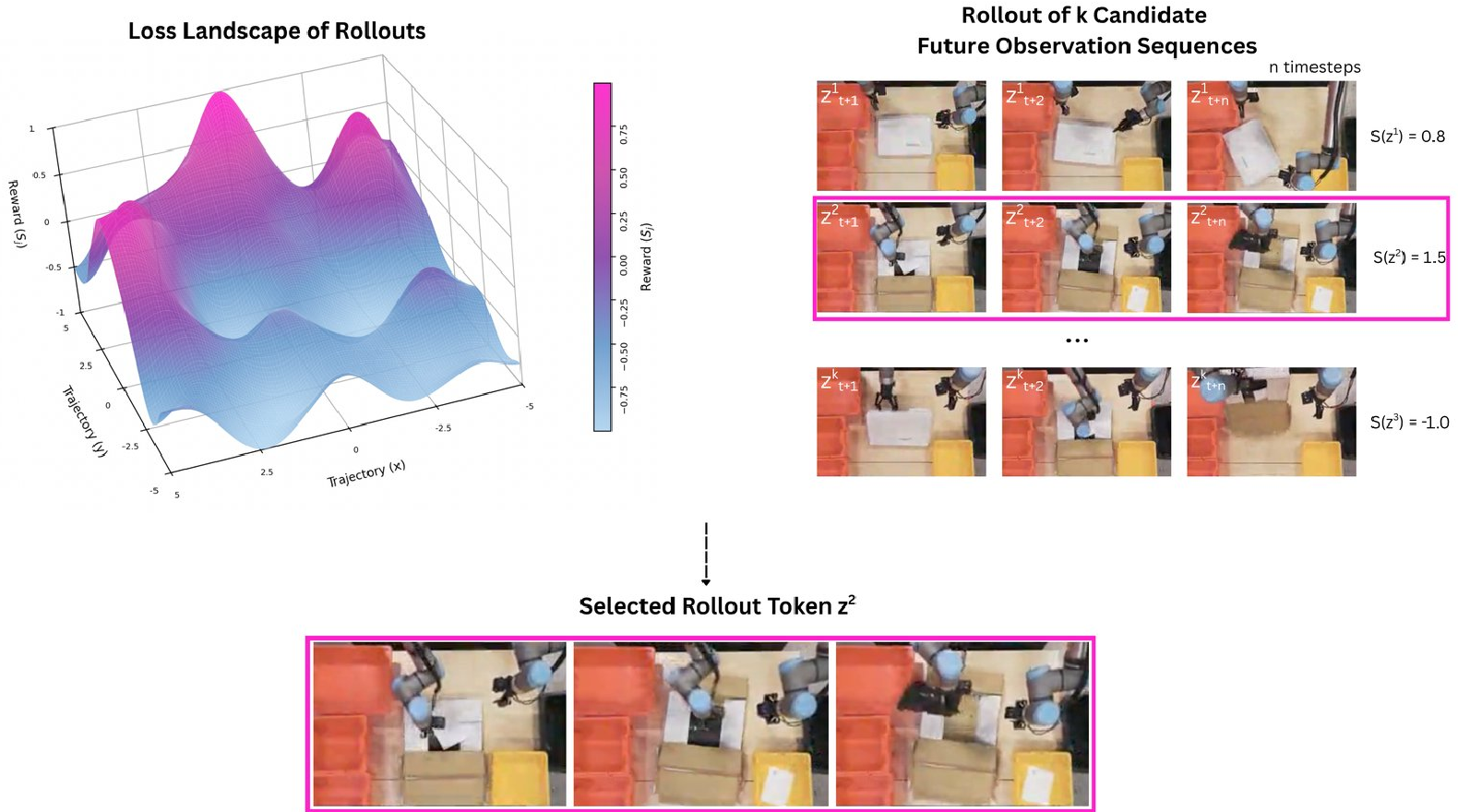
Using Flow Matching, the world model generates different "candidate futures" in the visual latent space. It doesn't just predict the next frame; it predicts entire trajectories of how the scene might evolve.
3. PRO: The Process-Reward Operator
This is the "judge." It evaluates the imagined futures based on:
- Progress: Does this future get us closer to the goal?
- Risk: Is there a likelihood of a collision or a slip?
- Termination: What is the probability of total success?
The highest-scoring future is selected, and its "advantage" is used to guide the actual robot control.
4. Flow-Matching Action Heads
The final controller generates precise 30Hz movements. Because it is conditioned on the "best" imagined future, it inherits the strategic benefits of the planning phase.
Experiments: Dominating the Industrial Floor
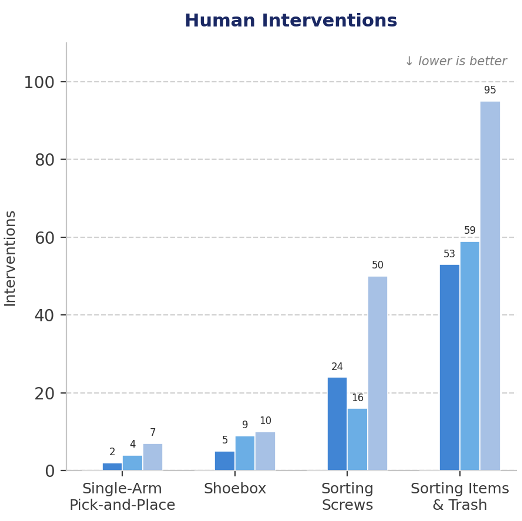
The researchers tested Cortex 2.0 on four grueling tasks, including sorting reflective screws and unpacking deformable shoeboxes.
Key Findings:
- Zero Interventions: Unlike baselines (π0.5, Diffusion Policy) which required human help in almost every trial, Cortex 2.0 achieved zero human interventions.
- Efficiency: Despite the extra "thinking time," Cortex 2.0 finished tasks faster because it didn't waste time on failed attempts and retries.
- Scaling Foresight: As the number of rollouts () increased, the success rate climbed toward 100%, demonstrating a clear "Compute-to-Performance" scaling law.
Critical Insight & Conclusion
Cortex 2.0's true breakthrough isn't just "better accuracy"—it's reliability. By training the PRO module on millions of real-world industrial interactions (including failures), Sereact has created a model that generalizes from the "edge cases" of actual factories.
Limitations: The primary bottleneck is inference speed. Sampling 30 rollouts takes nearly 9 seconds, which is too slow for dynamic environments. However, for high-stakes industrial tasks, this "deliberate thinking" is a price worth paying for total autonomy.
Final Takeaway: Cortex 2.0 proves that for Physical AI to reach the next level, it must stop reacting to the world and start predicting it.