
[3G GW Cosmology] BNS Mass Functions: The New Frontier for Standard Sirens and Modified Gravity
Cosmology and modified GW propagation from the BNS mass function at third-generation detector networks
The paper presents a comprehensive forecast for measuring the Hubble constant (H0) and modified gravitational-wave (GW) propagation (parameterized by Ξ0) using the Binary Neutron Star (BNS) mass function with third-generation (3G) detectors like the Einstein Telescope (ET) and Cosmic Explorer (CE). It demonstrates that a joint Bayesian inference of population and cosmology can yield ~11% precision on H0 and ~18% on Ξ0 using ET alone, improving to 9% and 6% respectively in an ET+CE network.
TL;DR
As we transition into the era of third-generation (3G) gravitational-wave (GW) detectors, the search for the "Standard Siren" is evolving. This paper demonstrates that we don't necessarily need electromagnetic counterparts to measure the expansion of the universe. By leveraging the BNS mass function as a spectral ruler, a network of 3G detectors (Einstein Telescope and Cosmic Explorer) can constrain the Hubble constant to 9% and test General Relativity via modified GW propagation to within 6% precision, even with a highly conservative sample of events.
Background: Breaking the Degeneracy
The fundamental challenge in GW cosmology is the mass-redshift degeneracy. In the frequency domain, a distant, heavy binary looks identical to a nearby, lighter one because the expansion of space stretches the signal's wavelength.
To extract the Hubble constant (), we need the redshift (). While "bright sirens" (like GW170817) provide this via a light-based counterpart, they are rare. The authors instead look toward "spectral sirens." If we know the physical distribution of neutron star masses is fixed by stellar physics, we can use that "mass function" as a reference to infer the redshift of the entire population.
Methodology: Joint Population-Cosmology Inference
The authors utilize a hierarchical Bayesian approach to perform a "joint inference." They don't just assume they know the BNS population; they solve for the cosmology and the astrophysical parameters simultaneously.
1. Modified GW Propagation
Beyond , the paper explores a profound question: Does gravity behave as General Relativity (GR) predicts over billions of light-years? In many modified gravity theories, GWs "leak" or interact with dark energy, causing the "GW luminosity distance" () to deviate from the standard electromagnetic distance (). The authors use the parametrization: Where represents General Relativity.
2. 3G Detector Networks
The study compares two configurations for the Einstein Telescope (ET)—the Triangle (single site) and the 2L (two L-shaped detectors at different sites)—and considers their performance when paired with the 40km Cosmic Explorer (CE).
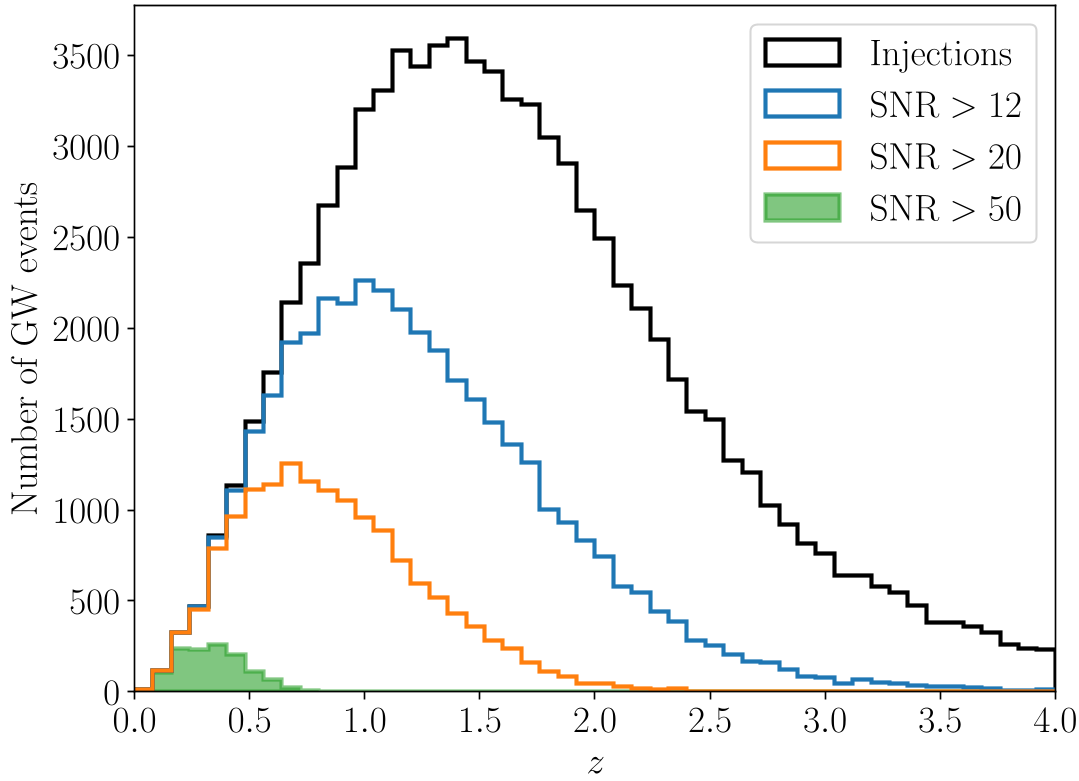 Figure 1: Comparison of BNS redshift distributions across different SNR thresholds. The green histogram represents the conservative dataset used (SNR > 50).
Key Results: Precision at the Horizon
The study finds that while ET alone is a powerful tool, the inclusion of CE is a game-changer for modified gravity.
- Hubble Constant (): ET (Triangle or 2L) achieves ~11-12% precision. The ET+CE network reaches 9%.
- Modified Gravity (): ET alone yields 18% precision. Adding CE drops this dramatically to 6%.
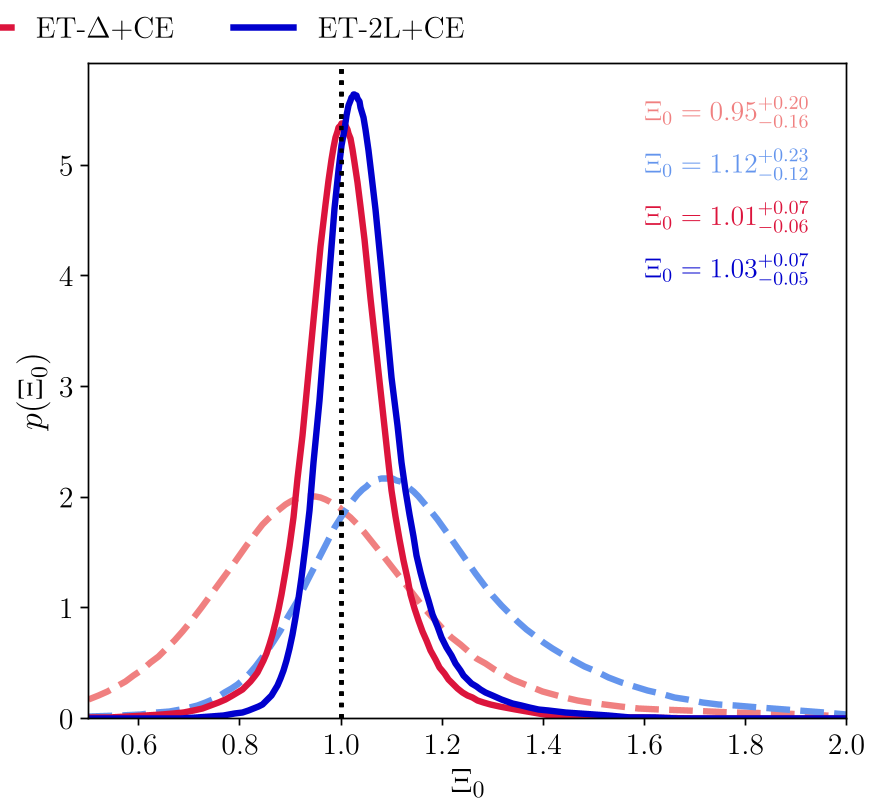 Figure 2: Posterior distributions for the Hubble parameter and the modified gravity parameter across different detector configurations.
The correlation between and the mass parameters (, ) confirms that our understanding of stellar physics is the "anchor" for this cosmological measurement.
Deep Insight: Why higher SNR?
One might ask: why restrict the analysis to SNR > 50? Usually, more data is better. However, the authors argue that at low SNR, the Fisher Matrix approximation becomes unreliable, and noise realizations can bias the results. By focusing on high-SNR events (the "gold plated" events), they provide an extremely conservative lower bound. If we include the thousands of lower SNR events expected per year, the precision could potentially reach the 1% level.
Critical Analysis & Conclusion
Takeaway
The BNS mass function is a remarkably stable "spectral ruler." Unlike Binary Black Holes (BBHs), which have complex mass distributions that may evolve with redshift, BNS masses are constrained by the physics of neutron degeneracy pressure, making them less prone to systematic modeling errors.
Limitations
- Redshift Reach: BNS signals are weaker than BBH signals. With an SNR > 50 cut, the study only probes up to . To truly test modified gravity at high redshifts, we will need to include BBHs or improve our low-SNR inference techniques.
- Selection Bias: The study relies heavily on the assumption that the BNS mass distribution does not evolve significantly with redshift.
Future Outlook
The integration of these "spectral sirens" with galaxy catalogs will be the final step. By the 2030s, when ET and CE come online, we will have a multi-layered map of the universe, using the BNS mass function as a crucial cross-check against traditional supernovae and CMB measurements, potentially solving the Hubble Tension once and for all.