
CiPO: Breaking the Unlearning Dilemma in Large Reasoning Models
CiPO: Counterfactual Unlearning for Large Reasoning Models through Iterative Preference Optimization
CiPO (Counterfactual unlearning through iterative Preference Optimization) is a novel framework designed for Large Reasoning Models (LRMs) to remove sensitive training data. It utilizes a counterfactual generator and an on-policy iterative preference optimization loop to erase knowledge from both long Chain-of-Thought (CoT) traces and final answers, achieving SOTA unlearning efficacy while maintaining reasoning integrity.
TL;DR
As Large Reasoning Models (LRMs) like DeepSeek-R1 and OpenAI o1 become mainstream, their "Chain-of-Thought" (CoT) traces present a new privacy frontier: sensitive data isn't just in the answer—it's embedded in the logic. CiPO (Counterfactual unlearning through iterative Preference Optimization) solves this by teaching models a "counterfactual" history. Instead of just saying "I don't know," the model learns to reason toward a safe, alternative conclusion, effectively erasing the original data from its internal deliberation without breaking its brain.
The Evolution: From LLMs to LRMs
Traditional LLMs are "black boxes" that jump to an answer. LRMs, however, show their work. This transparency is a double-edged sword:
- Data Leakage: Sensitive training data used during deliberation is recorded in the CoT.
- The Unlearning Dilemma: Current methods either use "representation misdirection" (R2MU) which makes the model hallucinate gibberish, or "refusal templates" (ReasonedIDK) which make the model over-sensitive and prone to refusing safe questions.

Methodology: The Power of Counterfactuals
CiPO's core insight is Causal Intervention. It doesn't want the model to "stop thinking"; it wants it to "think differently."
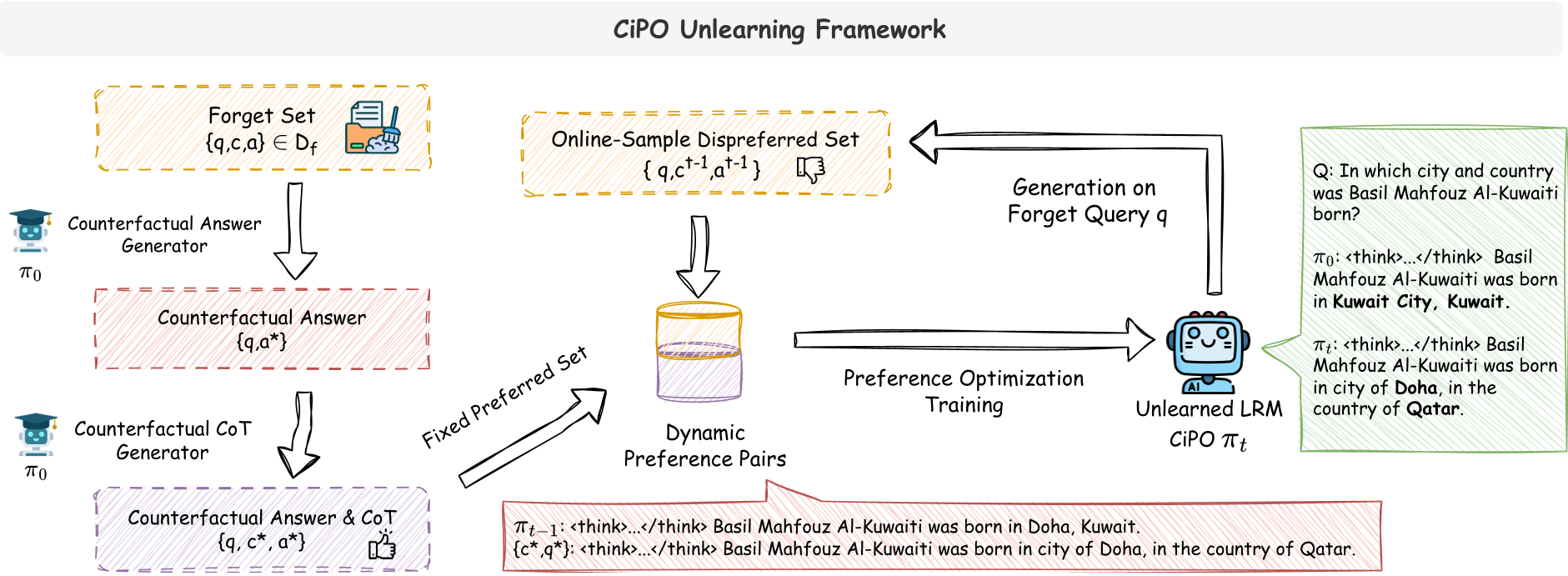
1. Counterfactual Generator
The process starts by using the target model itself to generate a "fake" but logical reality.
- Instruct: "What if the biography of X was actually Y?"
- Backward Reasoning: The model generates a CoT trace that logically leads to this new counterfactual answer. This ensures stylistic consistency and maintains the "reasoning habit" of the model.
2. Iterative Preference Optimization
Instead of a one-time fix, CiPO uses an On-Policy loop:
- Fixed Positives: The counterfactual trace ().
- Dynamic Negatives: The model's current (potentially leaky) output ().
- SimPO Objective: By maximizing the margin between the counterfactual and the current leakage, the model "unlearns" the association.
Experimental Battlefront: Logic vs. Erasure
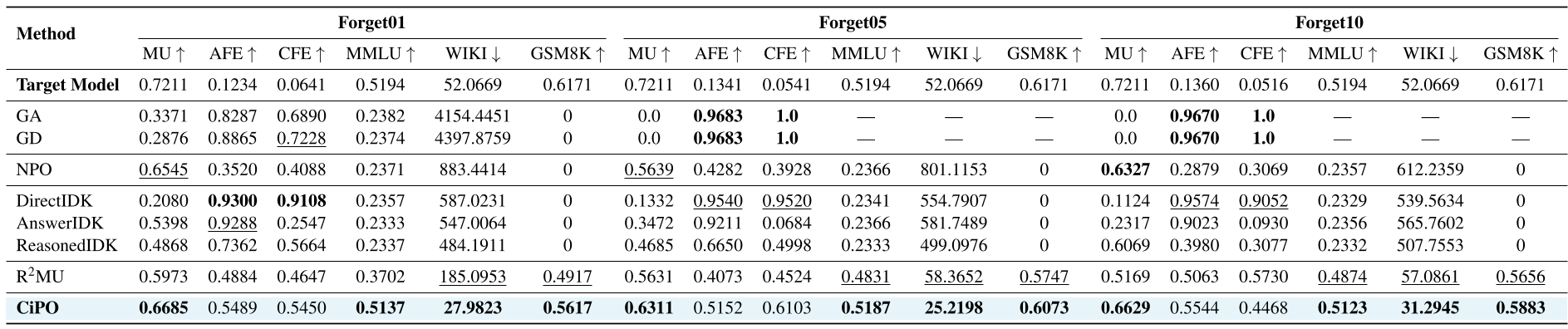
The researchers tested CiPO against heavyweights like Gradient Ascent (GA) and Reasoning-aware Representation Misdirection (R2MU).
SOTA Performance
In the R-TOFU benchmark (a specialized test for LRM forgetting), GA and GD variants achieved perfect forgetting but crashed the model's utility (GSM8K score went to 0). CiPO, however, maintained a GSM8K (math reasoning) score of ~0.58-0.60, nearly identical to the original model.
Real-World Robustness
On real-world private data (e.g., DeepSeek-R1-8B's memorized facts), CiPO was the only method that significantly reduced "CoT Leakage" (measured by LLM-as-a-judge) while keeping the Retain Accuracy above 80%.
Critical Insight: Why Does It Work?
Most unlearning methods treat the model like a database where you can "delete" a row. But reasoning models are more like a "web of logic." If you delete a node (a fact), the surrounding paths collapse. CiPO re-threads the web. By giving the model a valid alternative path, the optimization remains stable, and the model's fundamental ability to "think in steps" remains intact.
Conclusion & Limitations
CiPO is a major step forward for the "Right to be Forgotten" in the era of reasoning AI. It proves that we can secure model privacy without lobotomizing the AI's intelligence.
- The Catch: Currently, it is optimized for QA-style factual forgetting. Adapting this to more abstract reasoning or code-based unlearning remains a challenge for future research.
Takeaway for Architects
When building with LRMs, don't rely on simple prompt-filtering or negative SFT for unlearning. On-policy preference optimization with positive counterfactuals is the superior path for balancing safety and performance.