
Coupling Models: Rethinking One-Step Generation as a Representation Problem
Coupling Models for One-Step Discrete Generation
This paper introduces Coupling Models, a novel one-step discrete generative framework that learns a direct mapping between Gaussian latents and discrete sequences. By avoiding the typical trajectory compression or iterative refinement found in diffusion models, it achieves new SOTA performance for one-step generation on MNIST-Binary (FID 5.50) and LM1B text generation.
TL;DR
Coupling Models redefine the path to efficient discrete generation. Instead of trying to "shrink" a 100-step diffusion process into a single step—a process often fraught with optimization errors—this work proposes learning a direct, sampleable coupling between a Gaussian latent space and discrete tokens. The result is a true one-step generator that captures global structure without autoregressive lag or iterative refinement, setting new benchmarks in images, DNA sequences, and language.
The "Representational Barrier" of One-Step Decoding
Why is one-step generation so hard for discrete data? The authors identify a fundamental Expressivity Barrier. A standard parallel decoder predicts distributions for each token position independently. Mathematically, this induces a factorized sequence law: , which is incapable of representing joint dependencies (like "if token A is 'King', token B must be 'Male'").
To solve this, current SOTA models usually pick one of two poisons:
- Autoregressive models: Great quality, but slow serial decoding.
- Discrete Diffusion/Flows: Parallel, but require 10–100 refinement steps to "stitch" token relationships together.
The Coupling Model asks: What if we didn't try to compress a trajectory, but instead built a latent space designed to carry global information in a single pass?
Methodology: The Two-Stage Coupling
The core innovation lies in a two-stage training pipeline that separates "information alignment" from "sequence decoding."
Stage A: Discrete Gaussian
The model first learns to map a Discrete Sequence into a continuous representation , then uses a Normalizing Flow (NF) to align that representation with a standard Gaussian latent . This ensures that every point in the Gaussian prior actually corresponds to a valid, coherent global state of a sequence.
Stage B: Gaussian Discrete
Once the coupling is fixed, a parallel decoder is trained via supervised learning to invert the mapping (). Because is a global variable, the decoder can emit all tokens in parallel while still being "steered" by the global context captured in .
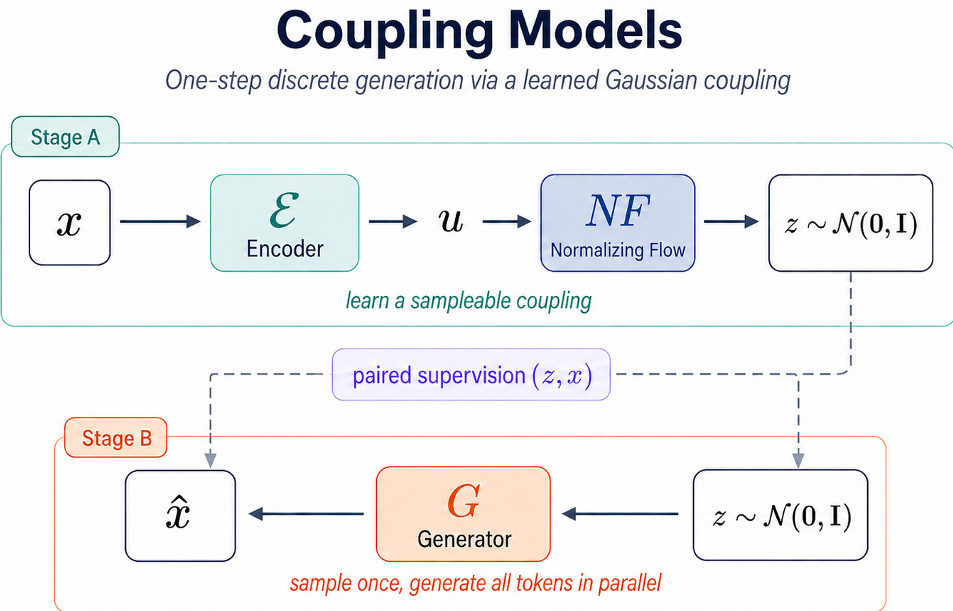 Figure 1: The two-stage training process: Stage A creates the latent-sequence bridge, and Stage B learns the one-step inversion.
Experimental Breakthroughs
The method was tested across three vastly different domains, proving its versatility:
1. MNIST-Binary (Image)
In the quest for perfect one-step binarized images, Coupling Models achieved an FID of 5.50, crushing the previous one-step SOTA (CFM at 10.10) and even competing with 64-step diffusion models.
2. LM1B (Language)
In language modeling, one-step models usually suffer from "mode collapse" (low perplexity but zero diversity). Coupling Models shifted the Entropy-Perplexity frontier, maintaining high diversity (entropy) while significantly lowering perplexity compared to distillation-based methods like FMLM.
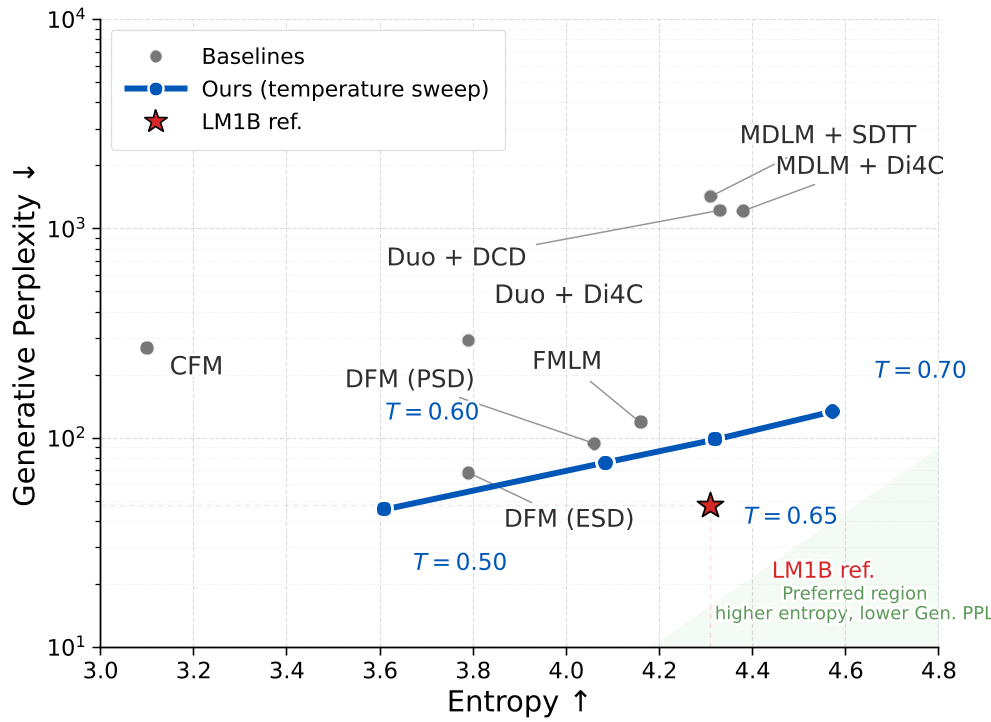 Figure 2: Coupling Models (in blue) move text generation closer to the "Ideal" region of high diversity and low perplexity.
3. Guided Generation
Perhaps the most "product-ready" advantage is Guidance Efficiency. In diffusion models, guiding a sample (e.g., "generated a digit '5'") requires backpropagating through dozens of steps. In Coupling Models, you only guide a single step. Experiments showed that Reward Fine-tuning with Coupling Models is over 300x faster than reward-guided Masked Diffusion Models.
Critical Insight & Limitations
The primary takeaway is that the "Trajectory Compression" (distillation) route might be unnecessarily complex for one-step tasks. By treating the problem as a coupling problem, we can use the strengths of continuous Normalizing Flows to handle the heavy lifting of joint distribution modeling.
Limitations:
- Scaling: The experiments were conducted on moderate-sized models (e.g., Qwen2.5-0.5B). Whether this scales to 70B+ parameter models remains an open question.
- Iterative Gap: While Coupling Models are the best one-step models, they still trail the very best 100-step iterative models in complex biological tasks.
Conclusion
Coupling Models prove that one-step discrete generation is viable if we provide the decoder with the right latent "global map." This work paves the way for ultra-fast, controllable generation in real-time LLM applications and high-throughput biological sequence design.
For more details, the code is available at github.com/pengzhangzhi/Coupling-Models.