
Arbiter-K: Moving Agentic AI from "Brittle Craft" to Robust Kernel Architectures
From Craft to Kernel: A Governance-First Execution Architecture and Semantic ISA for Agentic Computers
Arbiter-K is a Governance-First execution architecture for agentic AI that reimagines the Large Language Model (LLM) as an untrusted Probabilistic Processing Unit (PPU) managed by a deterministic neuro-symbolic kernel. By introducing a Semantic Instruction Set Architecture (ISA), it achieves a 76% to 95% unsafe action interception rate, providing a 92.79% absolute gain over native security policies in benchmarks like OpenClaw and NanoBot.
TL;DR
The transition of AI agents from experimental prototypes to production systems is currently stalled by a "crisis of craft"—a reliance on heuristic prompting and reactive guardrails. Arbiter-K solves this by introducing a Governance-First execution architecture. It treats the LLM as an untrusted "Neuromorphic Co-processor" governed by a deterministic symbolic kernel, achieving an unprecedented 92.79% absolute gain in security interception over native agent frameworks.
Problem & Motivation: The Orchestration Error
Traditional agent frameworks commit a fundamental category error: they treat the Large Language Model (LLM) as the core system controller. Because LLMs are probabilistic, this design makes the system inherently non-deterministic and vulnerable to Indirect Semantic Injections.
Standard "guardrails" fail because they operate on raw text at the "sink" (the moment a tool is called). By then, the malicious influence has already propagated through the agent's reasoning state. Furthermore, when a violation is detected, most systems simply "abort," wasting thousands of tokens of context. The authors identify two critical insights:
- Governance must operate on Semantic Instructions, not raw text.
- Policy Feedback should be used as a resilience primitive to correct trajectories rather than starting from scratch.
Methodology: The Neuro-Symbolic Kernel
Arbiter-K bifurcates the agent into two domains: the Probabilistic Processing Unit (PPU) for reasoning and the Symbolic Kernel for enforcement.
1. The Semantic ISA
The core of Arbiter-K is a Semantic Instruction Set Architecture (ISA). Instead of opaque strings, the agent's intents are reified into discrete instructions across five cores:
- Cognitive Core: Proposals (Generate, Decompose).
- Memory Core: State management (Load, Store, Compress).
- Execution Core: Environment interaction (Tool calls).
- Normative Core: Hard constraints and Verifications.
- Meta-cognitive Core: Self-assessment.
2. Neuro-Symbolic Taint Tracking
By mapping tokens to a structured ISA, the kernel can implement Taint Analysis. Data from untrusted sources (like web searches) or probabilistic reasoning is "tagged." The kernel tracks this tag through the Instruction Dependency Graph (IDG). If "tainted" data attempts to reach a high-risk "Sink" (like a SQL execution) without passing through a "Verify" instruction in the Normative Core, the kernel intercepts it.
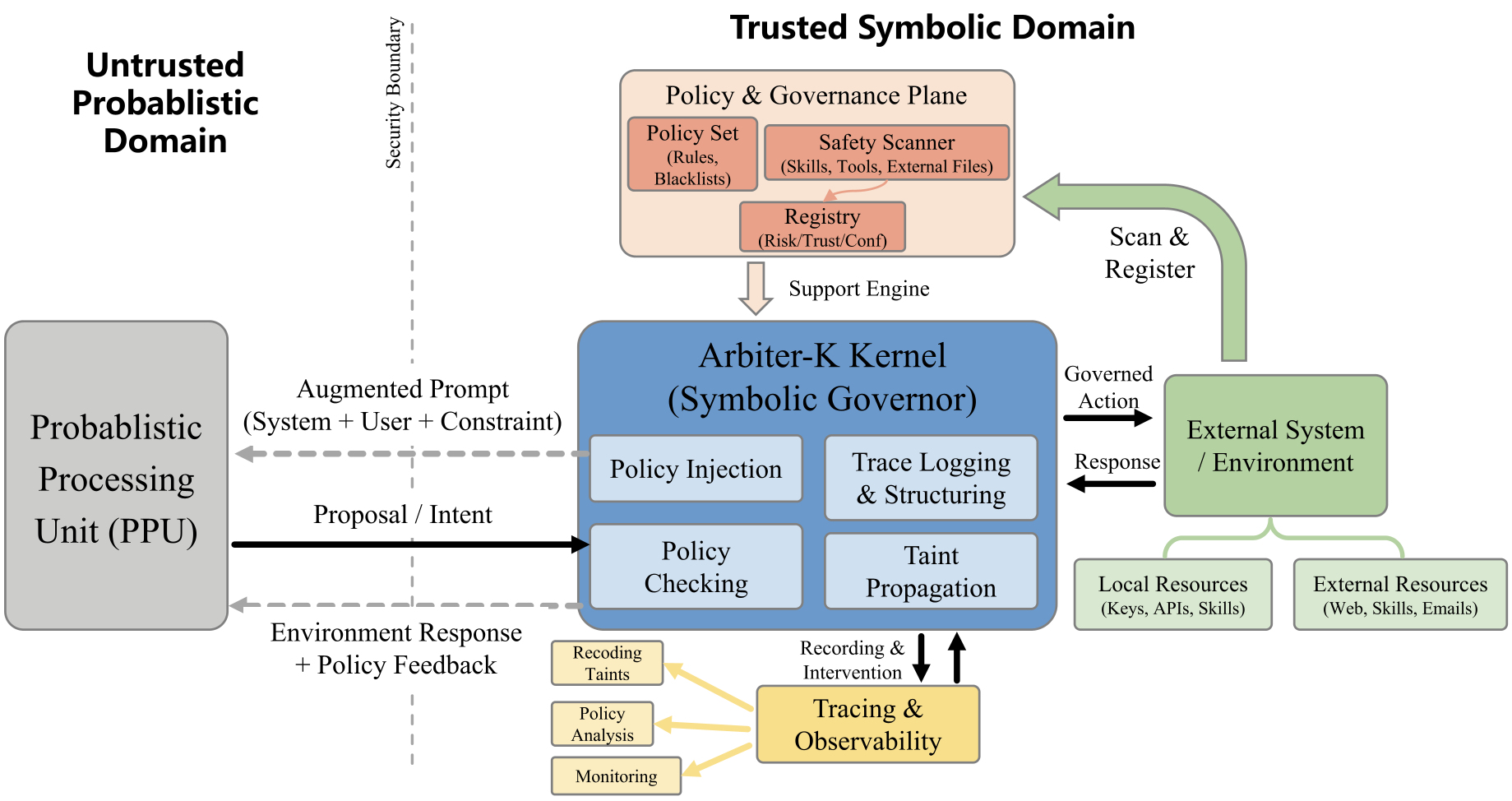 Figure 1: The dual-domain architecture of Arbiter-K separating the Neural Engine and Deterministic Kernel.
Experiments & Results: Shifting the Defense Line
The researchers tested Arbiter-K against OpenClaw and NanoBot frameworks using 1,914 unsafe cases.
Performance Gains
While native policies intercepted less than 9% of threats, Arbiter-K achieved 76% to 95% interception. Crucially, it doesn't just block more; it blocks earlier. The median "first-block" position moved from 80% of the session to 50%, preventing the agent from carrying out the bulk of a malicious trajectory.
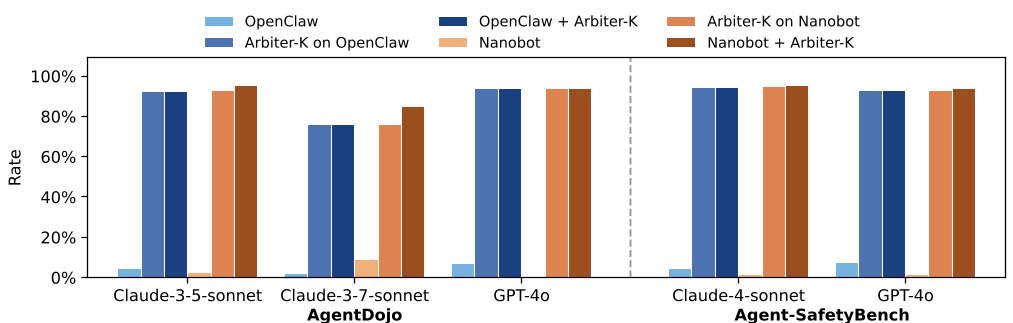 Figure 2: Arbiter-K consistently outperforms native host policies across multiple LLM backends (Claude 3.5, 3.7, GPT-4o).
Efficiency and Context Reuse
Instead of the "Abort-on-Violation" paradigm, Arbiter-K uses the kernel's error signals as Policy Feedback. In safety benchmarks, 73.8% of the context was preserved and reused, with the kernel providing a small (approx. 250-300 token) "correction" to steer the agent back to a safe path.
Critical Insight & Conclusion
Arbiter-K represents a paradigm shift from Prompt Engineering to Microarchitectural Security.
Key Takeaways:
- Instruction-Level Visibility: You cannot secure what you cannot label. By moving from text to a Semantic ISA, agents become auditable.
- Taint-Awareness: Provenance is the only way to solve the "Indirect Injection" problem.
- Separation of Concerns: Let the LLM be creative; let the Kernel be the adult in the room.
Limitations: The system does introduce a "Governance Tax" (latency and computation). While managed via "Reliability Budgets," high-stakes human-in-the-loop verification remains the most expensive bottleneck. Future work should focus on automating the "Migrator" that translates legacy agents into this ISA-governed world.
In conclusion, Arbiter-K proves that reliability in agentic AI is not something we wait for the next "smarter" model to provide—it is something we must build into the runtime architecture itself.