
ToolAnalogy: Creative Robot Tool Use via Counterfactual Reasoning in Simulation
Creative Robot Tool Use by Counterfactual Reasoning
The paper introduces ToolAnalogy, a causal reasoning framework for creative robot tool use that repurposes everyday objects for tasks beyond their original intent. It combines Vision-Language Models (VLMs) with physics-based simulations to identify "causal features"—physical and geometric properties critical for task success—achieving state-of-the-art results in tool substitution and policy transfer.
Executive Summary
TL;DR: Researchers from Brown University have developed ToolAnalogy, a system that allows robots to creatively repurpose everyday objects—like using a selfie stick as a retrieval tool or a crate as a stepping stool. By combining the "imagination" of Vision-Language Models (VLMs) with the "rigor" of physics simulators, the robot identifies the underlying causal features (like mass or handle length) that make a tool work, allowing it to select and use substitutes with unprecedented reliability.
In the landscape of robotics, this work moves beyond simple "affordance matching" toward causal functional reasoning, establishing a new SOTA for one-shot tool substitution in open-world scenarios.
The Problem: The Gap Between "Looks Like" and "Works Like"
Traditional approaches to robot tool use suffer from a fundamental limitation: they are often "blind" to physics.
- Vision-only models: Might suggest a heavy iron crowbar because it "looks" like a hook, ignoring that it exceeds the robot's payload.
- Affordance-based models: Usually require massive datasets of specific interactions, failing the moment they encounter a tool that doesn't fit a known category.
Humans don't need a thousand trials to know a short ruler won't reach a remote under a sofa; we use an internal physics model to reason about causality. ToolAnalogy replicates this by asking: "What specific feature of this tool makes the task succeed?"
Methodology: Discovering Causality Through "What If?"
The core of the ToolAnalogy pipeline is a Real-to-Sim-to-Real loop that uses counterfactual reasoning.
1. Feature Suggestion (The VLM)
The robot starts with a source object it knows how to use (e.g., a toy hockey stick). A VLM (like ChatGPT) acts as a "commonsense database," suggesting features that might matter, such as "shaft length" or "blade angle."
2. Counterfactual Generation (The Semantic Editor)
Instead of just trying different objects, the system uses ParSEL, a 3D semantic shape editor. It takes the source tool and creates "counterfactual" versions—e.g., a hockey stick with a 2-meter shaft, or one with a 10-degree blade angle.
3. Simulation & Discovery (The Physics Engine)
The robot executes its skill in a simulator (IsaacSim or MuJoCo) using these modified tools. By observing which modifications cause failure (the "make or break" features), it identifies the Causal Features.
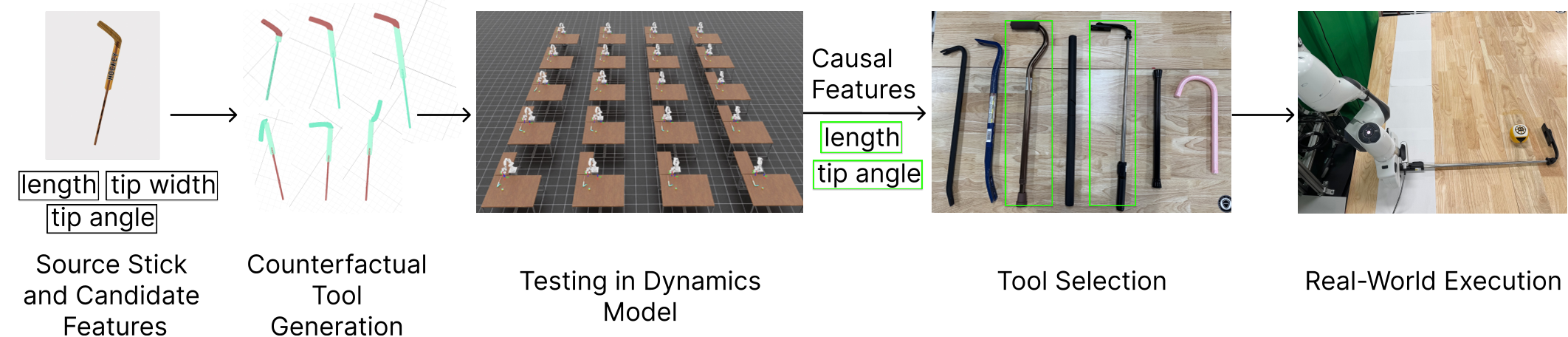 Fig 1: The ToolAnalogy pipeline—from VLM suggestions to counterfactual simulation and final real-world execution.
4. Selection and Policy Transfer
Once causal features are identified, the robot can evaluate any novel object by checking if its specific causal dimensions (e.g., "is it long enough?" and "is it light enough?") fall within the successful range discovered in simulation.
Experimental Battleground: Pulling, Scooping, and Reaching
The authors tested ToolAnalogy across three distinct domains:
- Table-top Pulling: Retrieving objects beyond the workspace using sticks/canes.
- Table-top Scooping: Getting candies using spoons or scrapers.
- Quadruped Reaching: A Spot robot using boxes/crates to reach high-shelf items.
Key Results
In the Pulling task, ToolAnalogy achieved 90% success, whereas standard VLM baselines (GPT) hovered around 20%. The reason? Baselines frequently chose tools that were visually similar but physically unsuitable (too heavy for the motors or too short for the reach).
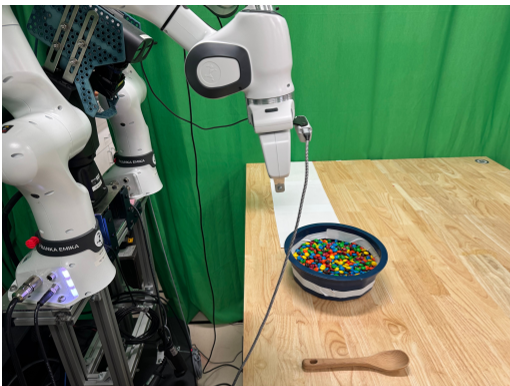 Fig 2: Real-world execution vs. Simulation reconstruction. Note the diversity of "tools" successfully used.
One of the most impressive feats was Functional Keypoint Transfer. By matching objects based on their causal features rather than visual pixels, the robot could accurately identify where to grasp a "selfie stick" for a pulling task, even though it looked nothing like the original "hockey stick."
Critical Insight: Why This Matters
The breakthrough here isn't just "better accuracy"—it's interpretability. Unlike a black-box neural network, ToolAnalogy can tell you why it rejected a tool: "The mass of the crowbar (2.5kg) exceeds the robot's payload (2kg) for this specific movement."
Limitations
- Geometric Fidelity: The system relies on single-view point clouds, which can struggle with thin or hollow objects.
- Editor Expressivity: If the 3D editor (ParSEL) can't model a specific physical change (like deforming a soft shoe), the reasoning loop breaks.
Conclusion: Toward Truly Intelligent Agents
ToolAnalogy demonstrates that the future of robotics lies in the intersection of symbolic reasoning (VLMs) and physical grounding (Simulators). By focusing on the causal nature of tools, we move one step closer to robots that can operate in unpredictable, human-centric environments using whatever is "at hand" to get the job done.
Reference: Akbulut et al., "Creative Robot Tool Use by Counterfactual Reasoning," 2026.