
From Reasoning to Agentic: Solving the Credit Assignment Crisis in LLM RL
From Reasoning to Agentic: Credit Assignment in Reinforcement Learning for Large Language Models
This paper provides a comprehensive survey of 47 Credit Assignment (CA) methods in Reinforcement Learning for Large Language Models, spanning from single-turn reasoning (CoT) to multi-turn agentic environments. It introduces a two-dimensional taxonomy based on granularity and methodology, highlighting SOTA shifts from process reward models (PRMs) to hindsight counterfactual analysis.
TL;DR
The success of models like DeepSeek-R1 and OpenAI’s o1 has proven that Reinforcement Learning (RL) can elicit "reasoning." However, as we move toward Agentic RL—where LLMs browse the web and use tools over hundreds of turns—traditional RL methods fail. This paper surveys 47 methods to solve the Credit Assignment (CA) problem: identifying which specific "token" or "turn" in a 1,000,000-token trajectory actually earned the reward.
The Core Bottleneck: The "Echo Trap"
In reasoning tasks (like math), the trajectory is a single generation. In agentic tasks, the agent interacts with a stochastic environment. Episode-level rewards (did the agent finish the task?) are too coarse.
- The Problem: If an agent makes 100 tool calls and fails, standard GRPO/REINFORCE blames all 100 calls equally.
- The Consequence: Agents fall into the "echo trap," repeating safe but useless actions because the gradient signal is too noisy to distinguish a pivotal breakthrough from a formatting error.
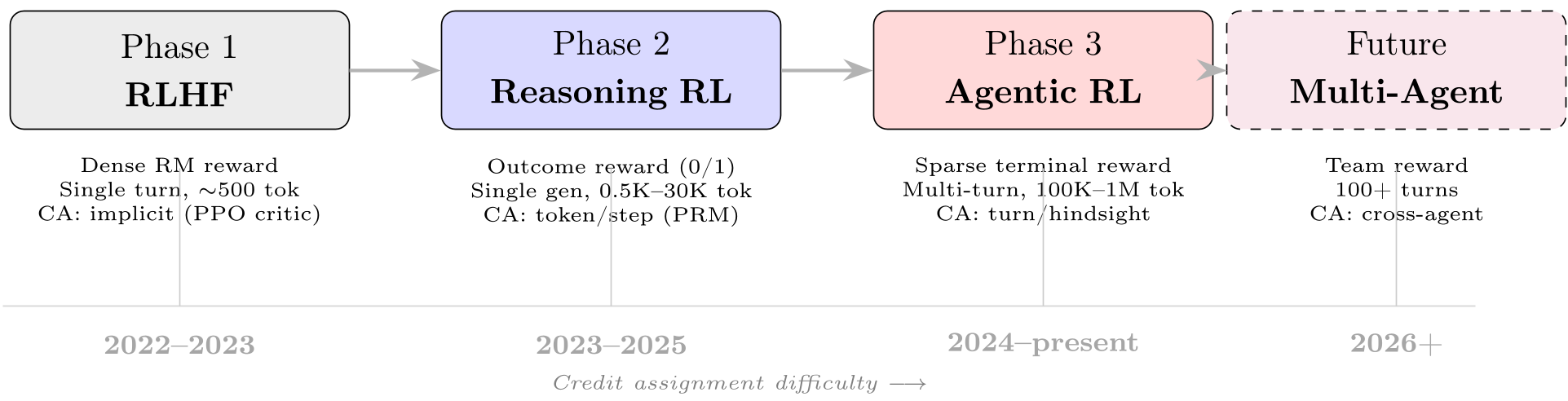
A New Taxonomy for Credit
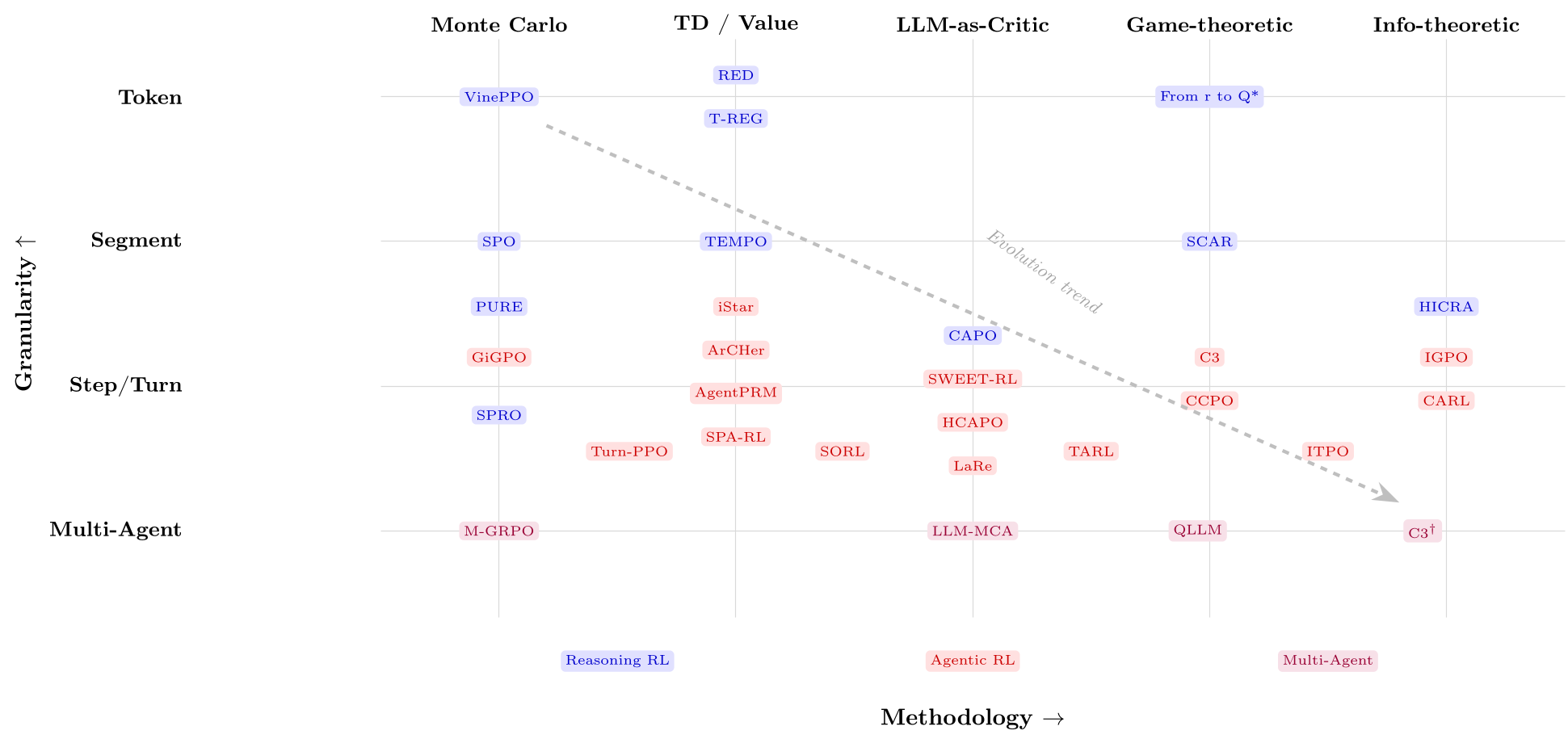
The survey organizes the field into two axes: Granularity (Token, Step, Turn, Multi-agent) and Methodology.
1. Reasoning RL: The Maturing Frontier
In reasoning, we assume the environment is the LLM itself (deterministic).
- VinePPO: Forks multiple "vines" (continuations) from a single token to estimate its value via Monte Carlo.
- PRMs (Process Reward Models): The "gold standard" for reasoning, where each step is verified.
2. Agentic RL: The Wild West
Agentic transitions are stochastic and partially observable. You can't just "reset" the internet to check a counterfactual.
- Hindsight Analysis: Methods like HCAPO and C3 look backward after the task is done, using an LLM to "imagine" what would have happened if a specific turn was different.
- Privileged Critics: During training, the critic sees the "hidden" ground truth (like the final answer or system state) that the agent can't see, providing a much sharper signal.
Why "Bifurcation Points" Matter
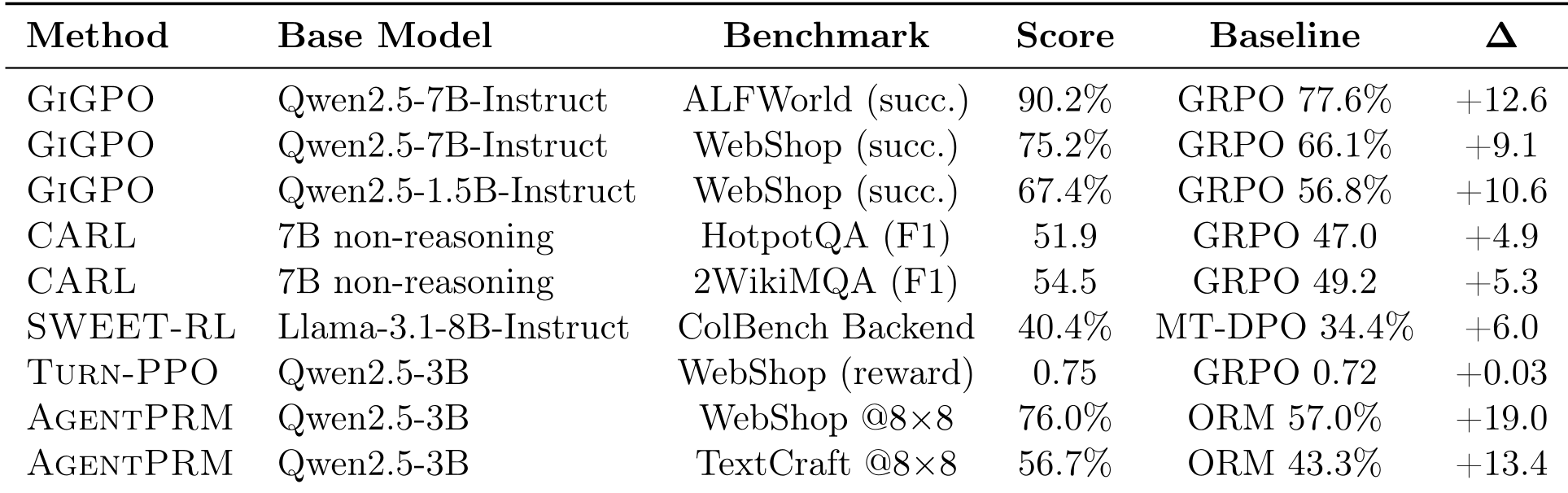
A key insight from the CARL method is that most actions in a long trajectory are routine (e.g., "format the output"). Credit should be concentrated on Bifurcation Points—the critical "forks in the road" where a decision dramatically changes the outcome. By focusing RL updates only on high-entropy (uncertain) actions, CARL achieves SOTA results with 72% fewer gradient updates.
Experimental Proof: The Complexity Scaling Law
The paper reveals a "scaling law" for credit assignment value:
- Reasoning Gain: ~6.0% improvement over base RL.
- Agentic Gain: ~8.5% improvement. As trajectories get longer and more complex, the "quality" of the credit assignment matters more than the "quantity" of the data.
Critical Insight & Future Outlook
The most distinctive trend in 2026 is the LLM-as-Critic paradigm. Unlike classical RL which uses simple neural networks for value estimation, LLM agents use other LLMs to explain why an action was good in natural language (LaRe).
The Future:
- Ultra-Long Horizons: Solving tasks with 100+ turns (SWE-bench).
- Multi-Agent CA: Decomposing credit in a team (e.g., who "caused" the success in a multi-agent debate?).
- The Compute-Signal Trade-off: Is it better to spend compute on 10,000 cheap rollouts (GRPO) or 100 high-quality sessions with hindsight CA? The survey suggests the latter is the path to AGI agents.
Conclusion
We are moving from a world where we reward outcomes to a world where we reward processes. For anyone building autonomous agents, Credit Assignment is no longer an "optional optimization"—it is the core engine of learning.