
[CVPR 2025] Cubic Discrete Diffusion (CubiD): Bridging the Gap Between Visual Understanding and Generation
Cubic Discrete Diffusion: Discrete Visual Generation on High-Dimensional Representation Tokens
Cubic Discrete Diffusion (CubiD) is the first discrete generative model designed for high-dimensional representation tokens (768+ dims) from frozen pretrained encoders like DINOv2. By employing a novel fine-grained "cubic" masking strategy across a 3D tensor (), it achieves state-of-the-art ImageNet-256 generation (FID 1.88) and demonstrates strong scaling up to 3.7B parameters.
TL;DR
The divide between "understanding" (high-dimensional features) and "generation" (low-dimensional tokens) has long hindered unified multimodal AI. Cubic Discrete Diffusion (CubiD) breaks this barrier by being the first model to successfully perform discrete diffusion on 768-dimensional representation tokens. By treating the image as a 3D "cubic" tensor of and applying fine-grained masking, CubiD achieves SOTA ImageNet generation while retaining the semantic depth of foundation models like DINOv2.
The "Curse of Dimensionality" in Visual Tokenization
For years, the industry has relied on VQ-VAEs to compress images into low-dimensional latents (usually 8 to 32 dimensions). While efficient for generation, these compressed tokens lose the "semantic richness" required for deep understanding tasks.
If we try to use high-dimensional features (768+ dims) from models like DINOv2 or SigLIP2:
- Quantization Fails: Traditional Vector Quantization (VQ) suffers from the curse of dimensionality—codebooks cannot effectively cover the sparse high-dimensional space.
- Generation Explodes: An autoregressive model would need to predict tokens sequentially, which is computationally impossible for real-time applications.
Methodology: The Cubic Breakthrough
The authors propose two key shifts in perspective:
1. Dimension-wise Quantization
Instead of quantizing a whole vector into one code, they quantize each dimension independently into levels. This training-free approach proves that discrete tokens can be just as good as continuous features for multimodal understanding (LLaVA benchmarks).
2. Fine-grained Cubic Masking
The core of CubiD is the masking strategy. Previous masked models (like MaskGIT) mask an entire "pixel" (all dimensions at one spatial position). CubiD instead masks individual elements within the tensor.
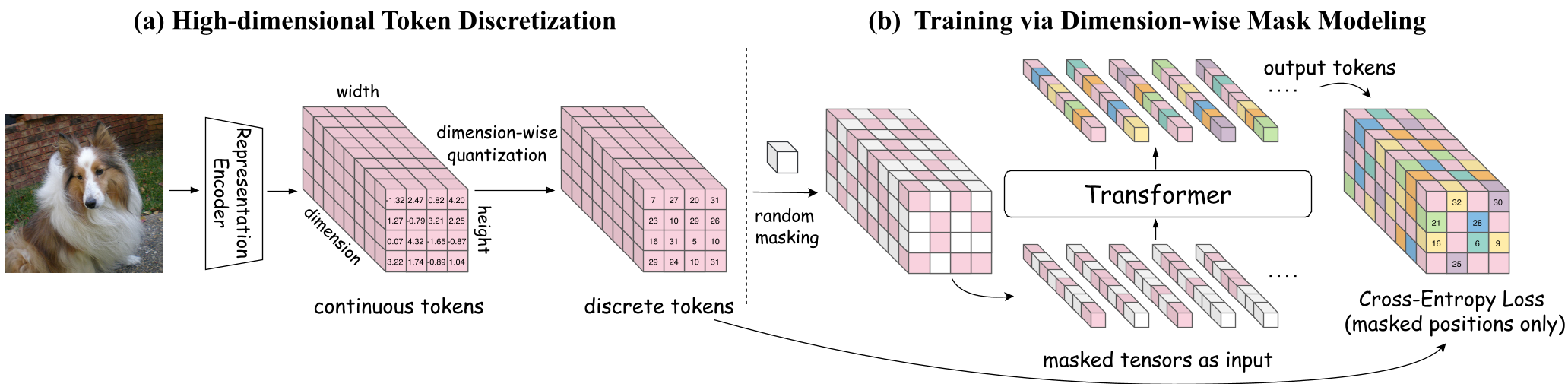
This "Cubic" approach allows the Transformer to:
- Learn internal correlations within a single spatial point (how dim 1 relates to dim 768).
- Learn spatial correlations across the image.
- Perform parallel refinement: Generating all 196,608 tokens in just 256 parallel steps.
Experimental Excellence
The results on ImageNet-256 are striking. CubiD doesn't just work; it scales.
- SOTA Performance: CubiD-XXL (3.7B) achieves a 1.88 FID, outperforming LlamaGen and VAR-based methods.
- Scaling Laws: Performance improves consistently as parameters increase from 900M to 3.7B.
- Efficiency: Despite the massive increase in token count compared to low-dim models, the inference time remains practical because of the parallel diffusion mechanism.
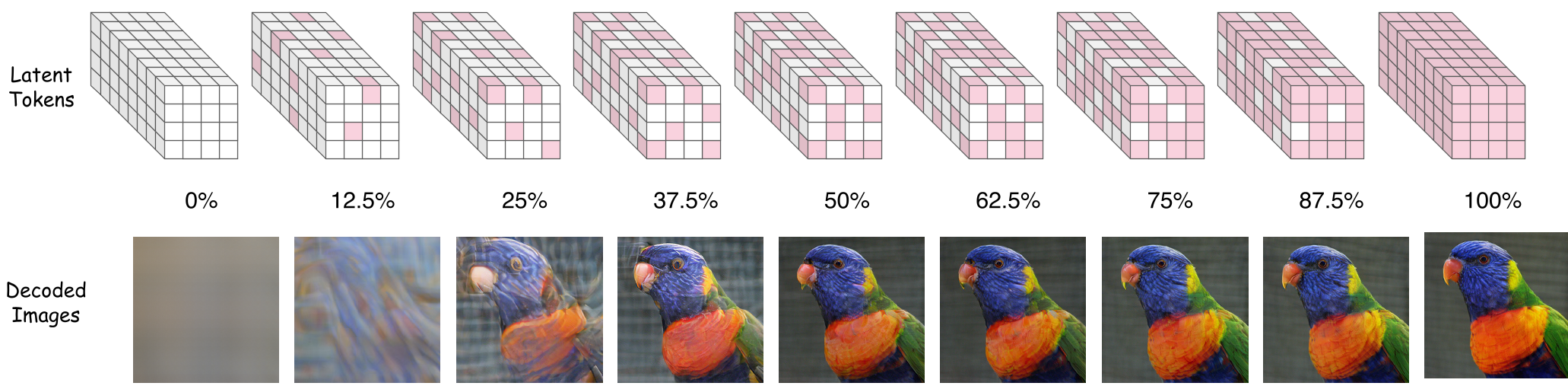 The visual evolution from 0% to 100% shows a clear coarse-to-fine refinement, unique to the cubic masking approach.
Critical Insight: Why Does It Work?
The secret lies in redundancy. High-dimensional semantic features are inherently redundant. By masking at the element level, the model is forced to "reconstruct" missing dimensions using both neighboring spatial info and neighboring dimensional info. This bidirectional constraint makes the generative process much more robust than predicted tokens in a vacuum.
Conclusion & Future Look
CubiD is a significant milestone for Unified Multimodal Modeling. By proving that we don't need to "dumb down" visual features for generation, it opens the door for a single Transformer to handle both Vision-Language Understanding and High-Fidelity Image Synthesis using the exact same vocabulary.
Limitations to Watch: The model's upper bound is currently limited by the reconstruction quality of the frozen encoder's decoder. As "Representation Autoencoders" improve, we can expect CubiD-style models to eventually outperform even the best continuous diffusion models (like Stable Diffusion).