
D-Mem: Bridging Fast Intuition and Deep Deliberation in LLM Agent Memory
D-Mem: A Dual-Process Memory System for LLM Agents
This paper introduces D-Mem, a dual-process memory system designed for LLM agents to handle long-horizon reasoning. It combines a fast, lightweight vector retrieval (System 1) with an exhaustive, chunk-based "Full Deliberation" module (System 2) as a high-fidelity fallback, achieving SOTA results on LoCoMo and RealTalk benchmarks.
TL;DR
Researchers have developed D-Mem, a memory architecture for LLM agents inspired by human dual-process cognition. By combining a fast "System 1" (vector retrieval) with a thorough "System 2" (Full Deliberation fallback), D-Mem solves the lossy abstraction problem—where critical details are lost during memory compression—while maintaining computational efficiency via a Multi-dimensional Quality Gating policy.
Background: The Price of Efficiency
Modern LLM agents often use vector databases (like Mem0 or Zep) to store past interactions. While efficient, this approach is fundamentally flawed for complex reasoning. Because these systems compress data before a query is known, they often strip away temporal anchors (e.g., "yesterday") or subtle causal links. This "lossy abstraction" means that no matter how good the retrieval algorithm is, the information needed to answer complex questions simply isn't there anymore.
Methodology: System 1 Meets System 2
D-Mem addresses this by mimicking the human metacognitive process. The architecture is split into two paths:
- System 1 (Mem0):* A refined version of standard incremental memory that provides rapid, low-cost semantic retrieval.
- System 2 (Full Deliberation): A high-fidelity fallback that ignores compressed snippets and scans the raw dialogue history chunk-by-chunk (60 messages at a time) to extract query-specific facts.
- The Quality Gate: The "brain" of the system. It checks the initial System 1 answer for Relevance, Faithfulness, and Completeness. Only if System 1 fails does the agent incur the "energy cost" of System 2.
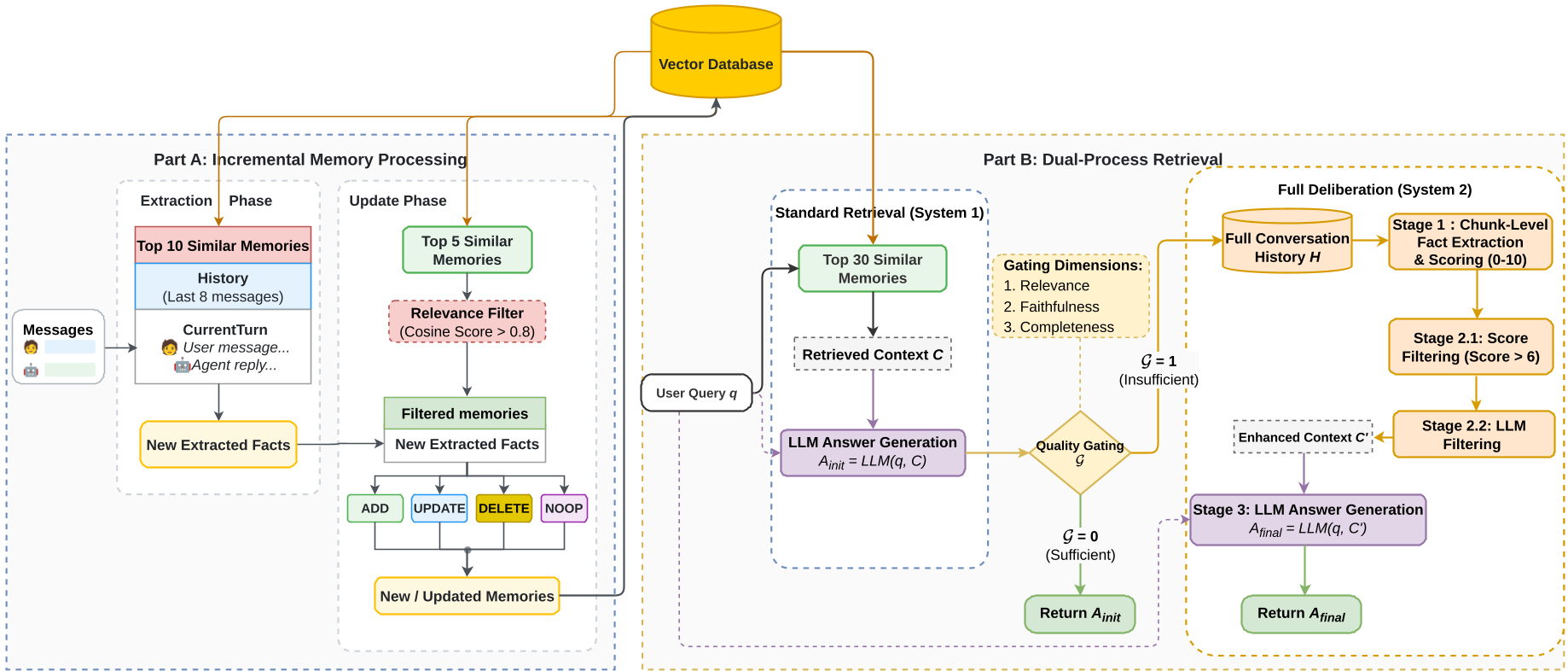 Figure 1: The D-Mem Framework. Note how Quality Gating (Part B) acts as the bridge between fast retrieval and exhaustive deliberation.
Why It Works: Breaking the "Lost-in-the-Middle" Curse
Standard LLMs often struggle when fed massive context windows—a phenomenon known as "Lost-in-the-Middle." System 2's chunked extraction effectively bypasses this by filtering irrelevant noise before the final generation. In the paper's case study, a temporal query about a specific date failed in static retrieval because "yesterday" was lost during compression. D-Mem's System 2 successfully reconstructed the timeline by re-examining the raw text.
Performance & Efficiency
Experimental results on benchmarks like LoCoMo and RealTalk show a clear "Cognitive Economy." As question difficulty increases (from Single-hop to Multi-hop and Temporal), the performance gap between D-Mem and standard RAG widens.
 Table 1: D-Mem delivers near-Full Deliberation accuracy with a fraction of the token cost and time.
Key highlights:
- Accuracy: D-Mem recovers 96.7% of the accuracy of an exhaustive search.
- Efficiency: It uses roughly 65% fewer tokens than a full history scan.
- Intelligence: The fallback rate naturally scales with dataset complexity (rising in the more difficult RealTalk benchmark).
Critical Insights & Future Outlook
While D-Mem is a significant leap forward, it highlights a new bottleneck: explicit vs. implicit reasoning. The authors note that while D-Mem is excellent at extracting explicit facts, future systems must improve at synthesizing implicit logic—the things "not said" but implied across months of interaction.
As agents move toward "lifelong learning" deployments, the dual-process approach provides a scalable blueprint: trust your "gut" (System 1) for the easy stuff, but keep a "meticulous researcher" (System 2) on standby for when things get complicated.
Conclusion
D-Mem proves that we don't have to choose between speed and depth. By implementing a quality-aware gating mechanism, we can build agents that are both responsive and rigorously accurate, providing a potential standard for the next generation of autonomous digital assistants.