
D-OPSD: Bridging the Gap Between Efficient Inference and Continuous Learning in Diffusion Models
D-OPSD: On-Policy Self-Distillation for Continuously Tuning Step-Distilled Diffusion Models
The paper introduces D-OPSD (On-Policy Self-Distillation), a training paradigm designed to fine-tune few-step distilled diffusion models (like Z-Image-Turbo and FLUX.2-klein) without compromising their efficiency. It leverages the in-context learning capabilities of LLM/VLM encoders to turn traditional supervised fine-tuning into an on-policy distillation process, achieving SOTA results in concept and style adaptation.
TL;DR
Step-distilled models (like FLUX.2 or Turbo versions) allow for high-quality image generation in just 1-4 steps but are notoriously difficult to fine-tune without "breaking" their efficiency. D-OPSD solves this by turning fine-tuning into an on-policy self-distillation task. By using a multimodal VLM encoder to create a "Teacher" within the model itself, it allows the model to learn new styles and concepts while remaining on its own optimized inference trajectory.
The "Fine-Tuning Trap" for Distilled Models
The industry is moving toward few-step diffusion models to reduce computational costs. However, these models are fragile. When you try to fine-tune them using standard Supervised Fine-Tuning (SFT), you are essentially forcing the model to follow a "Teacher Forcing" path based on a target image.
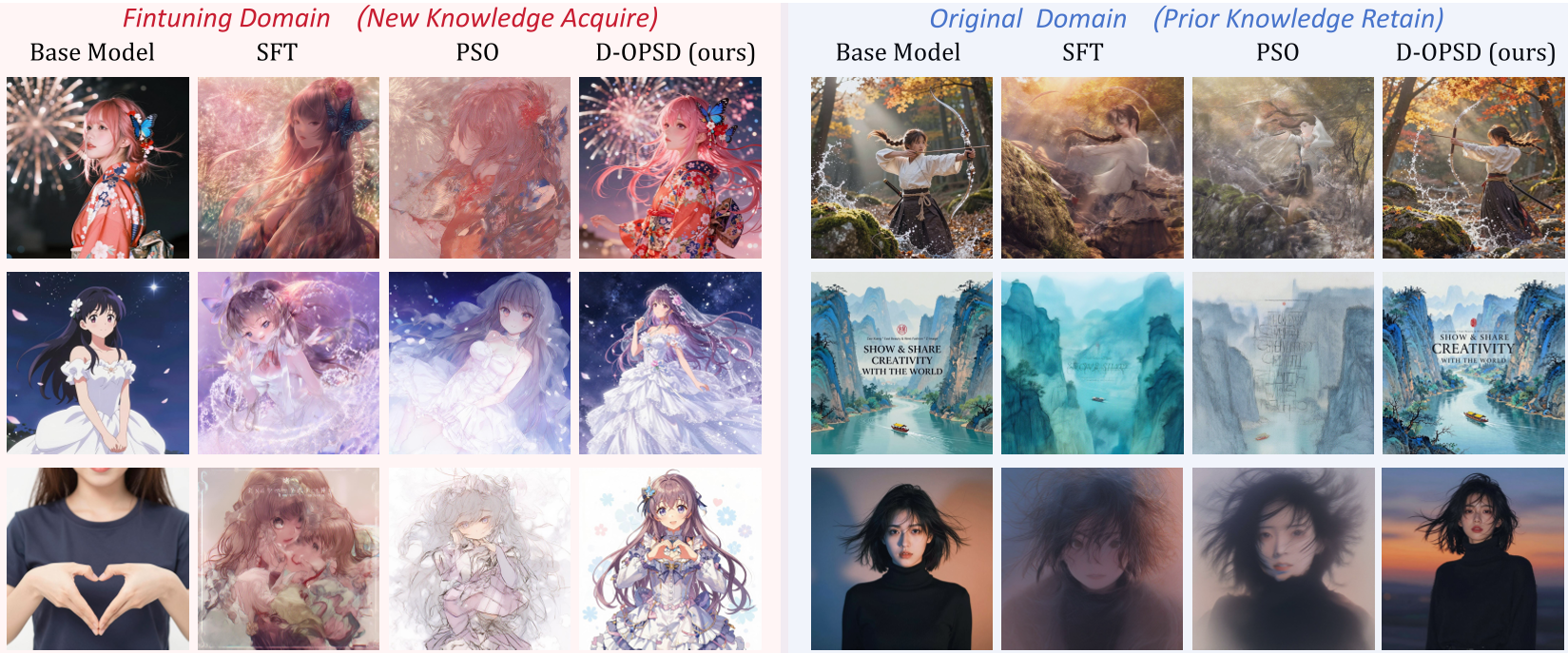
The problem? The paths (trajectories) the model takes during a 4-step inference are very different from the theoretical paths defined by an offline target image. This distribution shift results in blurry images and the loss of the model's original "magic" (the ability to generate high fidelity in few steps).
Methodology: High-Level Intuition
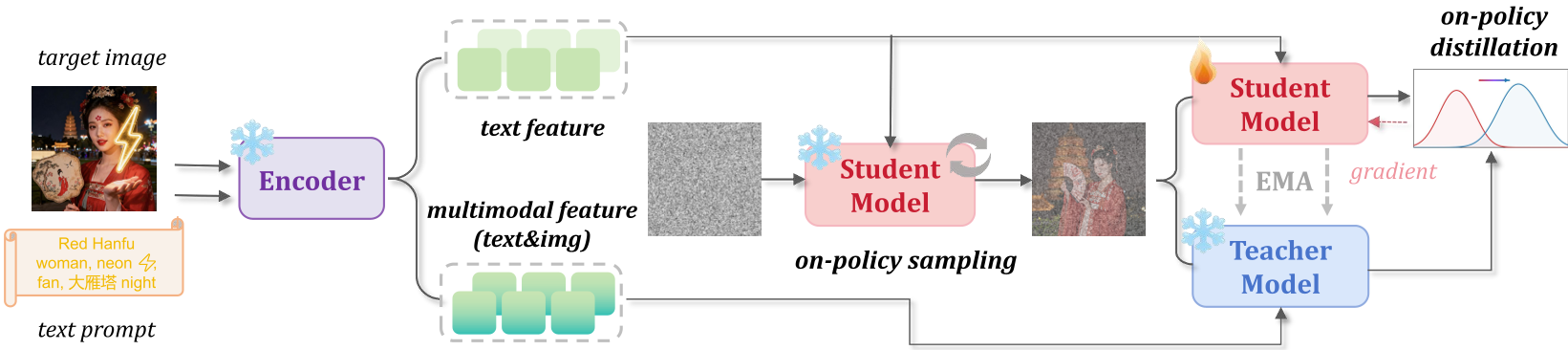
The core insight of D-OPSD is that modern diffusion models aren't just UNets or Transformers anymore; they use powerful LLMs/VLMs as encoders. These encoders have In-Context Learning (ICL) capabilities.
If you give the model just a text prompt, it acts as a Student. If you give it the prompt plus the target image as a visual context, it naturally becomes a Teacher that knows exactly what the output should look like, even without extra training.
The D-OPSD Loop:
- Roll-out: The Student generates a few-step trajectory using only the text prompt.
- Supervision: At each step of that actual trajectory, the Teacher (using multimodal context) predicts the ideal "velocity" (direction to noise).
- Alignment: The Student is updated to match the Teacher’s prediction.
Experiments and Results
The authors tested D-OPSD on two leading architectures: Z-Image-Turbo and FLUX.2-klein.
1. Style and Concept Customization (LoRA)
When learning specific objects or styles from a small dataset (DreamBooth style), D-OPSD maintained 100% of its inference speed and quality. Vanilla SFT and DreamBooth often resulted in "deep-fried" or blurry artifacts because they disrupted the distilled dynamics.
2. Large-Scale Domain Adaptation
In full fine-tuning on a 25K anime dataset, D-OPSD showed a significant drop in FID (lower is better), meaning it successfully shifted to the anime domain while keeping its "general knowledge" intact—a feat typically requiring complex Reinforcement Learning with human feedback (RLHF).
Technical Deep Dive: Why It Works
Standard SFT is Off-Policy: it evaluates the model on states it might never visit. D-OPSD is On-Policy: it only corrects the model on the specific steps it takes during a 4-step or 8-step generation.
By utilizing the shared weights between the Teacher and Student (Self-Distillation), the model is effectively "pulling itself up by its own bootstraps," guided by the richer information provided by the multimodal encoder.
Critical Analysis & Conclusion
Strengths:
- No Reward Model Required: Unlike Online RL (e.g., GRPO), you don't need a separate aesthetic or reward model. The target image is the reward through the VLM context.
- Efficiency: While it costs ~2x the training time per iteration compared to SFT, it saves the massive cost of having to "re-distill" the model after fine-tuning.
Limitations:
- Encoder Baseline: The success depends entirely on the VLM encoder's ICL capability. If the encoder isn't strong enough to understand the "prompt + image" relationship, the teacher will provide poor guidance.
Takeaway: D-OPSD marks a shift from "teaching models what to see" to "aligning how they move." For developers working with FLUX or other distilled architectures, this provides a stable, principled way to customize models without breaking the underlying speed optimization.