
Dark Energy vs. The Swampland: Why String Theory Prefers a Rolling Universe
Dark energy from string theory: an introductory review
This review synthesized the arduous quest to derive dark energy from string theory, contrasting the construction of stable de Sitter vacua against dynamical quintessence models. It highlights the rigorous "No-Go" theorems and Swampland conjectures that constrain positive vacuum energy in the classical and asymptotic regimes of string theory.
TL;DR
Is our universe a stable vacuum or a temporary rolling state? This comprehensive review by David Andriot explores the "troubled history" of dark energy in string theory. While the community has spent decades trying to construct a stable de Sitter (dS) vacuum, rigorous No-Go theorems and Swampland conjectures suggest that string theory naturally favors dynamical quintessence—specifically models where the universe's acceleration is transient and the underlying fields are still in motion.
Background: The de Sitter Dilemma
In 1998, we discovered the universe is accelerating. The simplest explanation is a Cosmological Constant (). However, in the realm of string theory—a UV-complete theory of quantum gravity— is notoriously difficult to "buy." To get a 4D de Sitter space (positive vacuum energy), you must compactify six extra dimensions. The Maldacena-Nuñez theorem states this is impossible with smooth, classical ingredients. You need "singular" sources like Orientifold planes (O-planes) to even have a chance.
The Problem: The Persistent Tachyon
Even when we circumvent the No-Go theorems by adding O-planes and fluxes, we hit a wall: Instability.
The author analyzes nearly 500 candidate solutions on group manifolds (mathematically tractable spaces like sol-manifolds). The result is sobering: every single classical de Sitter solution found contains a tachyon—a field direction where the potential is a maximum rather than a minimum.
Key Quantitative Insight:
In all tested 4D effective theories, the stability parameter (related to the mass of the lightest scalar) obeys: This is far from the \eta_V > 0 required for a stable vacuum. This suggests the Refined de Sitter Conjecture (RdSC) is likely a fundamental law of the string landscape: the potential is either too steep or too unstable.
Methodology: The Shift to Quintessence
If de Sitter vacua are "swamplandish," we must look at Dynamical Dark Energy (Quintessence). Here, a scalar field rolls down a potential .
1. The Power of Exponential Potentials
In the asymptotic limits of string theory (weak coupling, large volume), the scalar potential naturally takes an exponential form: The Strong de Sitter Conjecture (SdSC) dictates that . Historically, this was thought to be too "steep" to explain the slow acceleration we see today.
2. The "Phantom" Escape
Recent data from DESI (2024) gave us a shock: the dark energy equation of state might be less than (the "phantom" regime). In standard physics, w < -1 implies negative kinetic energy (ghosts).
Andriot highlights a brilliant "loophole": Coupling to Matter. If the quintessence field is coupled to dark matter, the effective can appear phantom-like (w_{DE} < -1) even if the physics is perfectly healthy.
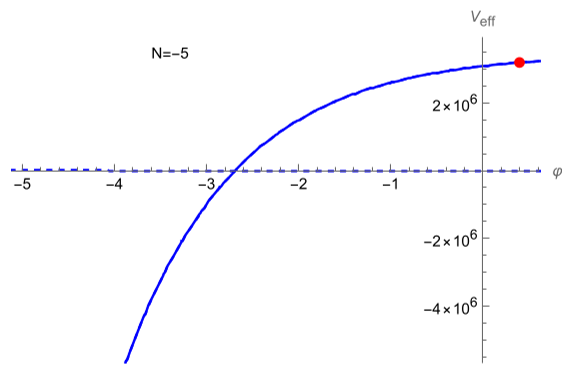 Figure: The interaction between the scalar potential and matter density creates an effective potential that shifts over time, allowing for a "thawing" behavior consistent with observation.
Critical Results: Matching the Data
The review shows that models with (highly "stringy" values) can now fit the DESI data better than the standard CDM model when matter coupling is included.
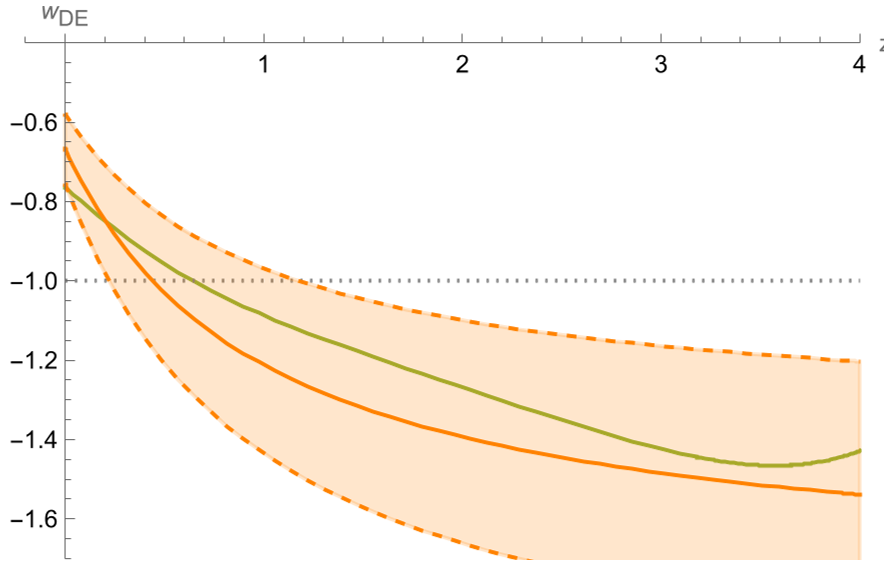 Figure: The effective crossing the boundary (phantom crossing) as predicted by coupled quintessence models.
The No Cosmological Horizon Conjecture (NCHC)
The paper introduces a bold unified vision: Nature abhors a horizon. A stable de Sitter space has a permanent event horizon, which creates massive problems for defining a Quantum Gravity S-matrix. Quintessence avoids this because the acceleration eventually stops, and the horizon disappears.
Deep Insight & Conclusion
This work signals a major paradigm shift. We may have to stop asking "How do we stabilize the cosmological constant?" and start asking "How does the rolling of string moduli couple to the dark sector?"
Takeaways:
- Classical dS is Dead?: Parametric control of classical de Sitter is almost impossible to achieve without violating flux quantization or O-plane bounds.
- Quintessence is the Future: Coupled quintessence remarkably bridges the gap between the "steep" potentials required by the Swampland and the "phantom" behaviors observed by DESI.
- The Anisotropy Key: The few supergravity solutions that almost work (like ) rely on 6D anisotropy, suggesting the extra dimensions are not uniform "balls" but complex, skewed shapes.
Limitations: We still lack a fully derived string model that includes both the standard model particles and the specific quintessence potential needed to match every data point. The "numerics" of the landscape remain our greatest hurdle.