
DART: The Foundation Model Defining the Future of Industrial Rope Inspection
DART: A Vision-Language Foundation Model for Comprehensive Rope Condition Monitoring
DART (Damage Assessment via Rope Transformer) is a vision-language foundation model designed for the comprehensive condition monitoring of synthetic fibre ropes. By coupling a ViT-H/14 encoder with Llama-3.2-3B via a novel cross-modal fusion module, it achieves SOTA results across 14 fine-grained damage classes, reaching 93.22% classification accuracy and 0.94 Spearman correlation for severity regression.
TL;DR
Rope failure in offshore and industrial settings is catastrophic. DART (Damage Assessment via Rope Transformer) moves beyond simple "defect vs. no-defect" classification. It is a Vision-Language foundation model that uses a unified embedding space to perform eight distinct tasks—ranging from fine-grained classification to maintenance recommendation—achieving a massive 38.5% accuracy boost over vision-only systems.
Problem & Motivation: The "Blind Spot" of Vision-Only AI
In the world of synthetic fibre ropes, a visual image is often not enough. A "Chafing" defect looks strikingly similar across different severity levels. Without the semantic context an inspector provides (e.g., "fibre bundle exposure along the outer sheath"), AI models often fail to distinguish between a minor scuff and a critical failure point.
Prior work has treated inspection as a fragmented workflow: one model for detection, another for severity, and a human for the final report. The authors of DART realized that natural language is the "missing link" that provides the necessary inductive bias to resolve these visual ambiguities.
Methodology: Engineering a Multi-Task Backbone
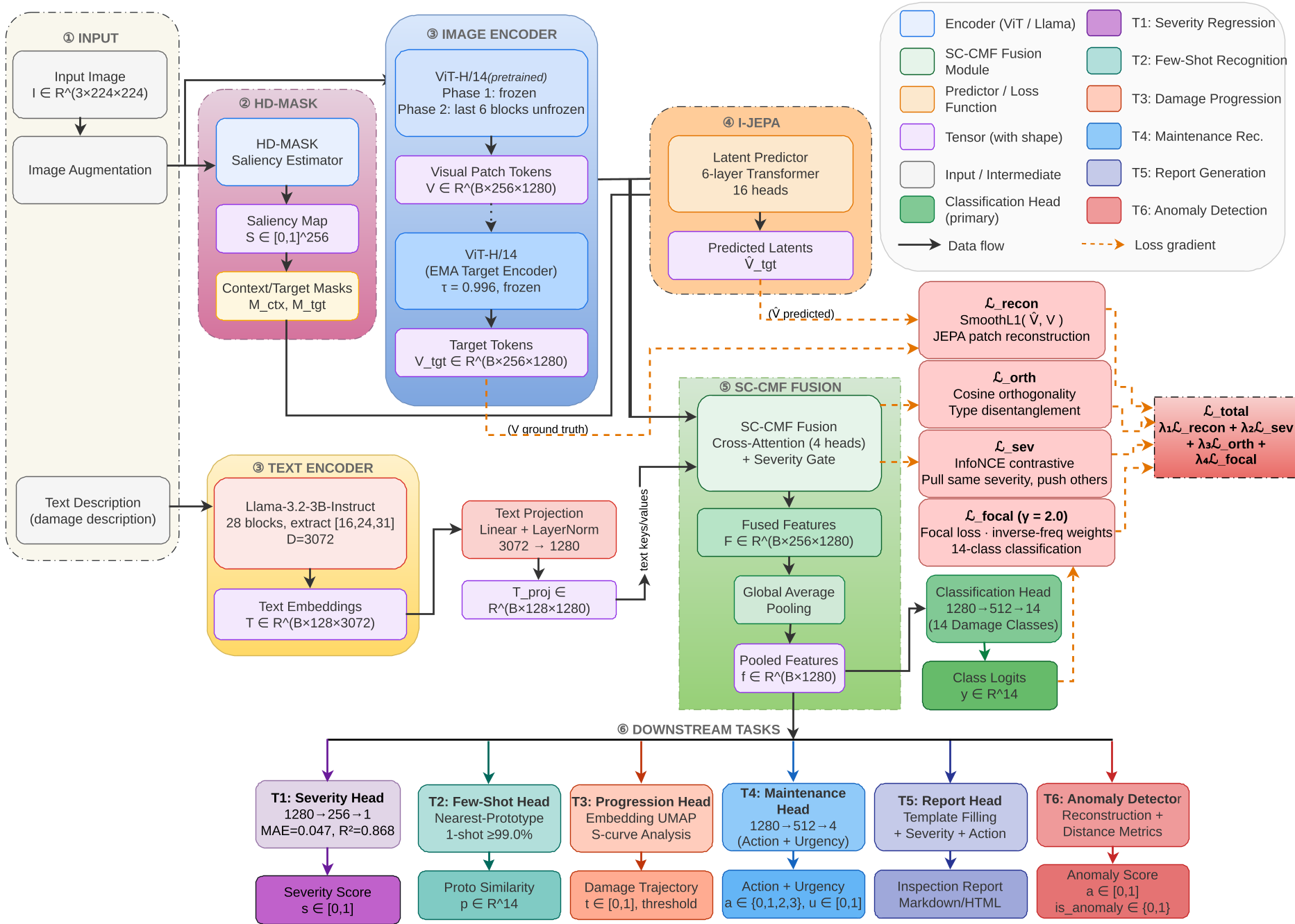
DART is not just a standard transformer; it is built on the Joint-Embedding Predictive Architecture (JEPA). Unlike Masked Autoencoders (MAE) that reconstruct pixels, JEPA predicts latent representations, making it more robust to visual noise.
1. HD-MASK (High-Discrepancy Masking)
Standard random masking often hides relevant damage. DART uses a saliency-guided network to ensure that 70% of damage-dense patches are masked and subsequently reconstructed, forcing the model to learn the intricacies of rope deterioration.
2. SC-CMF (Severity-Conditioned Cross-Modal Fusion)
Not all damage types need language equally. DART features 14 learnable per-class gates. These gates "dial up" the influence of the Llama-3.2 text encoder when dealing with severity-graded classes (like Placking) and "dial down" language for obvious physical deformities like Compression.
3. The CDD Loss Function
The model is optimized via the Contrastive Damage Disentanglement (CDD) loss, which combines:
- Latent Reconstruction: For structural features.
- Severity InfoNCE: To ensure the embedding space follows a logical severity order (Low → Medium → High).
- Type Orthogonality: To keep different damage categories (e.g., Cut Strands vs. Chafing) distinct in the vector space.
Experiments & Results: Crushing the Baselines
DART was tested against industry heavyweights including CLIP, BLIP-2, and DINOv2. The results confirm that domain-specific grounding is king.
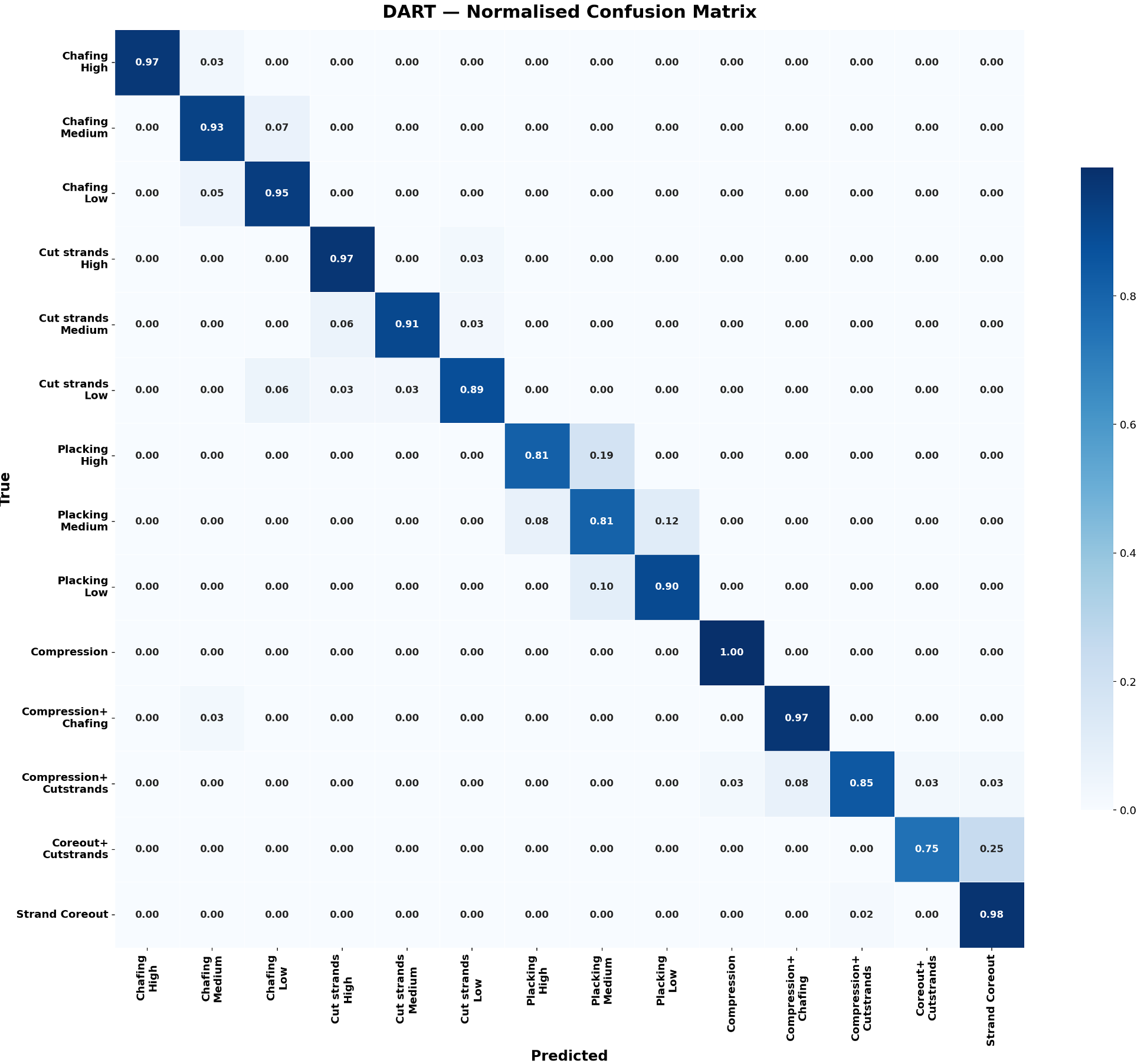
- Classification: 93.22% Accuracy (Next best: DINOv2 at 86.20%).
- Severity Regression: A Spearman of 0.94, meaning the model can track minute deterioration before a human might even notice.
- Zero-Shot/Few-Shot: With only 20 examples of a new damage type, DART reaches 89.2% F1-score, proving its "foundation model" status.
The "Geometric" Severity Manifold
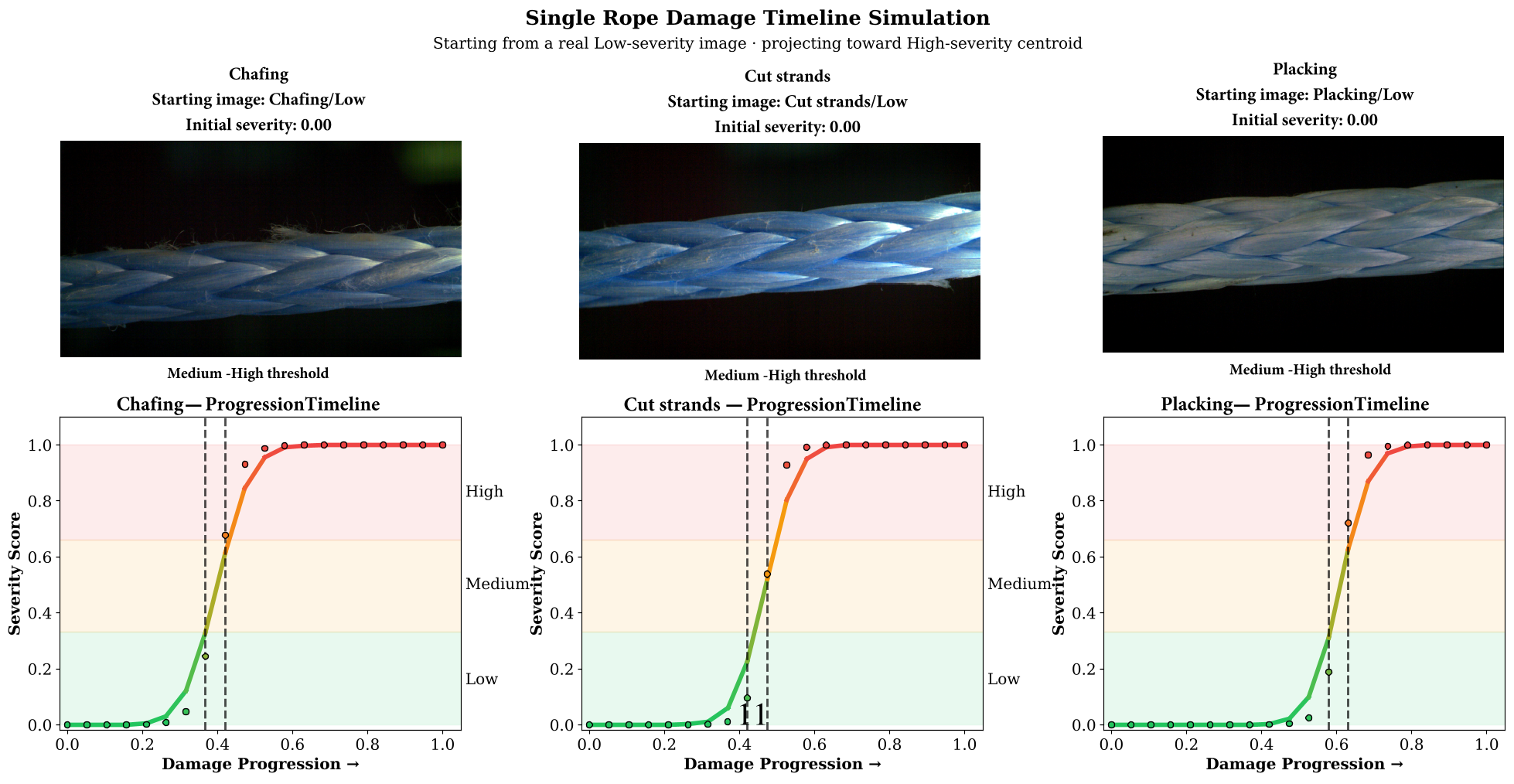
One of the most impressive findings is Embedding Arithmetic. The authors found that they could calculate a "severity vector" from one damage type and apply it to another (e.g., CutStrands/Low + Severity_Vector = CutStrands/High). This proves the model has learned a universal physical concept of "damage progression."
Critical Insight & Conclusion
DART represents a paradigm shift in Condition Monitoring (CM). Instead of building many small, fragile models, we can train one massive, knowledgeable backbone.
Key Takeaways:
- Language is a powerful regularizer: It resolves visual ambiguity in ways that 2D pixels cannot.
- JEPA is the superior foundation: Predicting in latent space is significantly better for fine-grained industrial tasks than contrastive learning (CLIP).
- Actionable AI: By mapping embeddings directly to maintenance actions (e.g., "Schedule Repair"), DART moves from "Academic Research" to "Industrial Tool."
Limitations: The model currently has a 45ms inference latency, which may need distillation for true edge deployment (on-site cameras). However, as a centralized inspection brain, DART is currently unrivaled in the maritime and offshore energy sector.