
[CVPR 2025] SITH: Cracking the CLIP Code via Weight-Space Singular Vector Decomposition
From Weights to Concepts: Data-Free Interpretability of CLIP via Singular Vector Decomposition
SITH (Semantic Inspection of Transformer Heads) is a data-free and training-free interpretability framework that analyzes CLIP's Vision Transformer in weight space by decomposing Value-Output (VO) matrices into singular vectors. Using the novel COMP (Coherent Orthogonal Matching Pursuit) algorithm, it maps these vectors to sparse, human-interpretable concepts, achieving SOTA results in fine-grained model editing and mechanistic understanding.
TL;DR
SITH (Semantic Inspection of Transformer Heads) is a revolutionary data-free and training-free framework for interpreting CLIP. Instead of looking at image activations, it looks directly at the model weights. By decomposing attention matrices using SVD and a new algorithm called COMP, SITH identifies specific "concept vectors" inside attention heads. This allows for surgical model edits—like removing bias or NSFW content—simply by zeroing out specific singular values.
Impact: This work shifts mechanistic interpretability from a dataset-heavy task to a pure linear algebra problem, proving that CLIP’s weights are a direct map of human concepts.
The Motivation: Interpretation Without Bias
Most interpretability tools (like Sparse Autoencoders) are dataset-dependent. If your probe dataset is biased, your interpretation is biased. Furthermore, identifying that a "head" likes "colors" is too coarse. We need to know which specific feature inside that head represents "Fire-Engine Red" vs "Navy Blue."
SITH solves this by bypassing data entirely, looking at the Weight Space.
Methodology: The Core Mechanics
1. Weight Matrix Factorization
SITH focuses on the Value-Output (VO) matrix () of each attention head. In the Transformer "circuit" view, the VO matrix determines what information is written into the residual stream.
SITH applies Singular Value Decomposition (SVD):
- Left Singular Vectors (): What the head "reads" from the input.
- Right Singular Vectors (): What the head "writes" to the output.
- Singular Values (): The technical "strength" or importance of that feature.
2. COMP: Making Math Human-Readable
To turn abstract vectors into words, the authors developed COMP (Coherent Orthogonal Matching Pursuit). Standard matching pursuit just looks for the best mathematical fit. COMP adds a coherence term to ensure the words chosen make sense together (e.g., "sea," "ocean," and "beach" instead of "sea," "toaster," and "politics").
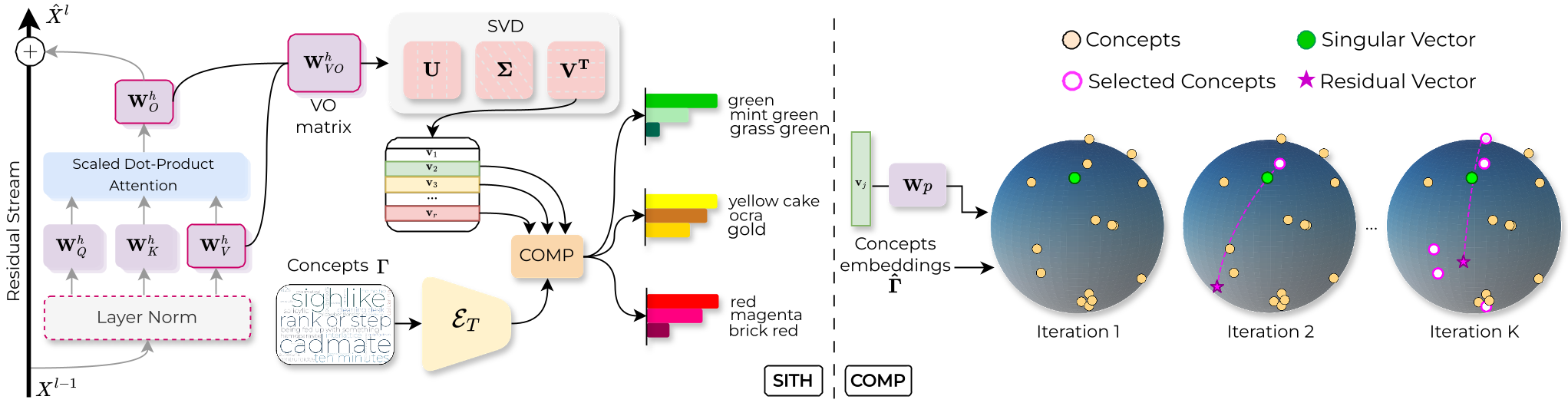 Figure 1: The SITH pipeline—from VO weight matrices to coherent concept clusters via SVD and COMP.
Interpretable Model Editing: Performance Results
Because SITH maps specific weights to specific concepts, we can "edit" the model without retraining.
Anti-Bias and Safety
- Spurious Correlations: On the "Waterbirds" dataset (birds on wrong backgrounds), SITH identifies "background" vectors. Setting for those vectors improved accuracy significantly, outperforming head-level ablation methods like TextSpan.
- NSFW Filters: SITH identifies "unsafe" vectors. By suppressing them, the model becomes safer in retrieval tasks without losing general performance.
Fine-Tuning Insights
SITH reveals that when we fine-tune CLIP, we aren't learning new concepts. Instead, we are simply re-weighting the existing semantic basis. The "subspace shift" is subtle but task-aligned.
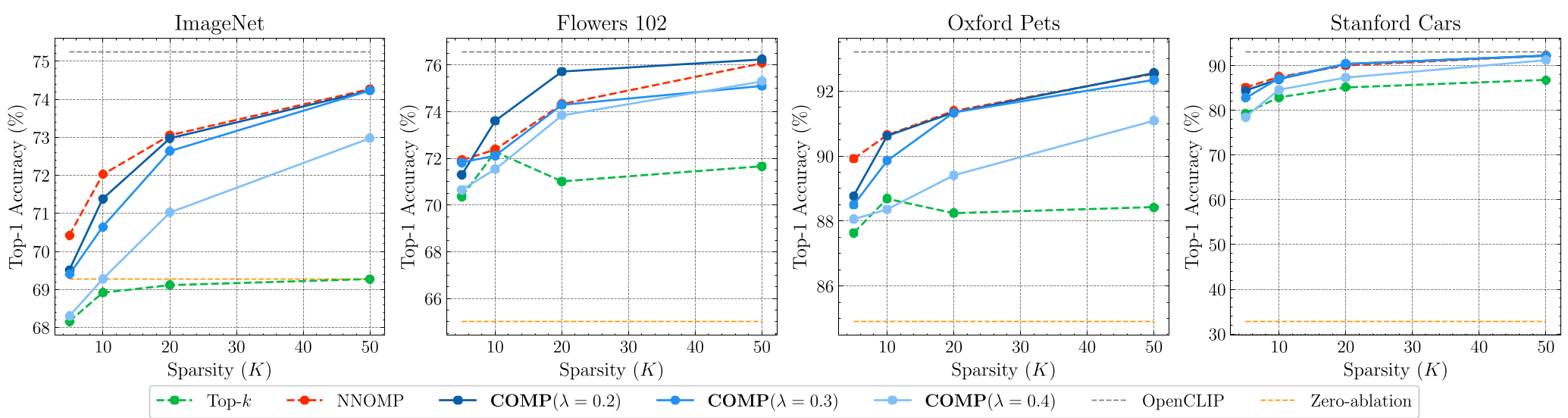 Figure 2: Substituting original singular vectors with SITH-reconstructed versions shows minimal loss in zero-shot accuracy, proving the fidelity of the decomposition.
Visual Evidence: Grounding Weights
Does a weight vector actually "see" what we think it does? The authors retrieved images from CC12M that most resembled specific singular vectors. The results are startling: a vector identified as "Two Children" consistently retrieves images of pairs of kids.
 Figure 3: Top-3 images matched to singular vectors—confirming that the weight-based interpretations align with visual reality.
Deep Insight & Conclusion
The SITH framework is a masterclass in mechanistic interpretability. It proves that the "vision-language" alignment in models like CLIP is so robust that it is reflected directly in the geometry of its weights.
Takeaway: We no longer need massive datasets to understand or fix VLMs. By applying spectral analysis to model weights, we can achieve surgical, data-free interventions that make AI safer, more robust, and more transparent. The future of AI safety and adaptation may not lie in more data, but in better linear algebra.