
De Sitter Vacua & pUniverses: Spontaneous Symmetry Breaking in the p-Schwinger Model
de Sitter Vacua & pUniverses
The paper investigates the "p-Schwinger model" (massless QED with charge-p fermions) on a 2D de Sitter background. It demonstrates the spontaneous breaking of discrete 0-form and 1-form global symmetries, resulting in degenerate, locally indistinguishable de Sitter invariant Hadamard vacua (pUniverses).
TL;DR
Can a quantum field theory maintain multiple, distinct "universes" or vacuum states in the rapidly expanding background of de Sitter space? This paper answers with a definitive "yes." By analyzing the p-Schwinger model—where fermions carry non-unit charge —the authors prove that discrete global symmetries are spontaneously broken in 2D de Sitter space, leading to locally indistinguishable but globally distinct Hadamard vacua.
Background: The Symmetry Map
Spontaneous Symmetry Breaking (SSB) in de Sitter (dS) space is a subtle topic. While continuous symmetries in 2D are generally not broken due to infrared fluctuations, discrete symmetries can persist.
The authors choose the p-Schwinger model as their laboratory. In Minkowski space, this model is known to flow to a topological BF theory in the infrared. The core innovation here is extending this analysis to the round two-sphere (), which is the Euclidean continuation of .
Methodology: Bosonization and Topological Operators
To solve an interacting theory of fermions non-perturbatively, the authors employ Abelian bosonization. The fermionic currents are mapped to a compact scalar field :
- Vector Current:
- Axial Current:
The presence of charge- fermions means that the axial symmetry is not entirely destroyed by the anomaly; a discrete subgroup survives. Simultaneously, the theory possesses a one-form symmetry because unit-charged Wilson lines cannot be screened by charge- matter.
The Construction of States
Using the Hartle-Hawking construction, the authors define the Hilbert space by performing path integrals over the northern hemisphere.
- Vacua: States carrying definite charge.
- pUniverses: States carrying definite charge.
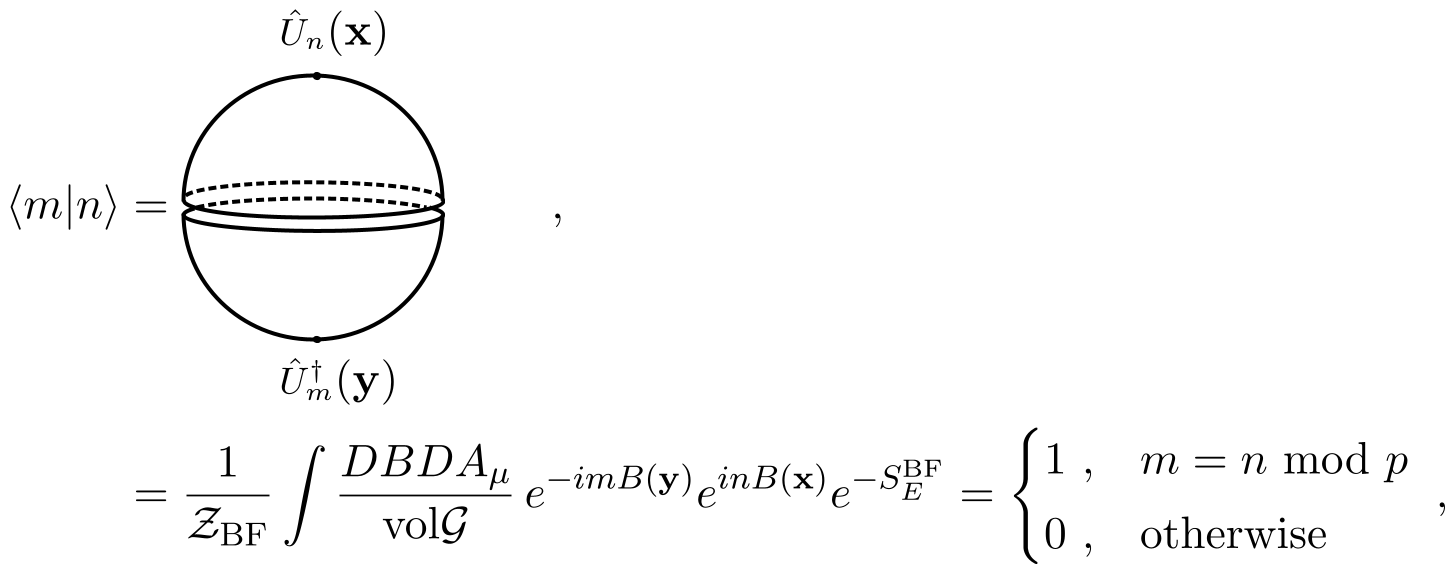 Figure: The path integral representation of vacuum overlaps using topological operator insertions.
Key Insights: Why It Works
- Topological Robustness: The symmetries participate in a mixed 't Hooft anomaly. This ensures that the vacuum cannot be unique; even if the theory is gapped, the degenerate vacua must exist.
- Hadamard Property: Unlike the famous "-vacua" which have singularities at antipodal points, the states found here are Hadamard, meaning they look like the standard Minkowski vacuum at short distances.
- Locally Indistinguishable: For a local observer, any of these states would look identical in terms of local correlation functions (like the electric field two-point function), yet they are globally distinct.
Experiments & Results
The paper provides exact, closed-form expressions for -point functions of "meson" operators (fermion bilinears).
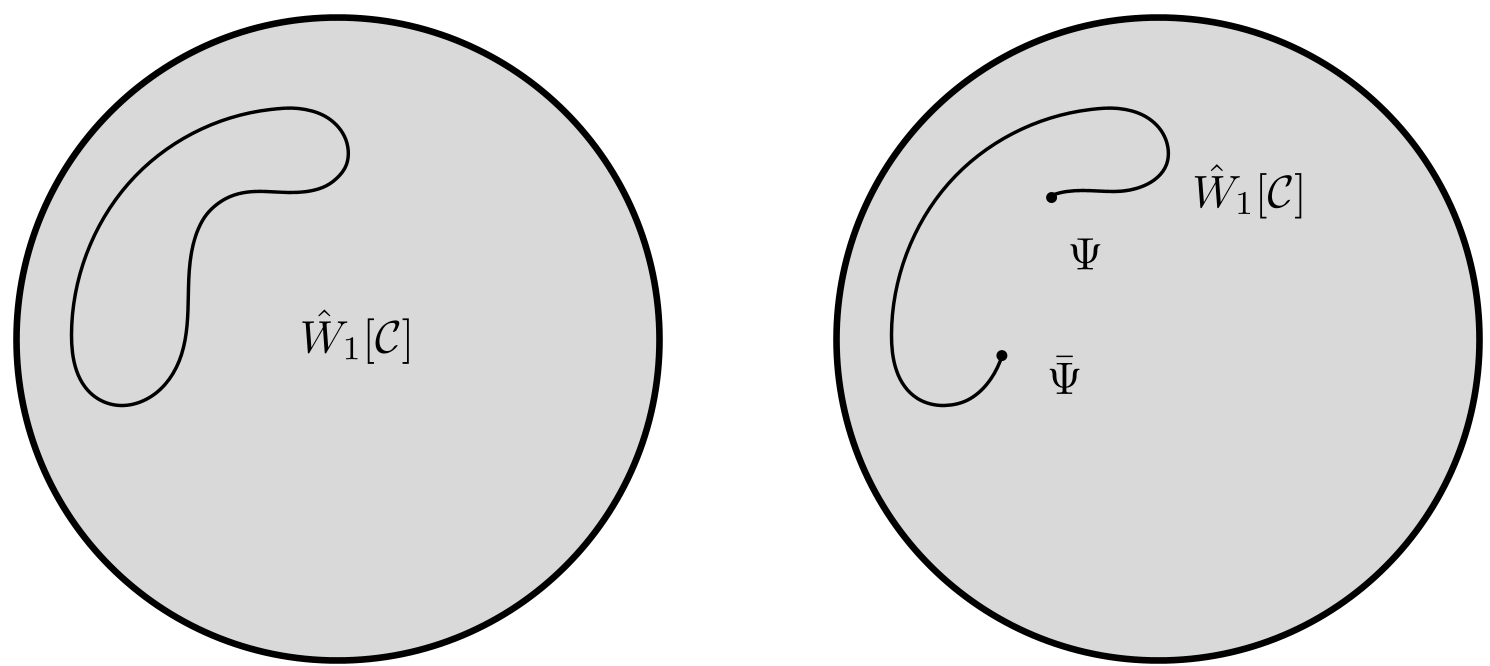 Figure: Representation of Wilson line screening (or lack thereof) in the charge-p theory.
Key numerical and analytical findings:
- Mass Generation: Interactions generate a mass , where is the coupling.
- Vacuum Overlaps: Overlaps between different vacuum sectors are strictly zero (), confirming the SSB.
- Gravitational Coupling: By adding flavors and coupling to 2D gravity, they find a semiclassical dS saddle where the horizon size scales as .
Critical Analysis & Future Outlook
The "pUniverses" provide a fascinating perspective on de Sitter microstates. If we view the dS horizon as a thermodynamic object, these degenerate states could contribute to the total entropy.
Limitations:
- The 2D nature of the model simplifies the gravity sector significantly (Liouville-like). Extending this to 4D is the "holy grail" for dS physics.
- The authors touch upon the "no global symmetries in gravity" conjecture, suggesting that wormholes or topology changes might eventually lift the degeneracy of these pUniverses.
Conclusion: This paper bridges the gap between topological quantum field theory (TQFT) and de Sitter gravity, showing that even in the most volatile backgrounds, discrete topological information remains remarkably resilient.