
De Sitter Wavefunction from Geometry: The Power of Quadrangular Polylogarithms
de Sitter Wavefunction from Quadrangular Polylogarithms: Chain Graphs
The paper presents an explicit, all-loop-order closed-form formula for the -site chain graph contributions to the cosmological wavefunction in de Sitter (dS) space. It identifies "quadrangular polylogarithms" as the natural mathematical basis for these wavefunction coefficients, leveraging their total compatibility with cluster algebras.
In the high-stakes intersection of theoretical physics and algebraic geometry, a long-standing quest involves finding the "Code" of the early universe. Specifically, how do we calculate the Cosmological Wavefunction in de Sitter (dS) space without drowning in the math of nested integrals?
A new paper, Ferro et al., delivers a breakthrough: for -site chain graphs, the answer isn't a mess of integrals, but a specific class of functions called Quadrangular Polylogarithms.
TL;DR
The authors provide the first closed-form, explicit formula (valid for any ) for chain graph contributions to the dS wavefunction. By realizing that these physical objects obey "total cluster compatibility," they bridge the gap between abstract cluster algebras () and the observable physics of the early universe.
The Problem: The "Nested" Nightmare
When physicists calculate the wavefunction of the universe, they usually look at Chain Graphs. For a 3-site chain, standard methods result in a symbol with over 104 terms. As grows, the complexity explodes.
Existing methods (like the "Cosmological Bootstrap") use differential equations to build these results. However, we lacked a final "basis"—a set of functions that naturally "live" in the geometry of the expanding universe. Until now, we knew these functions had some relationship with cluster algebras (a type of mathematical structure governing singularities), but we didn't have the explicit mapping.
The Insight: Total Cluster Compatibility
The secret sauce of this paper is Total Cluster Compatibility. In the study of scattering amplitudes (flat space), we talk about Cluster Adjacency—where neighboring letters in a math "word" must be compatible.
In dS cosmology, the constraint is much stronger: every single letter in the function's symbol must belong to the same cluster. This is exactly what Rudenko’s Quadrangular Polylogarithms are designed to do.
Arborification: Mapping Physics to Trees
The authors use a process called "Arborification" to define these functions. You draw a -sided polygon representing the sites in the universe, quadrangulate it, and turn that into a tree graph.
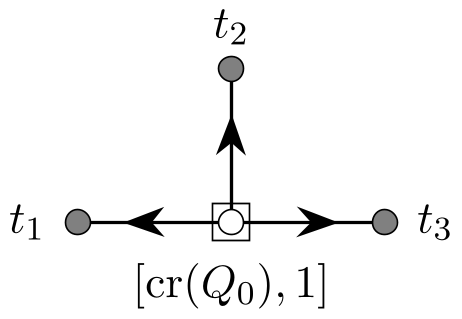 Figure: The recursive arborification process mapping geometric quadrangles to weighted symbol letters.
The Core Results: A Universal Formula
The authors' main achievement is expressed in Equation 5.1 and 5.2. Instead of solving a new integral for every site added to the chain, they prove that the n-site wavefunction () is an alternating sum of functions:
This is a sum over all ways to "dissect" a polygon into smaller even-sided polygons.
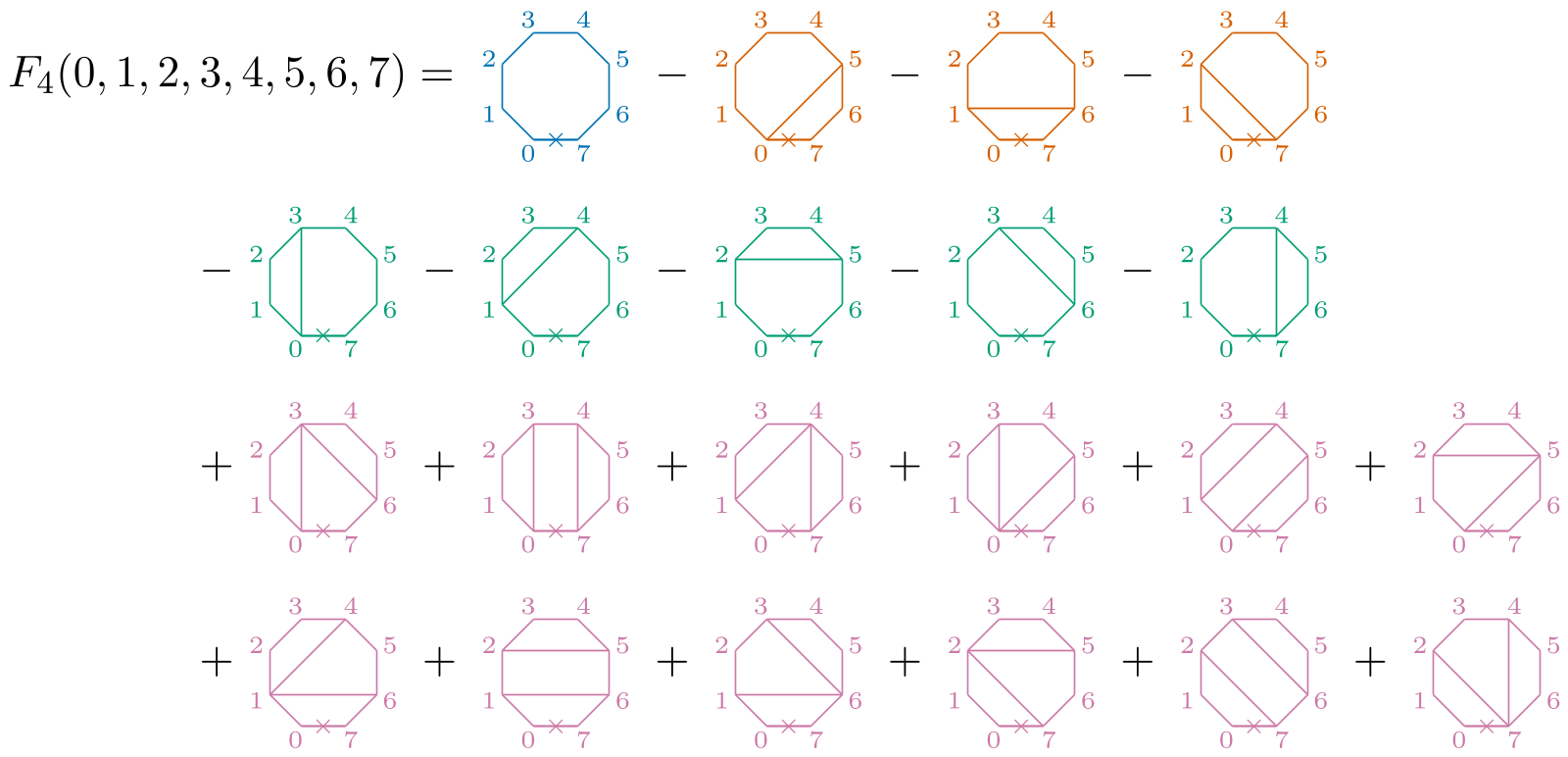 Graphic: Examples of polygon dissections for the 4-site case, leading to 21 distinct technical terms that sum to the final result.
Validation
How do we know it's right?
- The Coproduct Proof: They show the "differential" of their formula matches the physical recursion relations derived in previous years.
- The Soft Limit: Physical wavefunctions must vanish when the momentum of an internal edge goes to zero (). The paper proves their geometric formula does exactly this.
Critical Analysis: Why This Matters
For years, "Amplituhedrons" and "Cluster Algebras" were seen as tools for specialized particle physics (like SYM). This paper proves that these tools are much more universal.
Limitations:
- Currently limited to chain graphs (linear connections).
- Assumes conformally coupled (massless) fields.
Future Outlook: The door is now open to solve loop graphs (using B-type cluster algebras) and massive fields. If we can find the "polylogarithms" for those cases, we might eventually compute the entire cosmological history as a single geometric volume—no time integrals required.
Conclusion
This isn't just a math exercise; it's a structural realization. The universe's initial state—its wavefunction—follows the same strict geometric rules discovered in the heart of particle physics. By using Quadrangular Polylogarithms, we’ve found the "dictionary" to translate those rules into explicit physical values.