
Decoherence Without the State: How Dynamics Mother the Quantum World
Decoherence without the state: A causal quantum Darwinist approach
The paper proposes "Causal Quantum Darwinism," a framework that defines decoherence and the emergence of classicality purely through unitary dynamics and causal influences, without presupposing a quantum state. It unifies environmentally induced decoherence with consistent histories, achieving a state-independent derivation of unique, privileged history sets.
TL;DR
In a radical departure from the "state-first" view of physics, researchers Nick Ormrod and colleagues have introduced Causal Quantum Darwinism. This framework proves that we don't need to assume a quantum state to explain the classical world. Instead, both measurement outcomes and quantum states emerge as symptoms of the underlying unitary dynamics. By merging Quantum Darwinism with Causal Modelling, the authors provide a rigorous way to pick the "right" history out of the infinite possibilities of the Consistent Histories formalism.
Problem & Motivation: The Symptom vs. The Cause
For decades, we’ve defined decoherence by its symptoms—specifically, the "vanishing of off-diagonal terms" in a density matrix. But as Wojciech Zurek once noted, diagonality is a result, not the process itself.
Existing approaches suffer from a "chicken and egg" problem:
- Environmentally Induced Decoherence identifies preferred bases but struggles to glue them into a coherent long-term history.
- Consistent Histories provides the "glue" but offers no way to choose which history is physically meaningful, leading to a sea of non-classical "mathematical" histories.
The authors argue the missing link is the Quantum State itself. Usually, we think of dynamics as something that happens to a state. This paper flips the script: Dynamics is the "thing-in-itself," and the state is merely a redundant imprint left on the environment.
Methodology: The Causal Balance
The core of the paper lies in defining decoherence through two causal conditions:
- Accessibility (Reproduction): Can the environment "notice" changes in a system's observable?
- Potential Accessibility (Survival): Does the information stay local to the system instead of leaking and disappearing into the environment's internal degrees of freedom?
Decoherence occurs when an observable strikes a perfect balance: it is influential enough to be seen (reproduced) but robust enough to last (survive).
Dual Decoherence: Where States Come From
One of the most elegant insights is Dual Decoherence. If you reverse the arrow of time in a unitary circuit, decoherence (the spread of information) becomes dual decoherence (the implementation of generators).
- Outcomes (e.g., "The cat is dead") emerge from standard decoherence.
- States (e.g., "The cat was prepared in a specific box") emerge from dual decoherence.
In this view, "preparing a state" is just the environment acting as a "fat finger" that redundantly implements a transformation on a system.
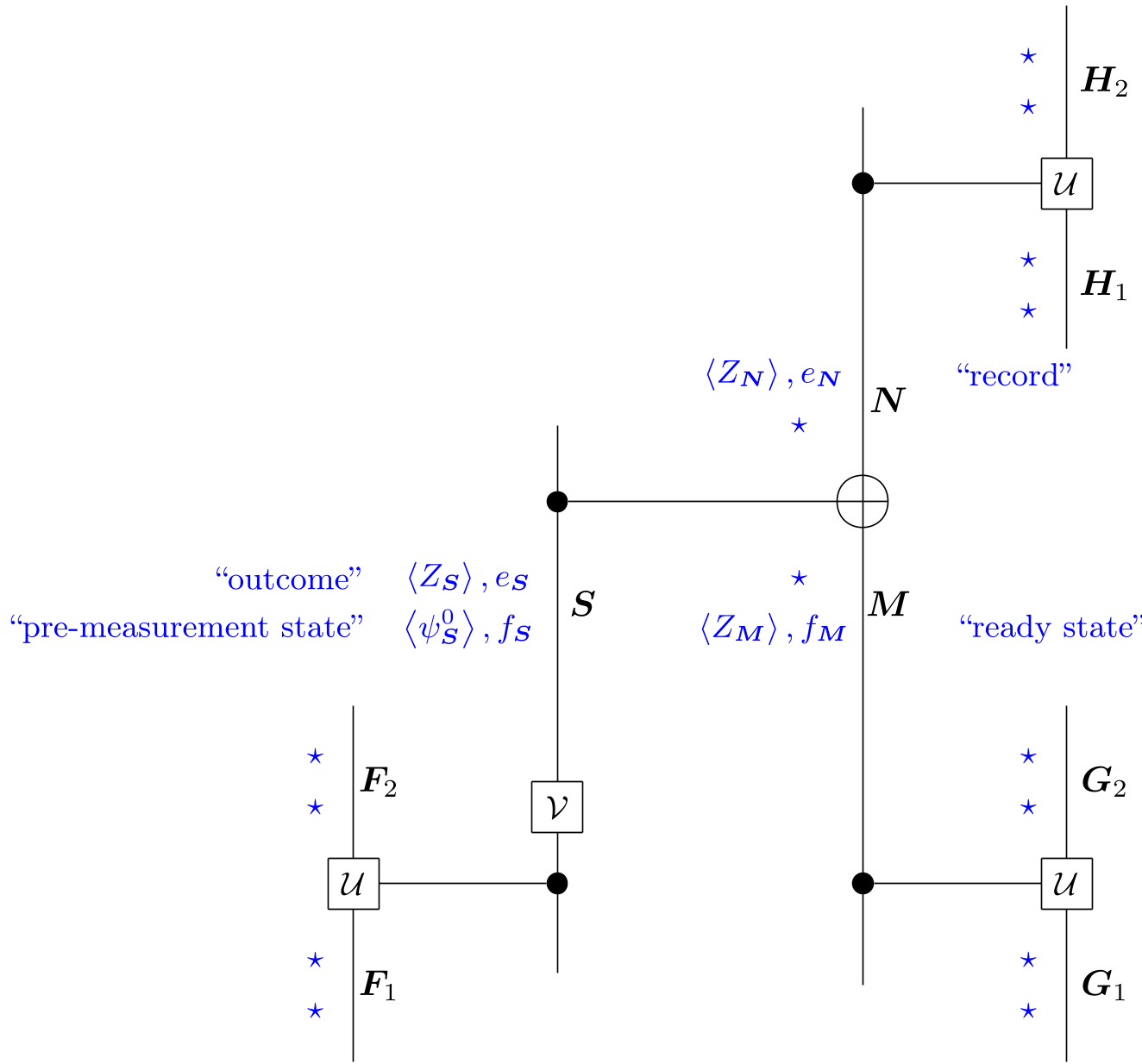 Figure 1: A minimal measurement model showing how outcomes (e) and states (f) emerge from different directions of causal influence.
Experiments & Results: Unifying the Field
By applying this to unitary circuits, the authors derived a Universal Probability Rule. They tested this against a sequence of non-commuting measurements (where the first outcome "disappears" but the record remains) and the infamous Wigner's Friend paradox.
The results show that:
- Consistency is Guaranteed: The history sets derived are mathematically consistent, meaning probabilities always add up to 1.
- Relational Classicality: Classicality isn't absolute; it depends on which systems you define as "of interest." In the Wigner's Friend case, the friend sees an outcome relative to themselves, but not relative to Wigner.
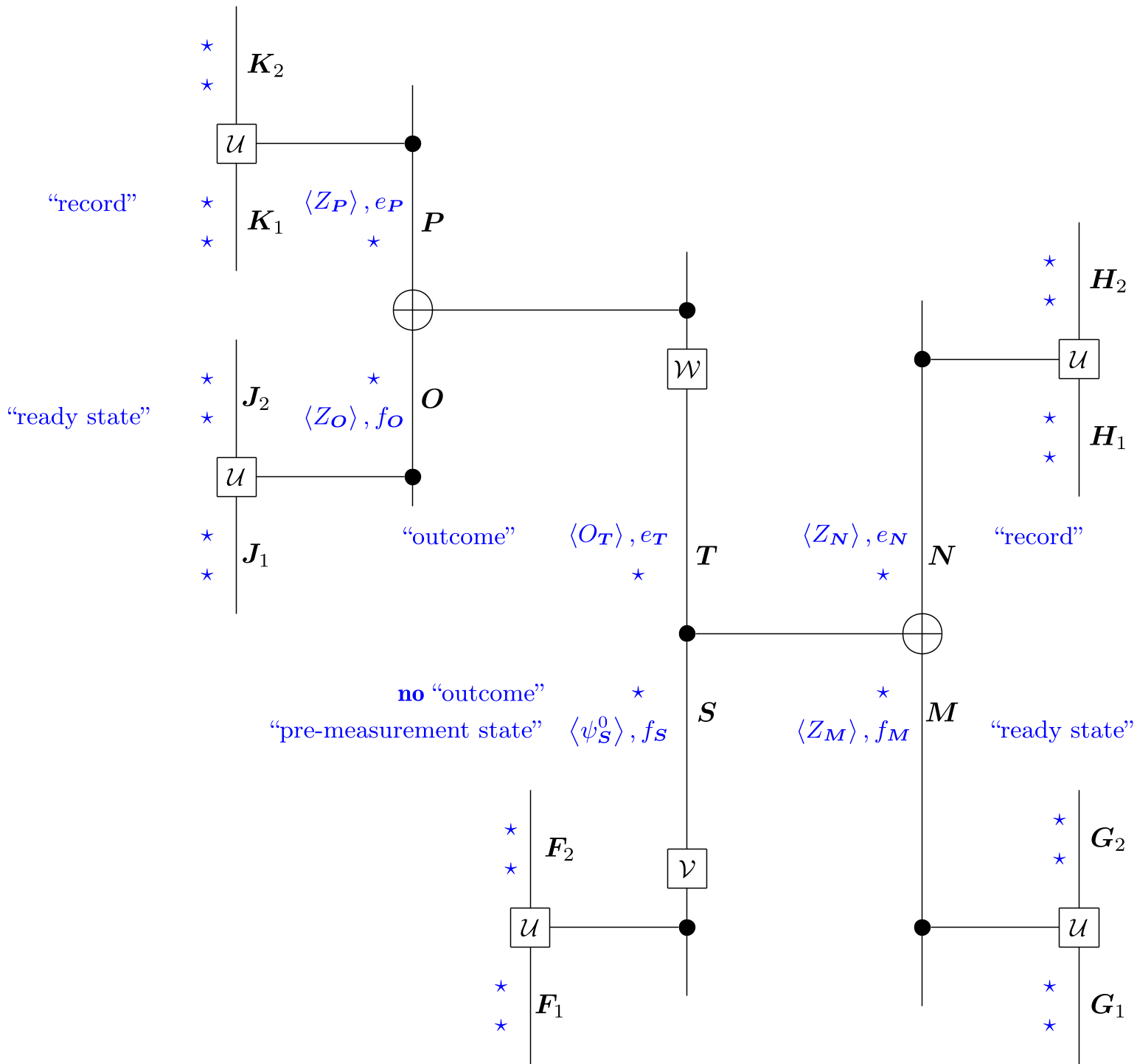 Figure 2: Sequential measurements where the record (eN) survives even when the intermediate outcome (eS) does not.
Critical Analysis & Conclusion
The "Dynamics-First" approach offers a profound ontological shift. If histories and states emerge from the causal structure of the dynamics, then the Universal Wavefunction might be an unnecessary postulate—a "ghost" in the machine.
Takeaway
For the researcher, this provides a cleaner path to the "preferred basis" problem. For the philosopher, it suggests that Action (Dual Decoherence) and Perception (Decoherence) are just two sides of the same unitary coin.
Limitations
The study currently focuses on finite-dimensional systems and ideal decoherence (no partial leakage). Translating this to the continuous variables of a Hamiltonian world (like the motion of a planet) remains the next "Mt. Everest" for this theory.
Conclusion: Dynamics is not the governor of states; it is the mother of states.