
[Deep Dive] A Decomposition Perspective: Why Your LLM Fails at Long-Context Reasoning
A Decomposition Perspective to Long-context Reasoning for LLMs
The paper introduces a "Decomposition Perspective" for long-context reasoning, breaking down complex tasks into five atomic skills: Foundational Retrieval, Anti-Interference, Global Integration, Relational Reasoning, and Dynamic State Tracking. Using an automated pipeline (AbR), the authors synthesize pseudo-datasets and employ Reinforcement Learning (GRPO) to boost LLM performance across major long-context benchmarks.
The current AI landscape is obsessed with "context window" size—the million-token milestone. However, there is a painful gap between accommodation (fitting text in memory) and efficacy (actually reasoning over it). A new paper, "A Decomposition Perspective to Long-context Reasoning for LLMs," argues that we’ve been looking at the problem all wrong.
TL;DR
Instead of treating long-context reasoning as one big, messy task, the researchers decompose it into five atomic skills. By training a model (like DeepSeek-R1-distill-32B) on just 4,000 high-quality, synthetic "atomic" samples using Reinforcement Learning (GRPO), they achieved a massive 7.7% average boost across major benchmarks, outperforming even massive models like Qwen-235B.
The Cognitive Hierarchy: Why "Needle-in-a-Haystack" Isn't Enough
The industry standard for long-context testing is the "Needle-in-a-Haystack" (NIAH) test. If a model finds the needle, we say it "works." The authors argue NIAH is merely the "Foundational Retrieval" layer of a much larger pyramid:
- Foundational Retrieval: Finding the fact.
- Anti-Interference: Finding the correct fact when distractors look similar.
- Global Integration: Connecting facts scattered across different documents.
- Relational Reasoning: Understanding logical structures (e.g., "Find the document with the most anchors").
- Dynamic State Tracking: The peak—performing multi-step math/logic and holding intermediate results in "working memory."
The AbR Framework: How to Build a Better "Brain"
The authors created the Anchor-based Reasoning (AbR) framework. Instead of relying on messy real-world data, they programmatically generate "logical blueprints."
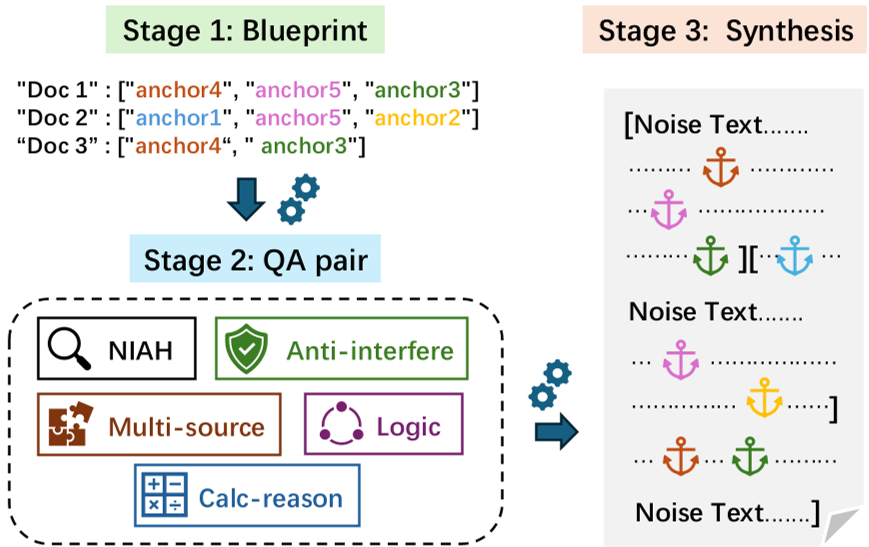 Figure 2: The AbR pipeline creates verifiable, scalable tasks by embedding specific "Anchors" into noise.
This allows for precise difficulty control. For "Anti-Interference" training, for example, they can intentionally insert multiple "lure" anchors that look exactly like the target to test if the model can respect document boundaries.
Methodology: RL-Based Enhancement
The researchers didn't just use Supervised Fine-Tuning (SFT). They used Group Relative Policy Optimization (GRPO).
- Why GRPO? It eliminates the need for a critic network, calculating advantages by comparing a group of outputs against their own average.
- The Result: A highly efficient training regime. With only 4,000 samples, the model learned a "rigorous reasoning mindset" that generalized to totally unseen, real-world tasks.
Critical Analysis: The Synergy of Skills
One of the most profound insights of the paper is the Non-Orthogonality of these skills.
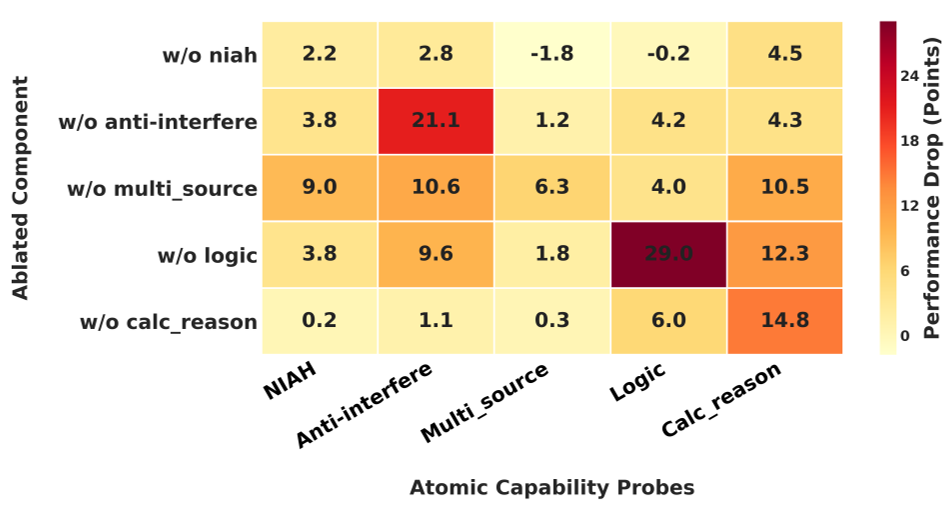 Figure 5: Removing "Logic" training crashes "Calculational Reasoning" performance, proving that complex state tracking relies on logical structuring.
The experiments show that Global Integration acts as a foundational stabilizer. If a model can't aggregate information from multiple sources, it can't perform high-level relational reasoning. This confirms that long-context capability is a hierarchy, not a list of features.
Results: Smashing the Retrieval Ceiling
The results on benchmarks like LongBench-v2 and Loogle show that this atomic training consistently pushes the performance curve upward across all context lengths, from 8k to 128k tokens.
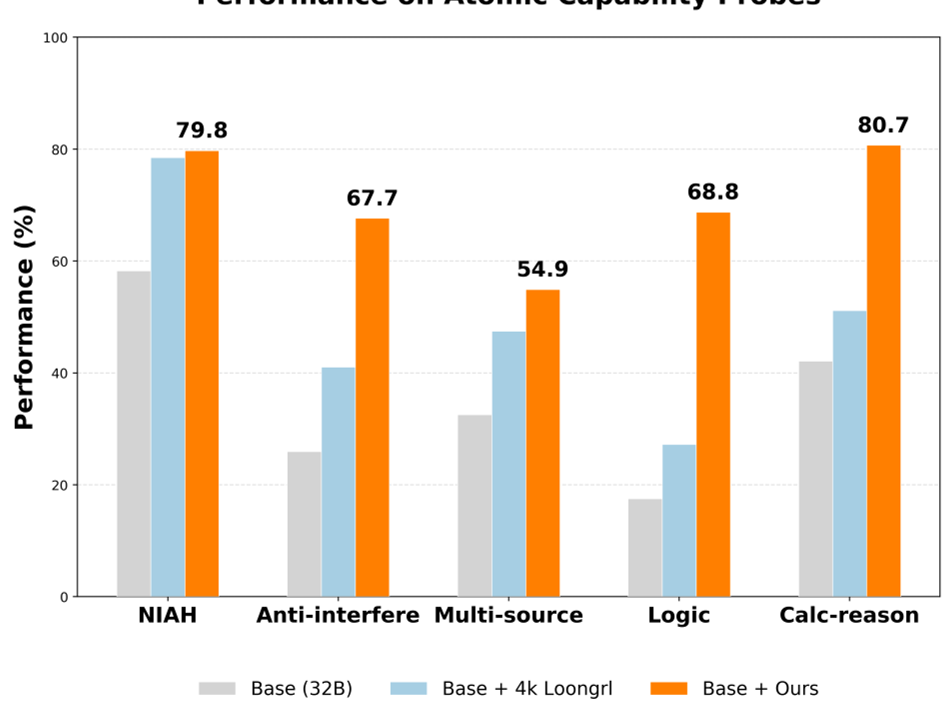 Figure 6: Note the massive jump in "Logic" and "Calc Reason" compared to the base model (Grey).
Conclusion & Takeaway
The "Decomposition Perspective" is a wakeup call for the industry. Increasing the token limit is a hardware and engineering feat; improving reasoning is a cognitive architecture feat. By focusing on verifiable, atomic sub-skills and using RL to sharpen them, we can build models that don't just "see" a million tokens, but actually "think" through them.
Key Contribution: This work proves that we don't need million-sample datasets to improve long-context reasoning. We need precise data that targets the logical bottlenecks of the model.