
Ceres vs. Moon: Quantifying the Elevated Crater Degradation on the Dwarf Planet
Degradation mechanisms and efficiency of heavily cratered regions on Ceres
This study characterizes the crater equilibrium and degradation mechanisms on Ceres using a semi-analytical statistical model applied to eight heavily cratered sites. By analyzing Dawn mission imagery, the authors demonstrate that Ceres's surface exhibits a denser crater population in equilibrium than the Moon, categorized as a Class I state, with impact bombardment serving as the primary erosional driver.
TL;DR
A new study utilizes Dawn mission data and a semi-analytical statistical model to reveal that Ceres undergoes far more intense crater degradation than the Moon. Despite this aggressive erosion, Ceres maintains a denser "equilibrium" crater population, likely due to unique surface materials that preserve crater rims even as they are bombarded.
Perspective: The Steady-State of a Battered World
In planetary science, crater equilibrium is the "break-even" point where new impacts erase old ones as fast as they form. While the Moon has long been our benchmark for this process, Ceres—sitting in the heart of the asteroid belt—presents a more chaotic laboratory. The core question addressed by Reem Vitale and Masatoshi Hirabayashi is: How efficiently does a single impact erase its predecessors on Ceres, and what does that tell us about its surface geology?
The Problem with Traditional Chronology
Determining the age and history of Ceres is notoriously difficult because of the "Model War" between:
- Lunar-Derived Models (LDM): Scaling lunar impact history to Ceres.
- Asteroid-Derived Models (ADM): Using the current population of the asteroid belt as the impactor source.
These models often disagree by factors of three or more. The authors bypass this "surface age" uncertainty by focusing on the degradation parameter (), a scalar quantity that measures the efficiency of erosion per crater production event—a metric that remains constant regardless of the absolute age of the terrain.
Methodology: The Anatomy of Erasure
The researchers selected eight sites across Ceres (Quadrangles Ac-2, 6, 8, and 12) featuring ancient, heavily cratered terrain. They utilized an analytical model where the degradation parameter is split into two regimes:
- Topographic Diffusion (): Small impacts gradually smoothing out larger craters.
- Cookie-Cutting (): New, larger craters physically overlapping and obliterating smaller ones.
Model Architecture
The observed crater population is governed by the balance of production and removal:
 The equation above tracks the evolution of the crater size-frequency distribution, where the removal term (the integral) accounts for multiple degradation mechanisms.
Experimental Results: Denser, Faster, Stronger
The team found that the "break diameter"—where craters start reaching equilibrium—is between 1 and 2 km on Ceres.
Key Insights:
- Denser Saturation: Ceres reaches a saturation level of 7-30%, significantly higher than the Moon's 2-5%.
- High-Efficiency Erosion: Topographic diffusion per impact on Ceres is comparable to, or even higher than, the Moon.
- Net Degradation: When you factor in that the impact flux on Ceres is orders of magnitude higher than the Moon's, the total erasure rate on Ceres is significantly more elevated.
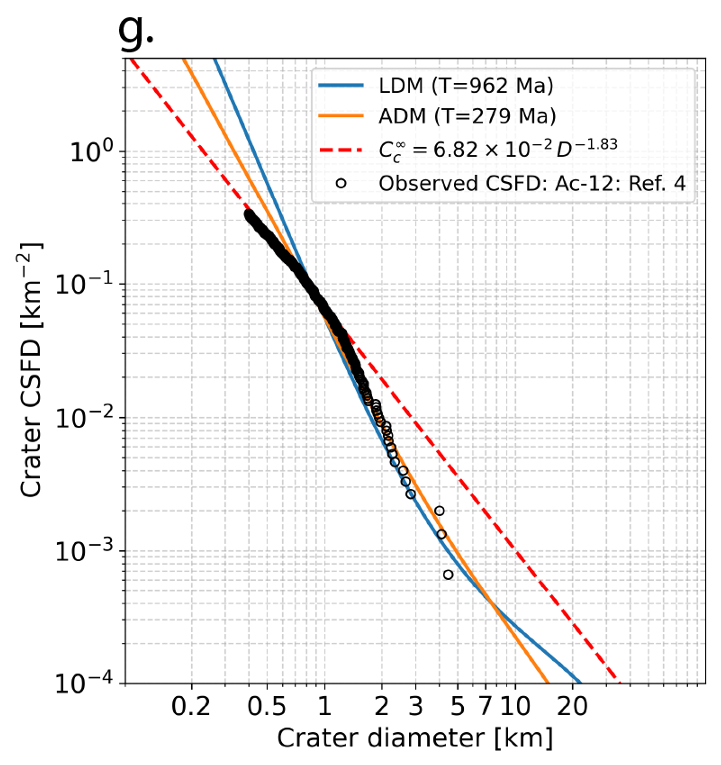 Figure 2: Observed vs. Fitted CSFDs across the target sites. The red dashed lines show the equilibrium state, clearly shallower than the production slopes (blue/orange), proving that these sites have reached a steady state of erasure.
Critical Analysis: Why Is Ceres So "Sticky"?
The most intriguing finding is the "Ceres Paradox": How can a surface with such high erosion rates maintain a denser population of craters than the Moon?
The authors propose a geological explanation: Cohesion. Ceres is covered in phyllosilicates and porous, ice-containing mixtures. These materials may have higher angles of repose and higher cohesion than lunar regolith. This allows crater rims to remain sharp and "identifiable" to researchers and computer models even as the rest of the crater is substantially degraded. Essentially, Ceres's "skin" is better at holding onto its scars.
Conclusion and Future Outlook
This work confirms that impact processes are the undisputed kings of Ceres's surface evolution, with non-impact processes like cryovolcanism playing only a localized role. Future research applying this model to other icy bodies (like Ganymede or Callisto) could determine if this "high-cohesion/high-saturation" state is a universal feature of ice-rich worlds or a unique trait of the largest asteroid in our solar system.
Takeaways for the Field:
- Impact Gardening: Ceres experiences intensive shallow degradation compared to the Moon.
- Material Science: Surface mineralogy (phyllosilicates) is a critical factor in how we interpret cratering records.