
[arXiv 2026] Detailed Geometry and Appearance from Opportunistic Motion: Breaking the Sparse-View Limit
Detailed Geometry and Appearance from Opportunistic Motion
The paper introduces a novel framework for high-fidelity 3D reconstruction of rigidly moving objects using an extremely sparse set of fixed cameras (e.g., four corner cameras). By leveraging "opportunistic motion"—the inherent movement of objects during human manipulation—it effectively creates a "virtual orbit" of viewpoints, achieving state-of-the-art results in both geometry and appearance recovery.
TL;DR
Reconstituting a 3D object from just four cameras in a room is usually impossible. This paper proves that if a person moves the object (a "hand-held orbit"), we can treat that motion as a source of dense viewpoints. By introducing a motion-aware appearance model and an alternating pose-geometry optimizer, the authors recover high-fidelity meshes and specular details that traditional 3D Gaussian Splatting (3DGS) misses.
Background: The Sparse View Paradox
In 3D reconstruction, we are usually taught that more cameras equal better results. When cameras are fixed and sparse (like home security setups), we hit a "hard bound" on geometric detail. Most SOTA methods (NeRF, 3DGS) compensate using monocular depth priors, but these are often blurry and lack fine-grained surface normals.
The authors' core insight is Opportunistic Motion: as you pick up a mug or move a chair, you are effectively performing an "Inverse SfM." Instead of the camera moving around the object, the object moves in front of the camera, providing the "missing" viewpoints for free.
The Technical Challenge: Lighting is Not "Attached"
While moving objects provide new views, they break the "Constant Intensity Assumption." In standard 3DGS, Spherical Harmonics (SH) are attached to each Gaussian. If the object rotates, the reflection (specularity) rotates with it—which is physically wrong. In reality, the light source is static.
1. Motion-Aware Appearance Modeling
To solve this, the paper factorizes the appearance into two components:
- Specular Component: Modeled by probing a global SH environment map using the reflected view direction ().
- Diffuse Component: Approximated by the surface normal's relationship to the static light field.
This ensures that as the object rotates, the highlights move across the surface realistically, rather than being "painted" on.
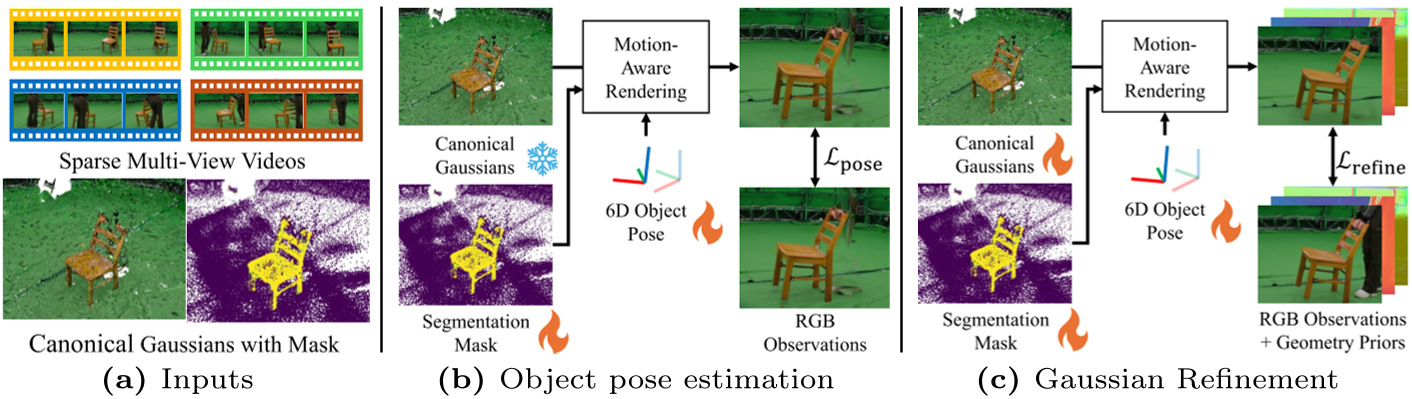 Fig 1: The alternating optimization framework: Pose Estimation Gaussian Refinement.
Methodology: Alternating Optimization
Because object pose and geometry are tightly coupled (you can’t estimate the pose of an object if you don't know its shape, and vice versa), the authors apply an Alternating Minimization:
- Single-Frame Initialization: Using learned priors (MAtCha) to get a "canonical" starting point.
- Pose Estimation: Fixing the geometry and solving for the 6DoF trajectory.
- Gaussian Refinement: Fixing the trajectory and refining the 2D Gaussian primitives.
- Final Mesh Extraction: Using "Mesh-in-the-loop" (MILo) strategy to aggregate all temporal observations into a single high-quality surface.
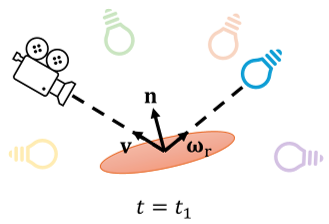 Fig 2: Comparison between standard 3DGS (fixed SH/body-attached) and the proposed factorized radiance probing.
Experiments & Results
The method was tested against DG-Mesh and MAtCha. On a suite of complex objects like a "Garden Gnome" and a "Drill," the findings were clear:
- Surface Normals: Significant reduction in angular error (Mean error dropped by ~20%).
- Photorealism: PSNR scores jumped from ~37 to ~40+ dB in novel view synthesis.
- Ablation: The results show that removing either the specular or diffuse component leads to "ghosting" or incorrect surface geometry, especially on shiny surfaces like the "Bunny" model.
 Fig 3: Qualitative results show that the motion-aware model captures fine surface details that other methods smooth out.
Critical Insight: Why This Matters
This work shifts the paradigm from "reconstructing static scenes" to "reconstructing through interaction." By treating the environment as a static light field and the object as a dynamic probe, it solves the long-standing problem of specular distortion in dynamic 3DGS.
Limitations:
- Rigidity: It currently only handles rigid objects (no squishy toys or clothing).
- Distant Lighting: It assumes light sources are far away, which might fail in very small, cluttered desk environments with desk lamps.
Conclusion
"Opportunistic Motion" is a powerful tool for ubiquitous computing and home sensing. It transforms simple corner cameras into high-precision 3D scanners just by observing how we interact with our world.
Main Reference: Hirai et al., "Detailed Geometry and Appearance from Opportunistic Motion", arXiv:2603.26665v1 (2026).