
[Phys. Rev. / JHEP] Massive Kinematic Flow: The Combinatorial Secret to de Sitter Correlators
Differential Equations for Massive Correlators
This paper uncovers a combinatorial structure, termed "Massive Kinematic Flow," which governs the first-order differential equations of scalar wavefunction coefficients with arbitrary masses in de Sitter space. By representing mode functions as twisted integrals, the authors prove that cosmological correlators belong to a finite set of master integrals whose evolution is encoded by graph tubings.
TL;DR
Calculating how massive particles interact in the early universe (de Sitter space) usually involves a nightmare of special functions and time integrals. This paper introduces a combinatorial revolution: by treating these integrals as a "flow" through kinematic space, the authors show that complex physics can be reduced to simple rules of "growing" and "shrinking" tubes on a graph. This allows them to systematically solve for both very heavy and very light particles, uncovering the geometric backbone of our cosmic history.
The "Hankel" Headache and the Search for Intuition
In flat-space particle physics, we are used to plane waves and simple momentum-space poles. However, in de Sitter space (the most likely geometry of cosmic inflation), space expands dynamically. This expansion warps the mode functions of particles into Hankel functions, which lack the simple exponential properties of plane waves.
Until now, the "Kinematic Flow" framework—a method to avoid time integrals by solving differential equations instead—only worked for conformally coupled (massless-like) scalars. The moment you add mass, the second-order nature of the Klein-Gordon equation seems to break the first-order simplicity of the flow.
The Method: From Special Functions to Rational Flow
The authors overcome this by using two brilliant maneuvers:
- Twisted Integral Representation: They treat the Hankel functions not as black boxes, but as integrals over auxiliary parameters. This transforms the problem into a "twisted" version of flat-space physics.
- Basis Expansion: By adding the time derivative of the mode function to their basis (creating auxiliary functions ), they force the second-order physics into a first-order matrix system:
The Visual Logic: Graph Tubings
The most striking contribution is the graphical description. Every basis function corresponds to a tubing (circles around vertices). In the massless case, these tubes only "merge." In the massive case, the authors introduce a Mixing rule:
- Activation: Individual tubes generate "letters" (singularities).
- Merger: Adjacent tubes combine, collapsing internal propagators.
- Mixing (New): Tubes pierced by massive lines can shrink or grow, capturing the exchange of massive information between vertices.
 The graphical tubing for a single massive exchange, showing how massive parameters () mix different basis states.
Experiments: Solving the Impossible
The authors validate their "flow" by solving the single-exchange diagram in two critical regimes:
1. The Large-Mass Limit (EFT Expansion)
When the mass , the particle is too heavy to be produced and effectively looks like a point-like "contact" interaction. The authors derive a recursive operator that generates the entire Effective Field Theory expansion. Remarkably, the Conformal Ward Identities—the core symmetries of de Sitter—emerge as a natural compatibility condition of this first-order system.
2. The Light-Mass Limit (Polylogs)
When the mass is near the conformal value, the wavefunction can be expressed in terms of Symbols and Polylogarithms. The authors provide the first systematic "symbol-level" derivation for massive exchanges, ensuring that "folded" singularities (unphysical non-localities) are correctly canceled.
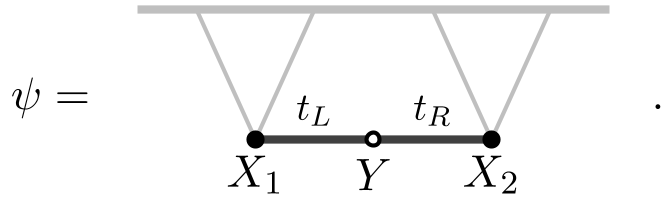 The exchange diagram and its associated rational integrand, bridging the gap between time-integrals and algebraic geometry.
Critical Insight: Why This Matters
This isn't just a math trick; it's a boundary-centric paradigm shift. It suggests that if we know the combinatorial rules of how kinematic tubes flow, we can reconstruct the history of the universe without ever needing to reference a "bulk" time coordinate.
Limitations: While the framework handles loops (as shown in the Bubble diagram in Appendix C), the final integration over loop momenta remains a separate, difficult task. Furthermore, the extension to particles with spin (like the graviton) is hinted at but not yet fully formulated.
Conclusion: The Massive Future
By unifying massive and massless fields under a single combinatorial language, Baumann et al. have provided a "universal parameterization" for cosmological observables. This paves the way for a "Massive Cosmological Polytope," a geometric object that could contain the entire story of our universe's birth within its facets and volumes.