
PAE: Explicit Manifold Shaping for SOTA Latent Diffusion
What Matters for Diffusion-Friendly Latent Manifold? Prior-Aligned Autoencoders for Latent Diffusion
This paper introduces Prior-Aligned Autoencoders (PAE), a novel tokenizer framework that optimizes the latent space specifically for Diffusion Models. By explicitly shaping the latent manifold to align with high-level visual priors, PAE achieves a new SOTA gFID of 1.03 on ImageNet 256x256 and significantly accelerates training convergence.
TL;DR
Most researchers treat tokenizers as a "black box" that compresses pixels into latents. Prior-Aligned Autoencoders (PAE) challenges this by proving that how the latent space is organized matters more than how well it reconstructs. By aligning latents with structured visual priors, PAE achieves a SOTA gFID of 1.03 on ImageNet with 13x faster convergence than previous leaders.
The Motivation: Why Reconstruction is a False Idol
In the world of Latent Diffusion Models (LDMs), the standard Variational Autoencoder (VAE) is optimized for reconstruction. However, as the authors of PAE demonstrate, a tokenizer that achieves a perfect reconstruction score (rFID) can still be a nightmare for a diffusion generator to learn.
The core insight is the Reconstruction-Generation Mismatch. If the latent space is spatially fragmented, locally shaky, or semantically chaotic, the Diffusion Transformer (DiT) wastes capacity trying to "fix" the manifold rather than learning to generate high-quality images.
Methodology: The Three Pillars of Diffusion-Friendliness
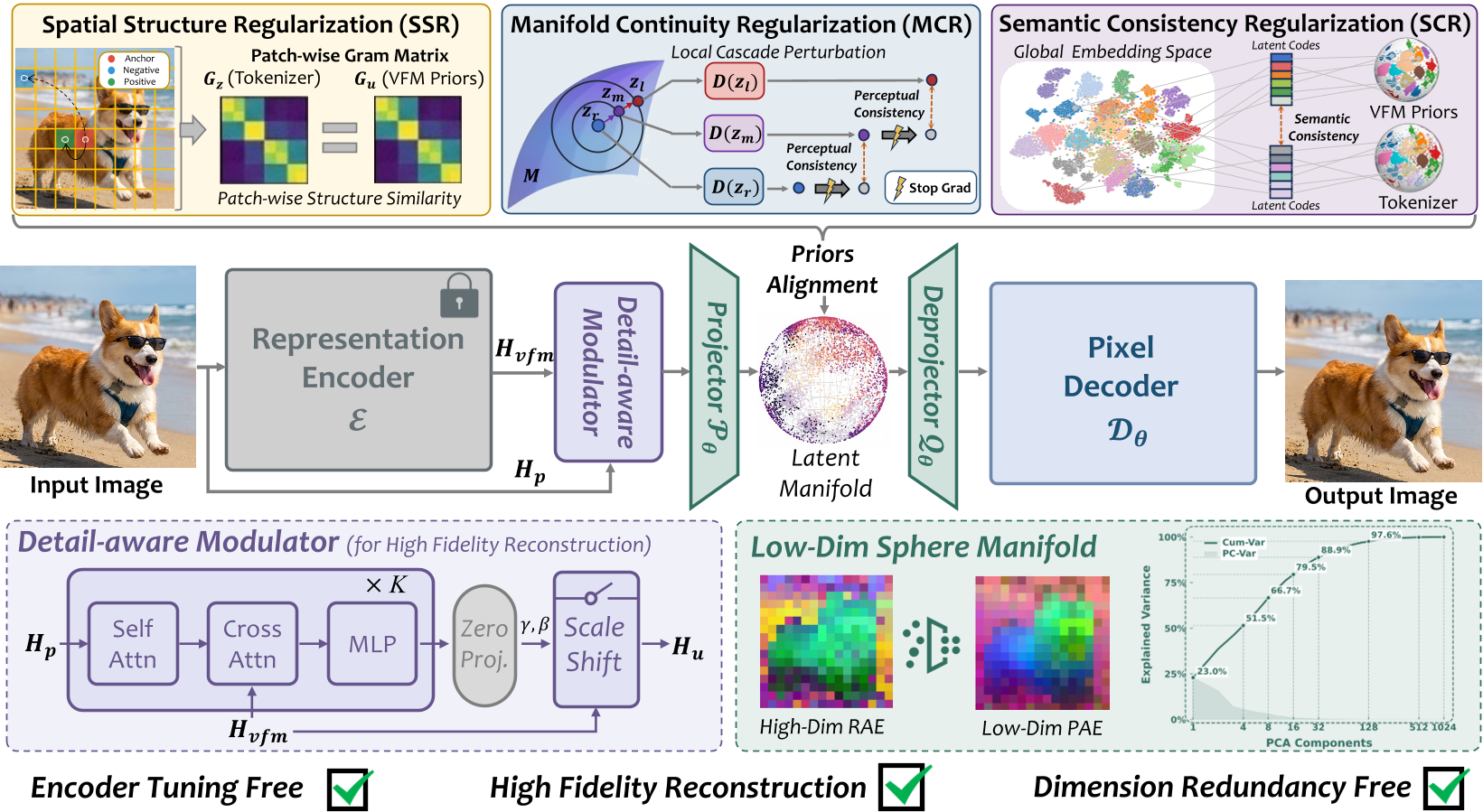
The authors deconstruct the "Ideal Latent Space" into three measurable properties:
- Spatial Structure Coherence (SSC): Ensuring token relationships preserve the physical topology of objects.
- Local Perceptual Continuity (LPC): Ensuring that if you move slightly in latent space, the decoded image changes smoothly, not chaotically.
- Global Semantic Quality (GSQ): Ensuring that images of the same "concept" (e.g., a dog) are clustered together, even in a highly compressed bottleneck.
The PAE Architecture
To achieve this, PAE uses a frozen Vision Foundation Model (VFM) (like DINOv2) as a teacher. Unlike previous works that blindly copy VFM features, PAE introduces:
- Detail-aware Modulator (DAM): Injects high-frequency pixel details into the VFM features without destroying their semantic structure.
- Refined VFM Priors: Pre-processes teacher features to match the tokenizer's resolution and suppress noise, providing a "cleaner" target for the student.
Experiments: Breaking the Speed Barrier
The most striking result of PAE is its efficiency. In the high-stakes benchmark of ImageNet 256x256:
- Efficiency: PAE reaches a gFID of 1.27 in just 80 epochs, while competing models like RAE require over 1000 epochs to reach similar performance.
- Quality: With long-term training (800 epochs), it hits an unprecedented 1.03 gFID.
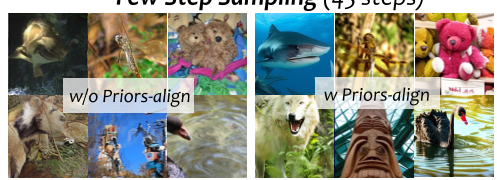
- Sampling: It delivers high-quality results in as few as 15-45 steps, outperforming older methods that need 250 steps.

Critical Insight: A Balanced Manifold
The "Aha!" moment comes from the Ablation Studies. Adding SSR (Spatial), MCR (Continuity), or SCR (Semantic) individually helps, but the real power comes from their joint optimization.
By visualizing the latent manifold (via interpolation and clustering), we can see that PAE creates a "navigable" space. Transitions between classes are semantic and smooth, rather than a jarring series of pixelated artifacts.

Conclusion & Future Outlook
PAE proves that the "First Stage" of LDMs is far from a solved problem. By shifting the objective from matching pixels to organizing the manifold, we can train faster and generate better.
Limitations: Currently, the method relies on a class-conditional ImageNet setup. The next frontier will be applying these "Manifold Continuity" principles to Video Generation and Dynamic Tokenization, where temporal and resolution-adaptive manifolds present even greater challenges.
Senior Editor's Take: PAE is a masterclass in AI research "back-to-basics." It stops chasing hyper-parameter tuning on the generator and instead fixes the very ground the generator walks on.