
Testing the Untestable: A Direct Experimental Probe for Conformal Invariance
Direct Experimental Test of Conformal Invariance via Grazing Scattering: A Proposal for X-ray and Neutron Experiments
The paper proposes a novel experimental test of Conformal Invariance (CI) in 3D critical phenomena using grazing X-ray and neutron scattering. It derives a momentum-space Conformal Ward Identity (WI) that acts as a differential constraint on the scattering cross-section, providing a direct method to verify CI beyond simple scale invariance.
TL;DR
For decades, physicist have assumed that continuous phase transitions (like those in magnets or alloys) are "Conformally Invariant"—meaning they look the same regardless of local stretching or twisting. While we have measured the consequences of this (critical exponents), we have never tested the symmetry itself. This paper provides the mathematical "smoking gun": a differential equation that experimentalists can apply to X-ray scattering data to prove conformal symmetry once and for all.
The "Missing Link" in Critical Phenomena
In the study of critical phenomena, we often talk about Scale Invariance: near a phase transition, the system looks the same whether you zoom in or out. Conformal Invariance (CI) is a much stronger requirement; it demands invariance under any transformation that preserves angles.
In 2D, CI is the backbone of string theory and statistical mechanics. In 3D, however, we've mostly taken it for granted. The problem is that in an infinite "bulk" space, the simplest thing we can measure—the two-point correlation function—looks exactly the same under both scale and conformal symmetry. To see a difference, you need a boundary.
The Insight: Boundaries and Grazing Scattering
The authors leverage Grazing Scattering. When X-rays or neutrons hit a surface at a very shallow angle (below the critical angle), they don't penetrate the bulk. Instead, they form an evanescent wave that skims the surface.
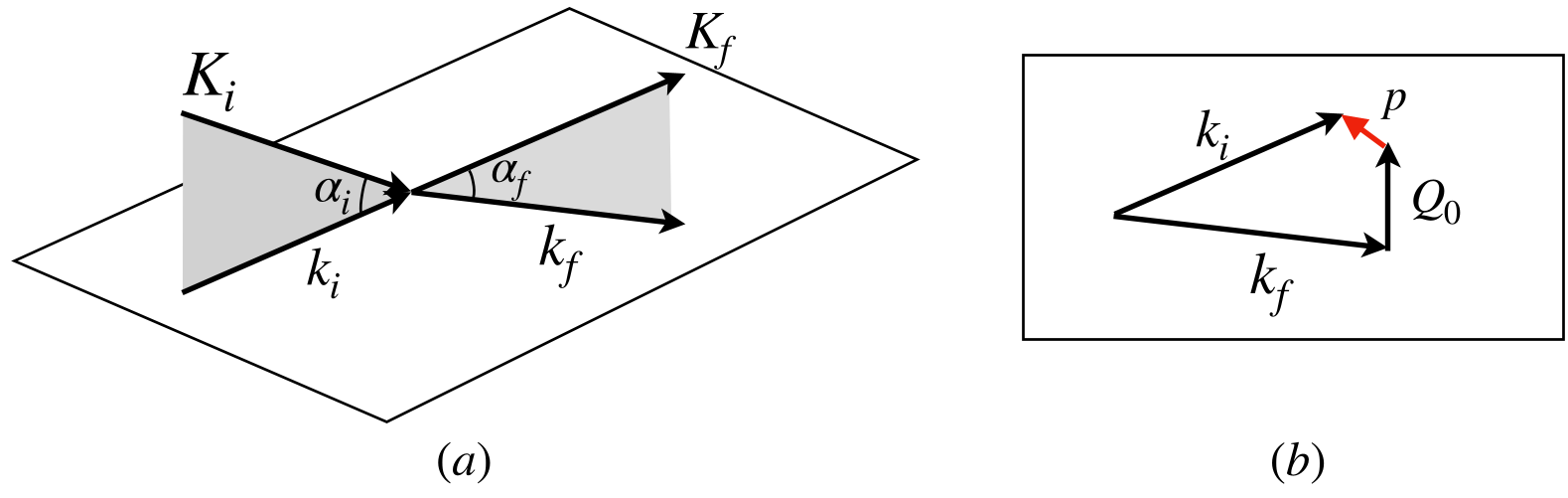
In this "half-space" geometry, Conformal Invariance is much more restrictive than scale invariance. While scale invariance allows the correlation function to depend on two cross-ratios, CI forces it to depend on only one.
Methodology: The Momentum-Space Ward Identity
The "Core" of the paper is the derivation of the Conformal Ward Identity (WI) in momentum space. Typically, WIs are differential equations in position space. By applying a Fourier-Laplace transform, the authors translated these into a language experimentalists speak: Momentum Transfer () and Scattering Angles ().
The main result is the Conf2 Identity (Eq. 4.32 in the paper):
A complex differential operator that, when applied to the "theory scattering rate" , must equal zero.
This is an elegant "check-sum." If you measure the scattering rate across different angles and momenta and the operator yields zero, the system is conformally invariant.
Numerical Verification and Realistic Testing
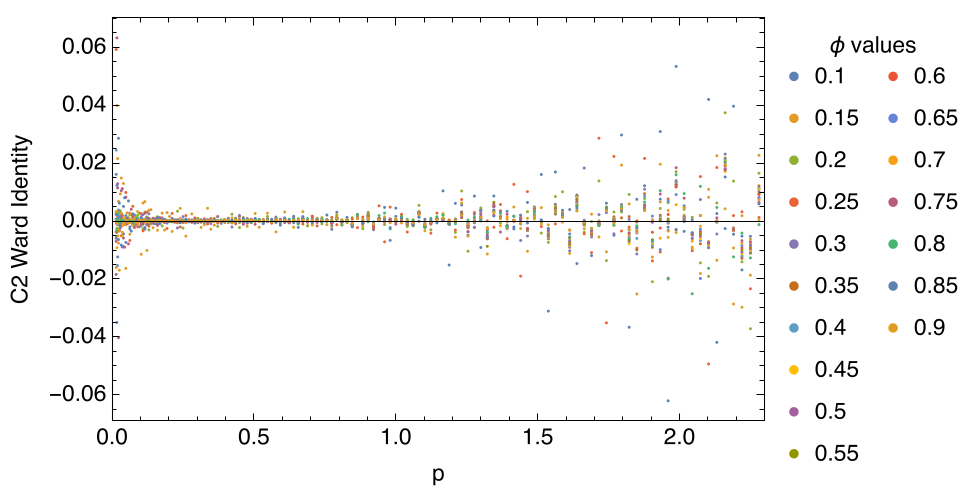
To prove this isn't just theory, the authors tested their identity using high-precision data from the 3D Ising Model (the gold standard of phase transitions). The identity held true with a mean error of .
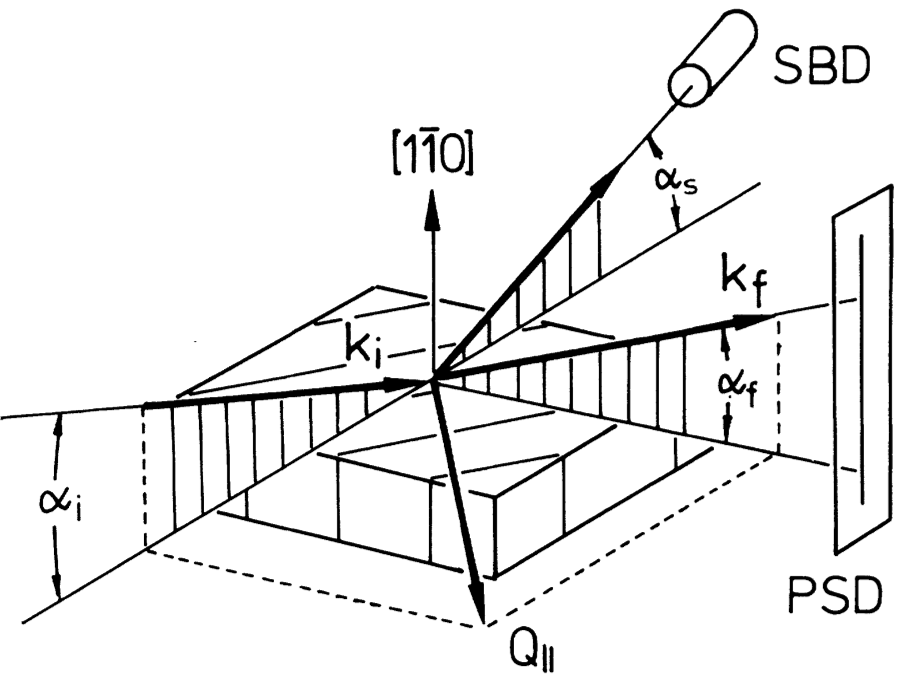
More importantly, they revisited an experiment from 1990 involving alloys. They found that the 1990 data almost tested this symmetry but failed because they integrated (averaged) over certain angles. By simply not averaging those angles in a new experiment, we can finally perform a direct test.
Critical Analysis & Conclusion
Takeaway
The paper effectively turns a high-level mathematical conjecture (Polyakov’s 1970 conjecture) into a concrete experimental protocol. It demonstrates that we don't need "new" technology; we just need better interpretation of existing scattering techniques.
Limitations
The primary challenge is the Fresnel Factor correction. Experimentalists must perfectly "strip away" the effects of surface refraction to reach the underlying "theory scattering rate." Small errors in measuring the critical angle or surface roughness could introduce noise that masks the conformal signature.
Future Outlook
This approach opens the door for testing CI in more exotic systems, such as Quantum Phase Transitions or Liquid Crystals. If the 3D Ising model passes this test, it solidifies our fundamental understanding of the Renormalization Group. If it fails? We may need to rewrite the books on 3D field theory.