
Dream-MPC: Resurrecting Gradient-Based Planning in Latent World Models
Dream-MPC: Gradient-Based Model Predictive Control with Latent Imagination
Dream-MPC is a novel model-based Reinforcement Learning (RL) framework that performs gradient-based Model Predictive Control (MPC) within a learned latent world model. By utilizing a policy network to warm-start optimization and incorporating uncertainty regularization, it achieves state-of-the-art performance across 24 continuous control tasks, outperforming gradient-free methods like MPPI and CEM.
TL;DR
Gradient-based planning has long been the "underdog" in Model-Based Reinforcement Learning (MBRL) compared to sampling-based methods like CEM. Dream-MPC changes this narrative. By combining a policy-guided "warm-start," uncertainty-aware objective functions, and temporal action reuse, it achieves SOTA results on 24 challenging tasks (including HumanoidBench) while remaining computationally efficient enough for real-time robotics.
Background: The Gradient vs. Sampling Dilemma
In MBRL, an agent "imagines" the future using a learned World Model. To decide on an action, it must find the sequence of future actions that maximizes reward—a process called Model Predictive Control (MPC).
- Sampling-based MPC (CEM/MPPI): Samples thousands of random paths. It is robust but scales poorly as action dimensions increase.
- Gradient-based MPC: Follows the model's gradients directly to the optimum. Mathematically elegant but prone to getting stuck in local optima and "exploiting" model inaccuracies.
Dream-MPC identifies that the failure of previous gradient methods wasn't the gradient itself, but rather how the optimization was initialized and regularized.
The Core Innovation: How Dream-MPC Succeeds
The method, built atop architectures like TD-MPC2 and Dreamer, refines the planning process through three pillars:
1. Policy-Guided Imagination
Instead of starting from scratch, Dream-MPC samples (e.g., only 5) candidate trajectories from a learned Policy Prior. This provides a high-quality "warm-start" in a promising region of the action space.
2. Uncertainty-Aware Objective
Learned models are "hallucinatory" in regions they haven't seen. Dream-MPC uses an ensemble of Q-functions to estimate epistemic uncertainty. The optimization objective is modified to penalize uncertainty: This forces the gradient optimizer to stick to paths the model is "confident" about, preventing model exploitation.
3. Action Amortization (Temporal Reuse)
Rather than re-optimizing from zero at every time step, Dream-MPC reuses actions from the previous step's plan. By mixing old optimized actions with new policy samples, the agent maintains temporal consistency and requires fewer iterations to reach a solution.
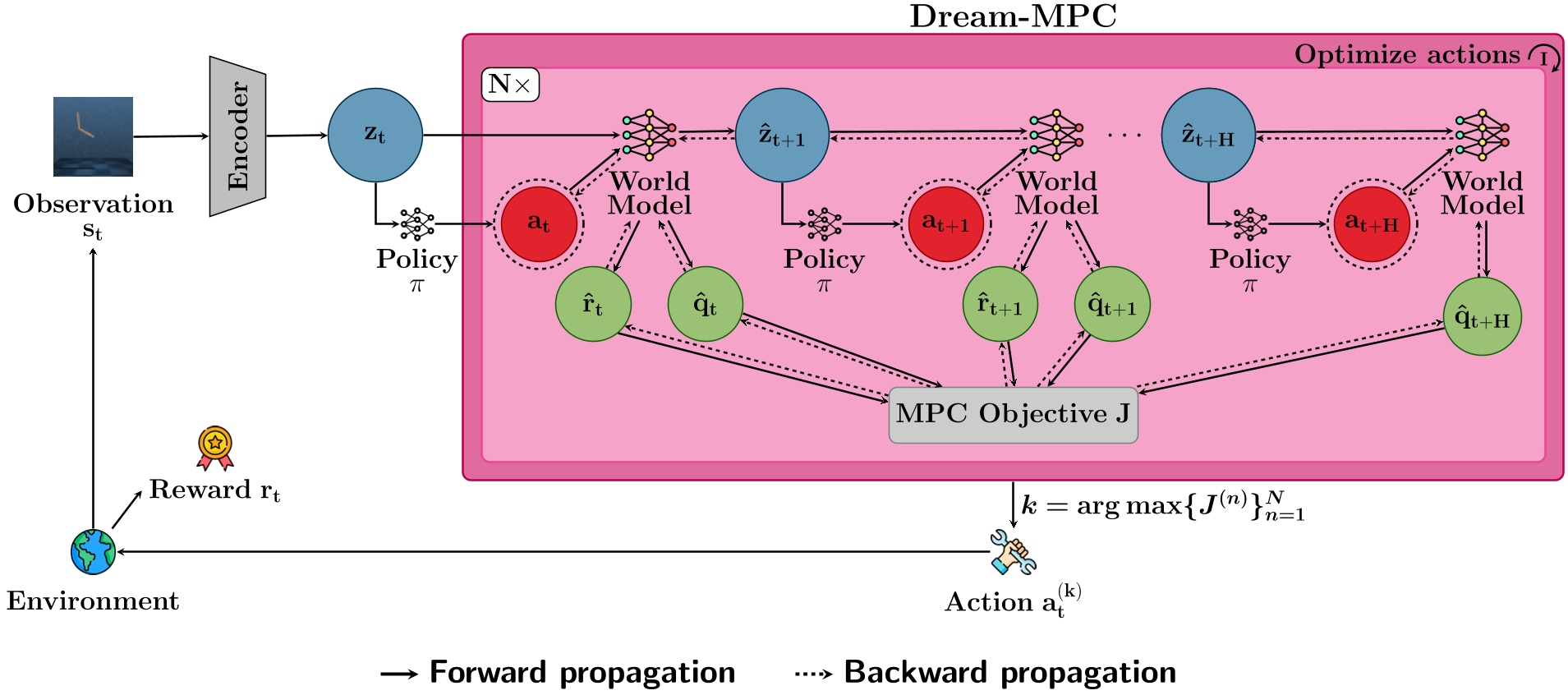 Figure 1: Dream-MPC optimizes sequences rolled out from a policy prior in latent space using gradient ascent.
Experimental Battleground: SOTA Performance
The authors tested Dream-MPC against heavyweights like Dreamer-v3, SAC, and TD-MPC2.
- High-Dimensional Scaling: On the "Humanoid" and "Dog" tasks (DMControl/HumanoidBench), where the action space is vast, Dream-MPC's gradient-guided refinement significantly boosted the base policy's performance.
- Efficiency: Despite involving backpropagation through time, Dream-MPC only uses a handful of candidates (). This makes it much faster than "Grad-MPC" baselines that use .
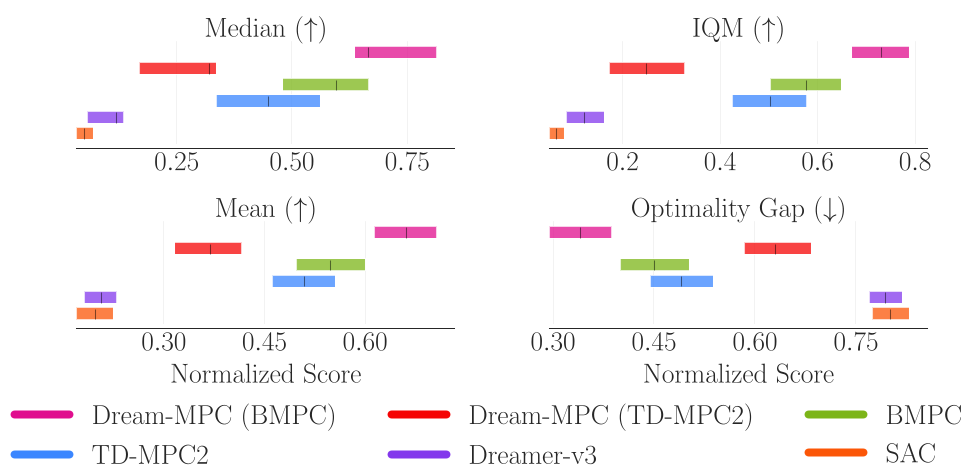 Figure 2: Aggregate performance across 24 tasks showing Dream-MPC (Blue) consistently outperforming the underlying BMPC and TD-MPC2 baselines.
Ablation Insights: Why does it work?
The ablation study revealed that Warm-starting with a Policy Prior is the most critical component. Without it, the agent fails to find successful trajectories in high-dimensional tasks (e.g., Humanoid Run). Interestingly, Uncertainty Regularization was found to be vital during the training phase to prevent the agent's policy from becoming overconfident in flawed model regions.
Critical Analysis & Conclusion
Dream-MPC proves that gradient-based planning is viable for complex robotics if we treat the world model's imperfections with respect (via uncertainty) and provide the optimizer with a good starting point (via the policy).
Limitations:
- The method still relies on a "good enough" initial policy prior. If the prior is terrible, the local nature of gradient ascent may face challenges.
- Tuning the uncertainty coefficient is currently heuristic.
Future Outlook: This work paves the way for integrating more sophisticated optimization techniques (like second-order methods) into world models and suggests that future "Foundation Models for Control" should focus on being differentiable and uncertainty-aware.