
[CVPR 2025] DROID-SLAM in the Wild: Robust Dynamic SLAM via Uncertainty-aware BA
DROID-SLAM in the Wild
DROID-W is a robust, real-time monocular SLAM system designed for dynamic "in-the-wild" environments. It introduces a differentiable Uncertainty-aware Bundle Adjustment (UBA) layer that leverages multi-view DINOv2 feature similarity to weight reprojection residuals, achieving SOTA tracking and reconstruction at 10 FPS.
TL;DR
DROID-W is a breakthrough in monocular SLAM that fixes the "dynamic scene" problem without needing to know what is moving. By integrating Uncertainty-aware Bundle Adjustment (UBA) and leveraging DINOv2 visual features, it suppresses dynamic distractors (like pedestrians or cars) to achieve state-of-the-art tracking accuracy at a real-time 10 FPS, even in cluttered "in-the-wild" outdoor environments.
Problem & Motivation: The "Static World" Trap
Most SLAM systems are built on a lie: the world is static. When a car drives past or a person walks through the frame, traditional Bundle Adjustment (BA) tries to reconcile these moving points with the static background, leading to pose drift and map corruption.
Existing solutions fall into two camps:
- Semantic Masking: Explicitly removing "people" or "cars." Fail condition: It can't handle unknown objects (a moving box, a swinging door).
- Mapping-based Uncertainty: Using NeRF or Gaussian Splatting to find "mismatched" pixels. Fail condition: If the map quality is poor (common in complex outdoor scenes), the uncertainty estimation becomes garbage.
The DROID-W Insight: Use the consistency of deep visual features (DINOv2) across multiple views to detect dynamics. If the features don't match up after a geometric warp, the pixel is likely dynamic—regardless of its semantic label.
Methodology: The Core Architecture
1. Uncertainty-aware Bundle Adjustment (UBA)
Instead of standard Mahalanobis distance, DROID-W modifies the energy function to include a per-pixel uncertainty term . Pixels with high uncertainty contribute less to the pose optimization. This prevents moving objects from "tugging" the camera trajectory away from the truth.
2. DINO-driven Inconsistency Detection
The system measures multi-view inconsistency using the cosine similarity of DINOv2 features. Because these features are robust to lighting and capture semantic essence, they provide a stable signal for identifying motion.
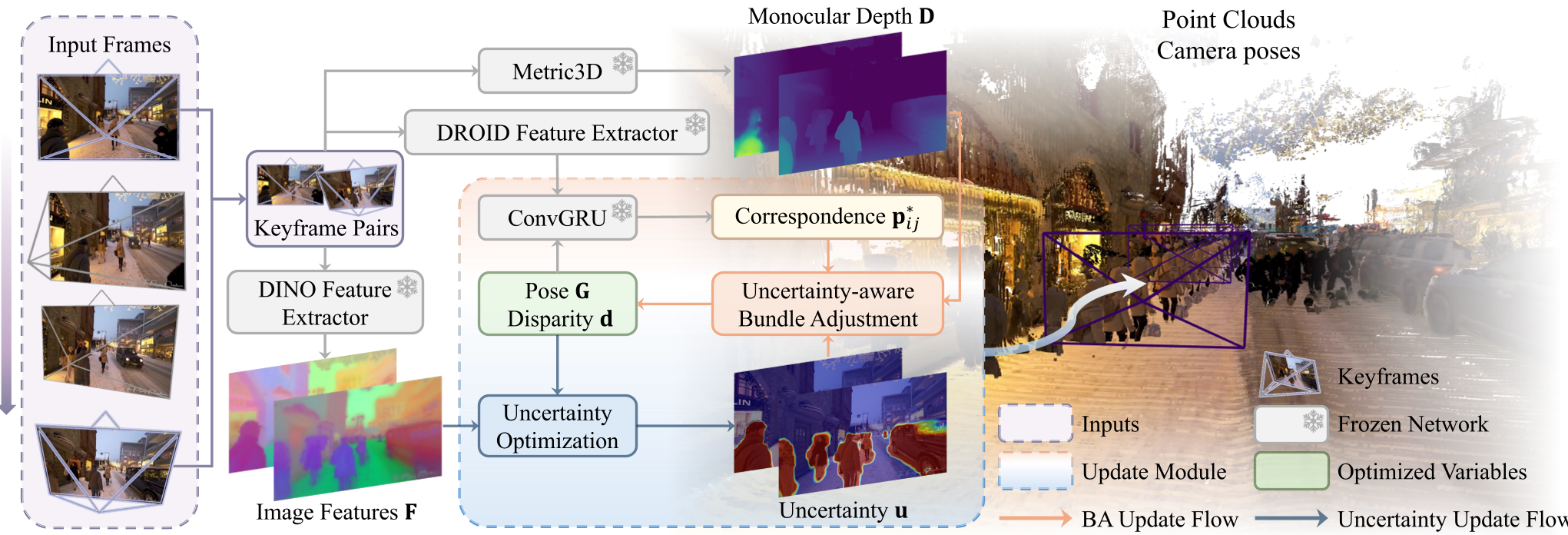 Figure: The DROID-W pipeline, alternating between pose-depth refinement and uncertainty optimization via DINOv2 feature consistency.
3. Metric Depth Regularization
To survive the "initialization phase" where poses are noisy, the authors use Metric3D to provide a monocular depth prior. This acts as a stabilizer, preventing the BA from diverging when the scene is overwhelmingly dynamic.
Experiments: Smashed Benchmarks
The authors didn't just test on easy indoor datasets like TUM RGB-D; they introduced the DROID-W Dataset, featuring 7 outdoor sequences with RTK-GPS ground truth.
- Bonn Dynamic: Achieved 2.30cm ATE, outperforming the previous best monocular dynamic SLAM (2.52cm).
- DROID-W Outdoor: Slashed the error from 1.46m (DROID-SLAM) down to 0.23m.
- Efficiency: While neural-map based sisters (like WildGS-SLAM) crawl at 0.2 FPS, DROID-W runs at 10 FPS.
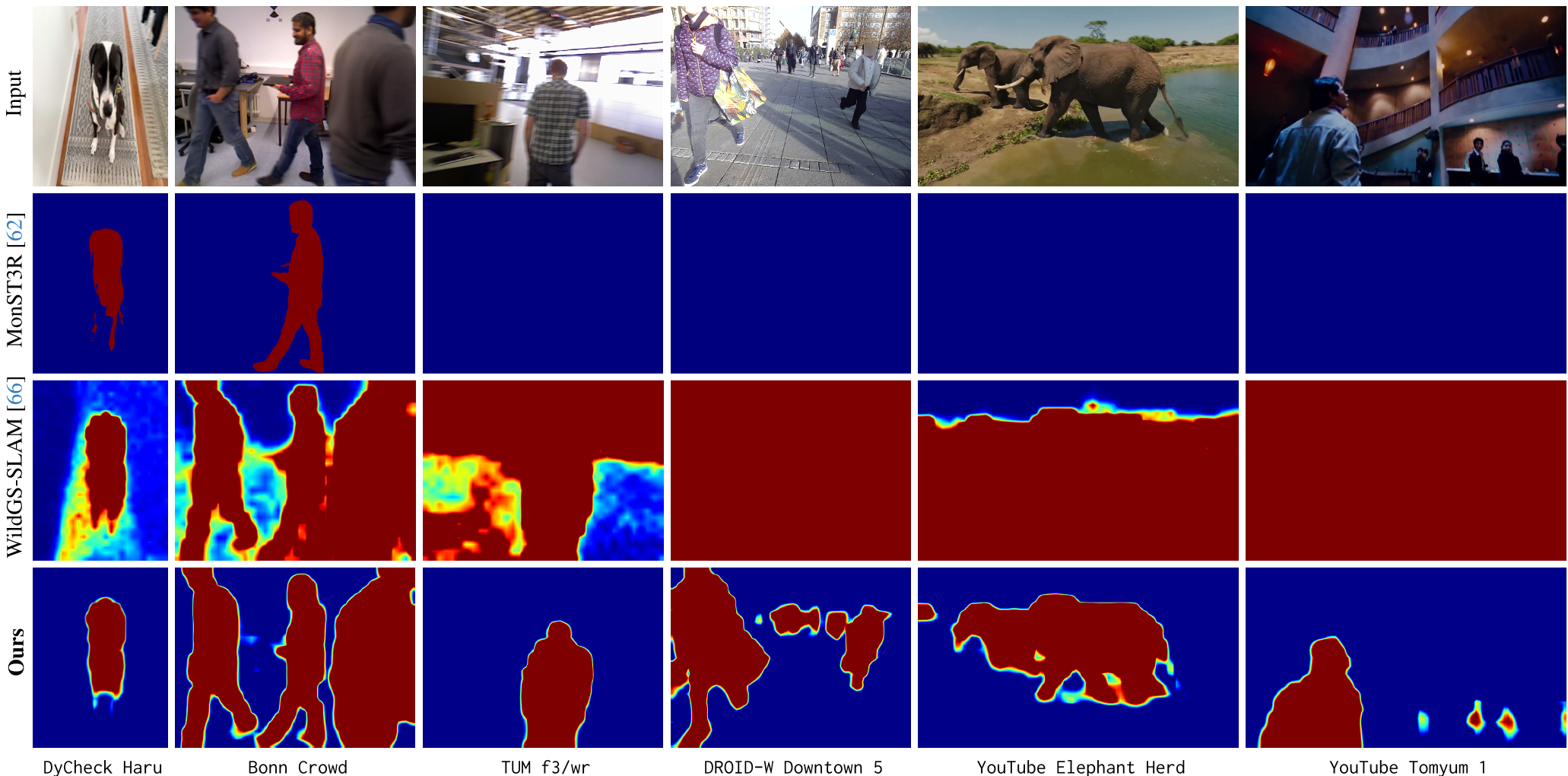 Figure: Visual comparison of uncertainty maps. DROID-W (right) provides much cleaner, semantically coherent motion masks compared to mapping-based approaches.
Critical Analysis & Conclusion
Takeaway: DROID-W proves that we can achieve robust "in-the-wild" SLAM by treating dynamic objects as statistical outliers identified through deep feature similarity. It avoids the heavy compute of NeRF/3DGS while maintaining the precision of deep BA.
Limitations:
- Initialization dependecy: If the very first 12 frames are too dynamic, the pose estimates might be too poor to even begin the uncertainty optimization.
- DINOv2 Overhead: While 10 FPS is fast for dynamic SLAM, it is slower than the original DROID-SLAM due to the feature extraction backbone.
Future Outlook: Integrating reconstruction priors directly into the initialization could make this the final word on monocular SLAM for autonomous robotics in human-centric spaces.
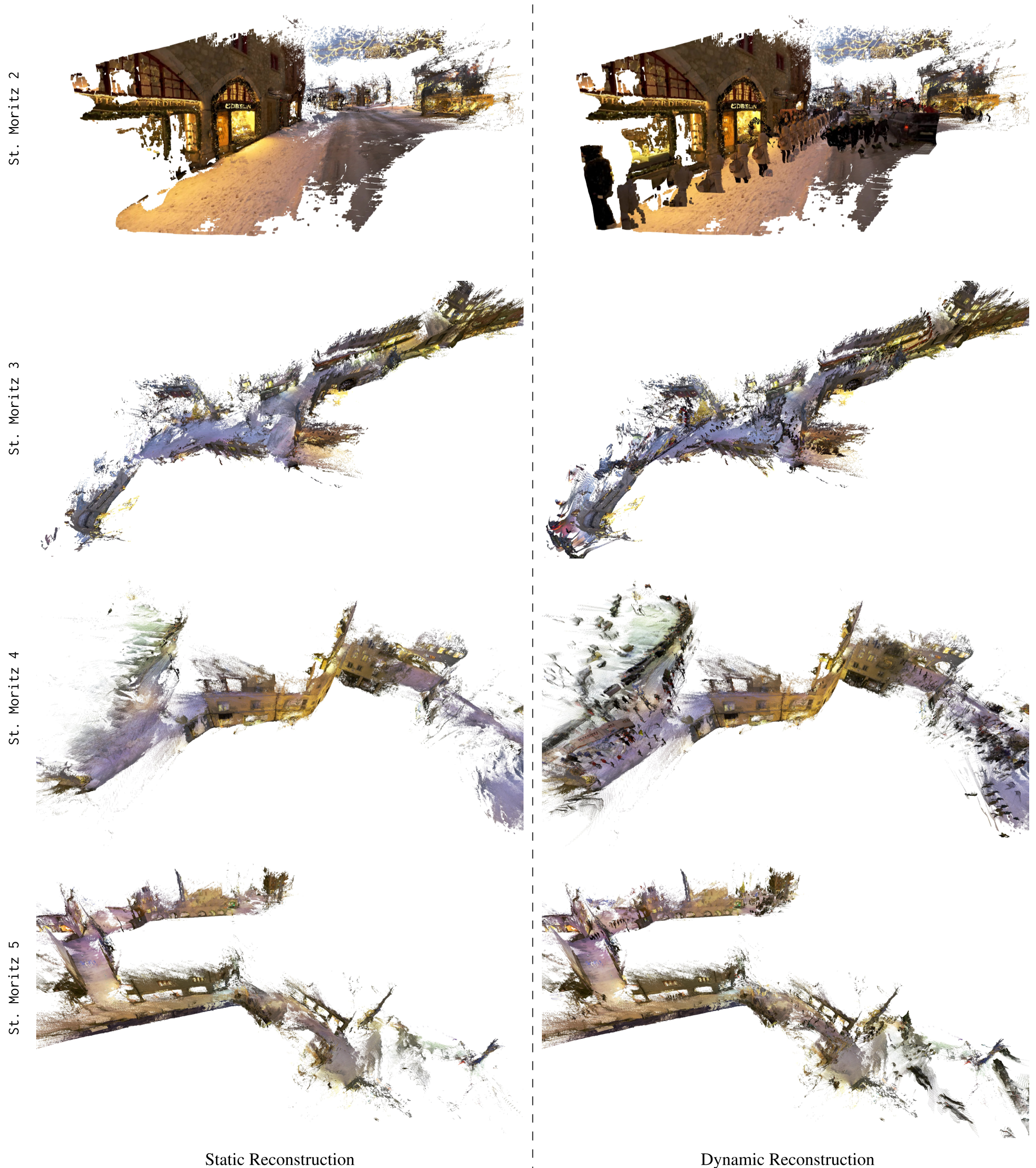 Figure: Static vs Dynamic point cloud reconstruction. Note how cleanly the system filters out moving pedestrians while keeping the sidewalk geometry perfect.