
[CVPR 2025] DRoPS: Rethinking Dynamic 3D Reconstruction with Surface-Aligned Gaussians and Deep Motion Priors
DRoPS: Dynamic 3D Reconstruction of Pre-Scanned Objects
The paper introduces DRoPS, a novel framework for high-fidelity dynamic 3D reconstruction from monocular video by leveraging a static pre-scan as a geometric prior. It combines surface-aligned 3D Gaussian Splatting (3DGS) with a Deep Motion Prior (DMP) to achieve SOTA novel-view synthesis and 3D tracking.
TL;DR
Reconstructing a moving person or animal from a single "casual" video is notoriously difficult because the depth and motion are ambiguous. DRoPS (Dynamic 3D Reconstruction of Pre-Scanned Objects) solves this by using a static 3D scan (the "pre-scan") of the object to anchor its geometry. By organizing 3D Gaussians into structured grids and using a CNN to predict how they move, DRoPS achieves unprecedented consistency, even when the "virtual camera" orbits to the back of the object where the original camera never went.
The "Ill-Posed" Nightmare of Monocular Video
In the world of 3D computer vision, the "Monocular Dynamic" problem is a classic. If you have a video of a person jumping, how do you know if their arm moved toward the camera or if the whole body just rotated? Without multi-view setup (like a Matrix-style camera rig), the math simply doesn't add up—there are infinite 3D solutions for a single 2D observation.
Most current SOTA methods try to guess the missing info using "Foundation Models" (priors from models trained on millions of images). While helpful, these often result in "floaties," distorted limbs, or textures that "slide" across the surface like wet paint.
Methodology: The Two Pillars of DRoPS
DRoPS moves away from unordered "point clouds" of Gaussians. Instead, it treats the object surface as a structured map.
1. Surface-Aligned Canonical Model
The authors take the static pre-scan and wrap it in pixel grids. By projecting the object onto virtual camera planes and back-projecting depth, they ensure that every Gaussian primitive is "persistent"—it belongs to a specific spot on the object's skin (e.g., the tip of the nose) and stays there throughout the animation.
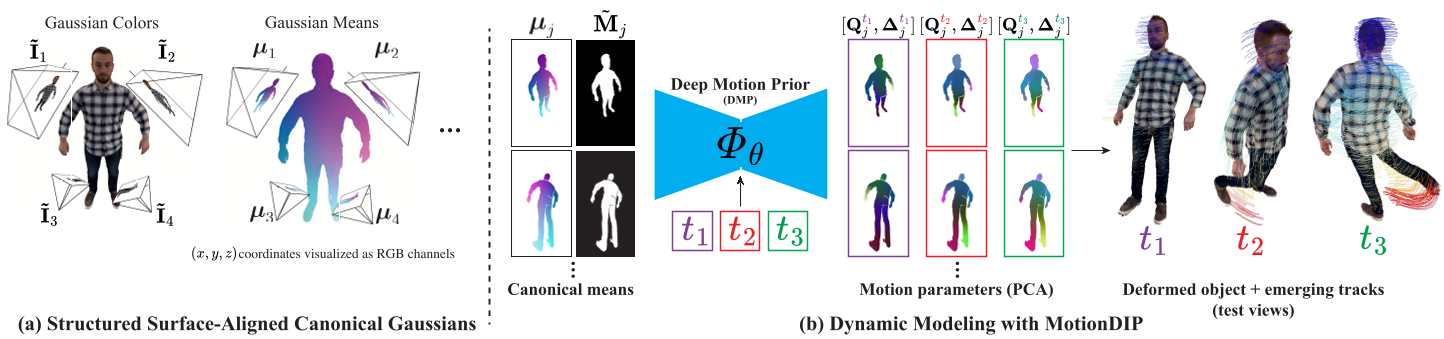 Fig 2: The pipeline showing (a) construction of grid-structured Gaussians and (b) the Deep Motion Prior (DMP) predicting deformations.
2. Deep Motion Prior (DMP)
Instead of using a standard MLP (which treats every point independently), DRoPS uses a CNN (U-Net) to predict motion.
- The Intuition: Convolutions naturally assume that nearby pixels should move similarly. This "spatial inductive bias" acts as a powerful, built-in smoother. It forces the elbow and the forearm to move together as a coherent structure without needing complex, hand-tuned physics equations.
Experimental Results: Extreme Novel Views
The true "stress test" for any dynamic 3D model is Novel View Synthesis (NVS) from extreme angles. If you train on a front-facing video, can you render a clean back-view?
DRoPS crushes the competition here. On the Panoptic Studio benchmark, it achieves a PSNR of 19.41, significantly higher than previous leaders like HiMoR (18.40).
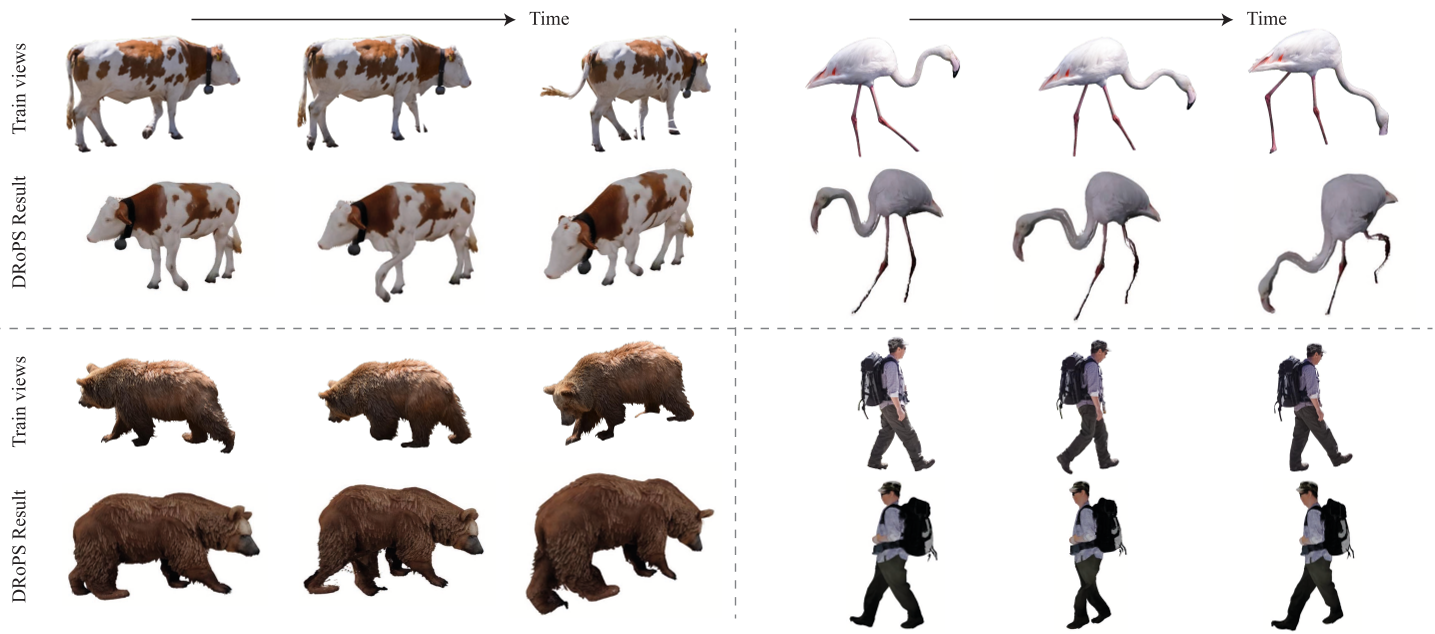 Fig 4: Comparison against OriGS and HiMoR. Notice how DRoPS maintains sharp textures and correct geometry where others fail.
Beyond just looking good, the 3D tracking (knowing where a specific point on the skin is in 3D space at all times) is much more accurate. The End-Point Error (EPE) dropped by nearly 30% compared to previous methods.
Critical Analysis & Conclusion
The genius of DRoPS lies in constrained optimization. By merging the geometric certainty of a pre-scan with the structural intelligence of a CNN, it removes the "guesswork" that plagues other monocular methods.
Limitations
- Single Subject: It currently struggles with multiple objects interacting or changing topology (like a person walking through fire/smoke).
- Dependency on Priors: If your 2D tracker (like AllTracker) or depth estimator (ViPE) fails completely, the reconstruction will follow.
Future Outlook
DRoPS opens the door for high-quality Text-to-4D and In-the-wild content creation. Imagine taking a 5-second video of your dog, and DRoPS instantly creates a fully riggable, 3D animated avatar that looks perfect from every angle. This is a significant step toward making 3D content creation as accessible as taking a photo.