
The Dual Nature of Plane Angles: Why the Radian Deserves to Be an SI Base Unit
On the dual nature of a plane angle
This paper explores the long-standing metrological debate regarding the nature of plane angles, proposing a "dual nature" theory. It argues that a plane angle acts as both a dimensional base quantity (the physical deviation between directions) and a dimensionless derived quantity (the ratio used in theoretical equations), advocating for the radian's inclusion as an SI base unit.
TL;DR
For decades, the International System of Units (SI) has treated the radian as a "dimensionless" entity—essentially the number 1. This paper by M.I. Kalinin challenges this convention, arguing that the plane angle is a physical property with its own unique dimension. By distinguishing between the dimensional angle (the physical deviation) and the dimensionless angle (the mathematical ratio), Kalinin provides a roadmap for resolving one of the most persistent "identity crises" in physics.
Problem & Motivation: The Identity Crisis of the Radian
In 1960, the SI categorized units into "base" and "derived." Angles were initially relegated to a "supplementary" class, a linguistic limbo that satisfied no one. In 1995, the CGPM officially declared the radian a dimensionless derived unit ().
However, this creates a logical friction:
- Physical Intuition: We perceive an angle as a "degree of deviation" between two rays. This property exists regardless of whether a circle or an arc length is present.
- Dimensional Analysis: In equations like , treating (rad/s) as purely makes it indistinguishable from frequency (, in Hz), leading to potential errors in engineering and automated physical modeling.
Methodology: Separating the Object from the Ratio
The author's core insight lies in dissecting the derivation of the standard angle formula.
1. The Pure Geometric Perspective
Kalinin defines the dimensional plane angle () as a base quantity. Unlike length or mass, which can go to infinity, the plane angle is inherently cyclic, defined on the interval , where is one full revolution. This cyclic nature is a fundamental property of our 2D space geometry.
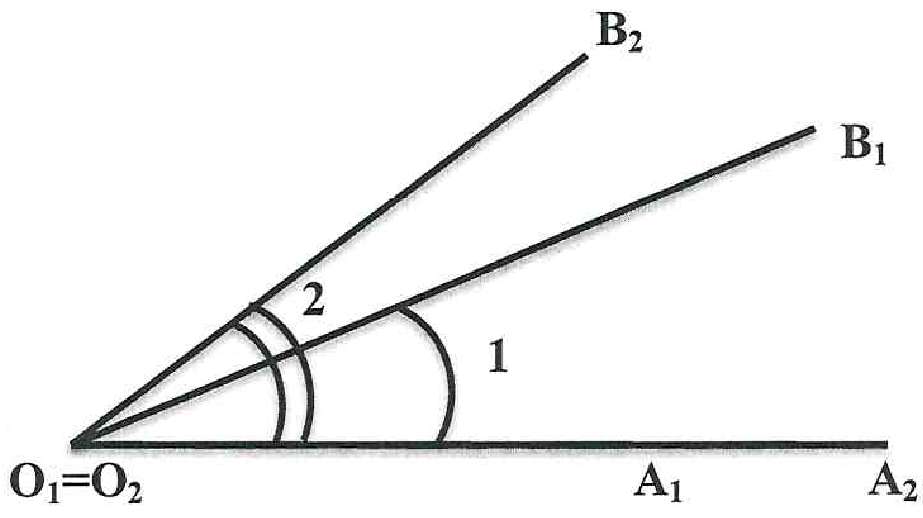
2. The Relationship to Arc Length
The author points out that the famous is not a definition of an angle, but a relationship derived from the properties of a circle. The fundamental geometric proportionality is: From here, we can define a dimensionless combination: This explains why appears dimensionless in theoretical physics: it is a ratio of two angles, not a ratio of two lengths.
Experiments & Results: Duality in Action
The author illustrates the necessity of this duality through rotational kinematics.
The Dimensional Angle () in Measurement
When we measure an angle in a workshop, we are measuring the physical deviation. If we change the unit from radians to degrees, the numerical value changes, which—by definition—makes it a dimensional quantity.
The Dimensionless Angle () in Theoretical Physics
In differential equations, such as those describing centripetal acceleration, the angle appears as a dimensionless ratio to simplify the calculus.
- Angular Velocity (Metrology): (rad/s)
- Angular Velocity (Physics/Euler): (Often just listed as in dimensional checks)
The author argues that the "confusion" in modern science stems from using the term "angle" for both (the base quantity) and (the derived ratio).
Critical Analysis & Conclusion
Takeaway
The plane angle should be the eighth base quantity of the SI. The radian is not just the number 1; it is a unit of a specific dimension, "Angle (A)".
Limitations
While scientifically sound, implementing this change would require rewriting thousands of standards and software libraries. The "dimensionless" convention is deeply embedded in the way we calculate Taylor series for trigonometric functions (where assumes is a pure number).
Future Outlook
As we move toward more rigorous machine-assisted science, the ambiguity of the radian becomes a liability. Kalinin’s work suggests that a more robust SI system—one that recognizes the unique, cyclic dimension of space—could prevent the "unit-mixing" errors that have plagued engineering projects for decades.
Original Source: M.I. Kalinin, "On the dual nature of a plane angle"