
[IEEE TMM] DDSR: Bridging the Gap in Black-Box Domain Adaptation via Dual-Teacher Distillation
Dual-Teacher Distillation with Subnetwork Rectification for Black-Box Domain Adaptation
The paper introduces Dual-Teacher Distillation with Subnetwork Rectification (DDSR), a framework for Black-Box Domain Adaptation (BBDA) that utilizes both a black-box source model and a Vision-Language Model (CLIP) as dual teachers. It achieves state-of-the-art results on benchmarks like Office-Home (83.2% avg accuracy) and Office-31 (93.1% avg accuracy) without accessing source data or model parameters.
TL;DR
Adapting a model to a new domain without seeing the original training data or even the model's internal weights is a "black-box" challenge. DDSR (Dual-Teacher Distillation with Subnetwork Rectification) solves this by using a smart fusion of the black-box's predictions and CLIP's semantic knowledge, paired with a unique "subnetwork" trick to stop the model from learning "noise" instead of "patterns."
Domain Positioning: This work sits at the cutting edge of Privacy-Preserving Machine Learning and Domain Adaptation, establishing a new SOTA for scenarios where source models are only available via APIs.
The Problem: Training in the Dark
In traditional Unsupervised Domain Adaptation (UDA), you have the source data. In Source-Free adaptation (SFDA), you at least have the model weights. In Black-Box Domain Adaptation (BBDA), you have neither. You can only "query" the source model with target images and look at the output probabilities.
The issues are twofold:
- Noise: The source model's predictions on target data are often wrong (domain shift).
- Heterogeneity: Vision-Language models like CLIP have great general knowledge but lack the "specialized" view of the source model.
Methodology: Dual Teachers & Subnetwork Rectification
The DDSR framework operates in a two-stage process designed to extract and then refine knowledge.
1. Adaptive Dual-Teacher Fusion
Instead of just trusting the source model, DDSR brings in CLIP as a second teacher. The "magic" lies in the Adaptive Prediction Fusion. The model calculates the entropy (uncertainty) of both teachers. If the target domain is large, it leans on CLIP; if the domain is small, it relies more on the source model's task-specific expertise.
2. Subnetwork Rectification
To prevent the student model from overfitting to the noisy pseudo-labels generated by the teachers, the authors use a structural trick. They define a subnetwork (sharing the first percentage of weights). By enforcing a gradient discrepancy between the full network and the subnetwork, the model is forced to learn more robust, diverse features rather than just memorizing the noise.
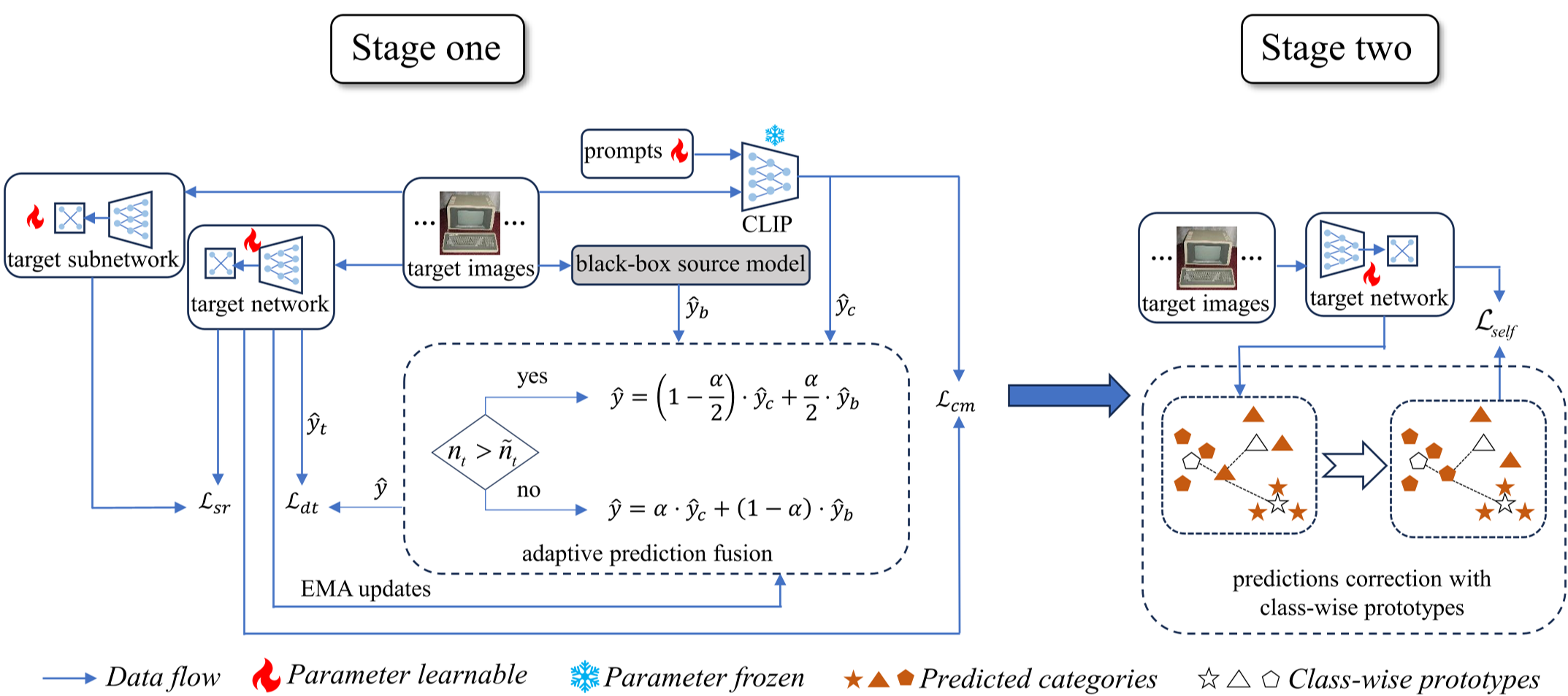 Figure 1: The DDSR framework utilizes a two-teacher setup (Black-box + CLIP) and a subnetwork to regularize the target model training.
Experiments: Breaking the SOTA
The authors tested DDSR against three categories of methods across Office-31, Office-Home, and VisDA-17.
- Performance: On Office-Home, DDSR achieved 83.2%, beating the previous best BBDA method (AEM) by a significant margin.
- Visualization: t-SNE plots show that while the original source model sees a "mess" of overlapping clusters, DDSR-trained features are tightly grouped and well-separated.
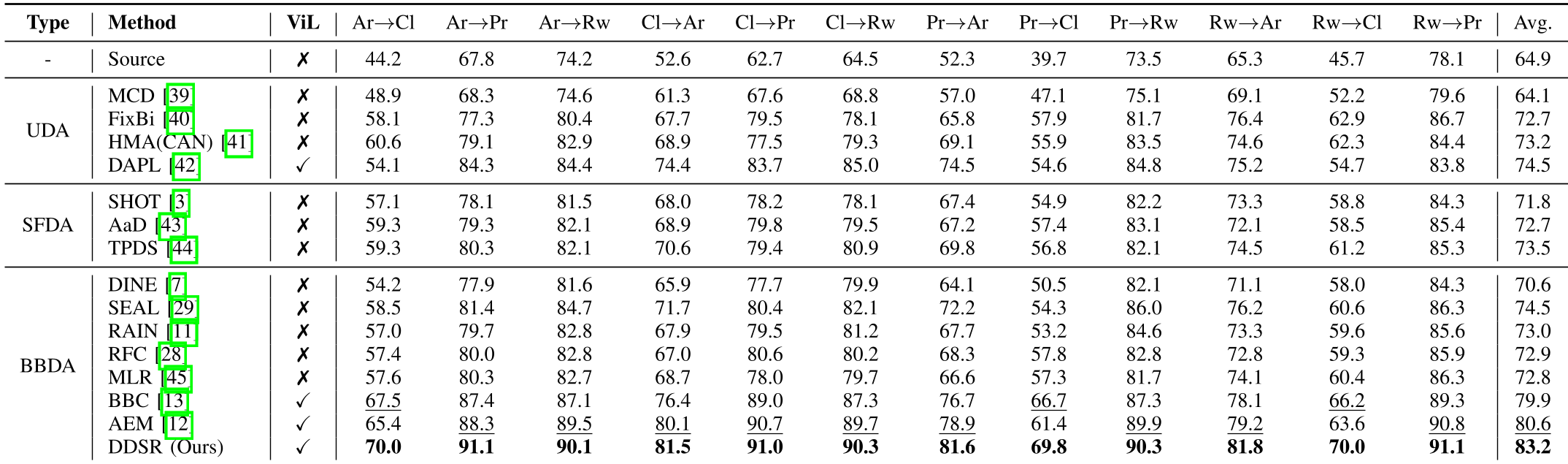 Table 1: Competitive results show DDSR outperforming even some methods that have access to source model parameters (SFDA).
Why does it work? (Ablation Insights)
The ablation study revealed that Information Maximization () and Subnetwork Rectification () are critical. Without the subnetwork rectification, the model's ability to handle domain shift drops, confirming that just "distilling" isn't enough—you need to supervise the way the network learns.
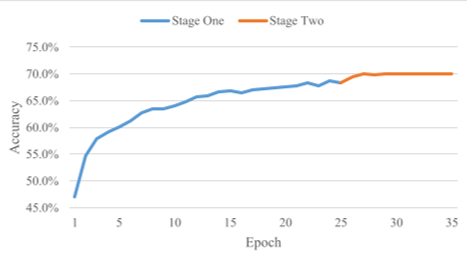 Figure 2: Feature clusters before and after DDSR. Note the improved class separation in (b) and (d).
Critical Analysis & Conclusion
Takeaway: BBDA is no longer a "second-class" adaptation setting. By intelligently fusing generic semantic models (CLIP) with specific black-box outputs, we can achieve performance that rivals "white-box" methods.
Limitations: The paper notes that it does not yet handle Category Shift (where source and target domains have different sets of classes). This remains the "final frontier" for black-box adaptation.
Future Outlook: As more AI is served via restricted APIs (like GPT-4-vision or specialized medical APIs), methods like DDSR will become the standard for local adaptation without compromising proprietary source intelligence.