
[CVPR 2026] DualCoT-VLA: Breaking the Latency Barrier in Robotic Reasoning with Parallel Visual-Linguistic CoT
DualCoT-VLA: Visual-Linguistic Chain of Thought via Parallel Reasoning for Vision-Language-Action Models
DualCoT-VLA is a novel Vision-Language-Action model that introduces a dual-stream, parallel Chain-of-Thought (CoT) mechanism to enhance robotic manipulation. It integrates visual CoT for 3D spatial perception and linguistic CoT for high-level task planning, achieving SOTA results on LIBERO and RoboCasa benchmarks.
TL;DR
DualCoT-VLA is a breakthrough in Vision-Language-Action (VLA) models that allows robots to "think" about both logic and space simultaneously without the heavy performance hit of traditional reasoning. By replacing slow, step-by-step token generation with a parallel latent reasoning mechanism, it achieves SOTA performance on complex benchmarks (LIBERO, RoboCasa) while being 50x faster than previous autoregressive reasoning models.
Problem & Motivation: The "Thinking" Bottleneck
To perform complex tasks—like placing a bowl on a plate in a moving environment—a robot needs two things: High-level logic (planning the sequence of moves) and Low-level perception (knowing exactly where the bowl is in 3D space).
Previous "Chain-of-Thought" (CoT) models for robotics tried to solve this but hit two walls:
- Modality Isolation: They usually used only text (good for logic, bad for space) or only vision (good for space, bad for long-term goals).
- The Autoregressive Tax: Generating reasoning tokens one-by-one is painfully slow. If a model takes 3 seconds to "think" before each move, the robot becomes stuttery and prone to "cascading errors" where one wrong word ruins the whole action.
Methodology: Thinking in Parallel
DualCoT-VLA introduces a Visual-Linguistic CoT paradigm that happens entirely in the "hidden" (latent) layers of the model.
1. Unified Architecture
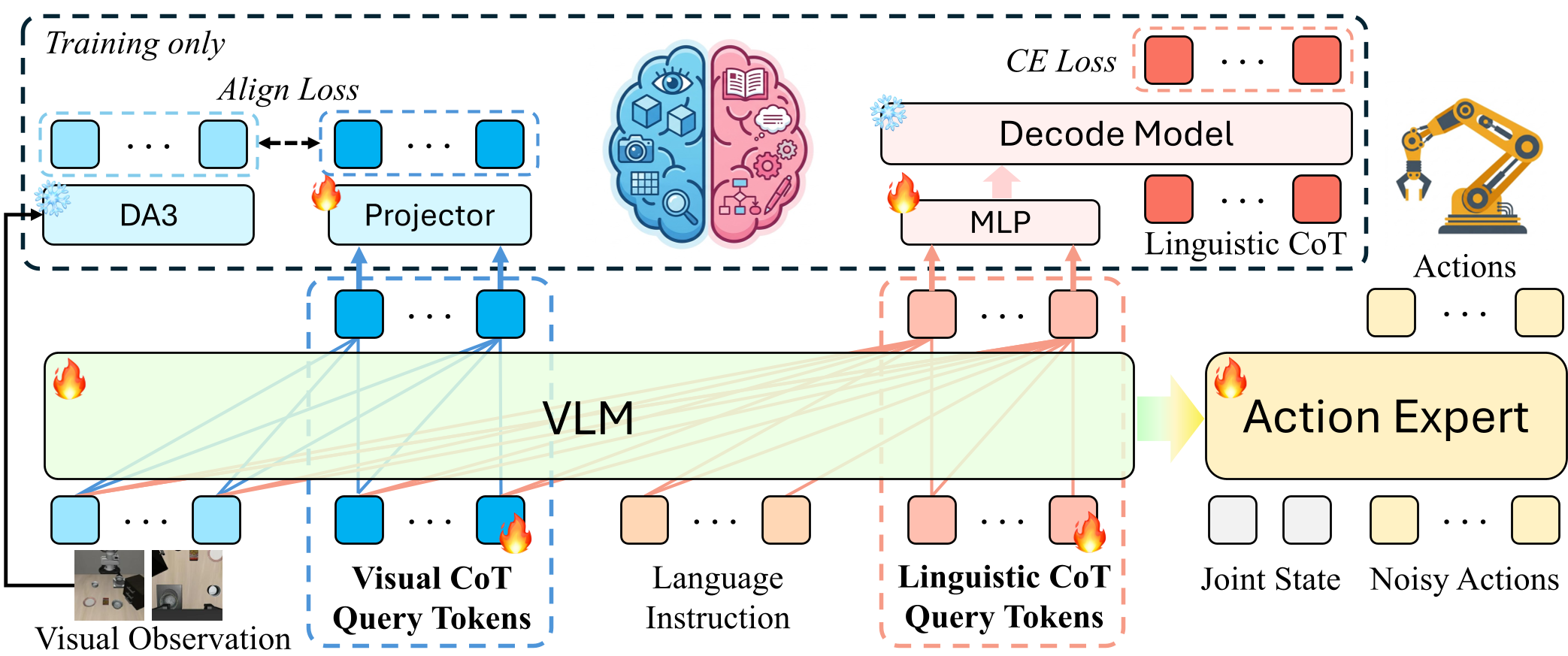
The model uses a VLM backbone (Qwen3-VL-4B) and injects two sets of "Query Tokens": Visual Queries and Linguistic Queries. These tokens are processed in a single forward pass alongside the image and instruction.
2. Dual-Stream Supervision (The Teachers)
To make these hidden tokens actually "mean" something, the authors use two frozen "teacher" models during training:
- Visual Stream: The hidden states of visual queries are aligned with Depth Anything 3 (DA3). This forces the model to encode dense 3D spatial information into its latent space.
- Linguistic Stream: The linguistic queries are used as prefixes for a lightweight LLM (Qwen3-0.6B). The VLM must condense complex step-by-step plans into these few tokens so the LLM can "reconstruct" the plan.
3. Parallel Execution
Unlike models that must output text like "I will first grab the handle...", DualCoT-VLA keeps these "thoughts" as continuous vectors. This allows the model to predict actions via a Flow-Matching DiT head at high frequencies.
Experiments & Results: Speed Meets Accuracy
The performance jump is most evident in two areas:
SOTA Performance
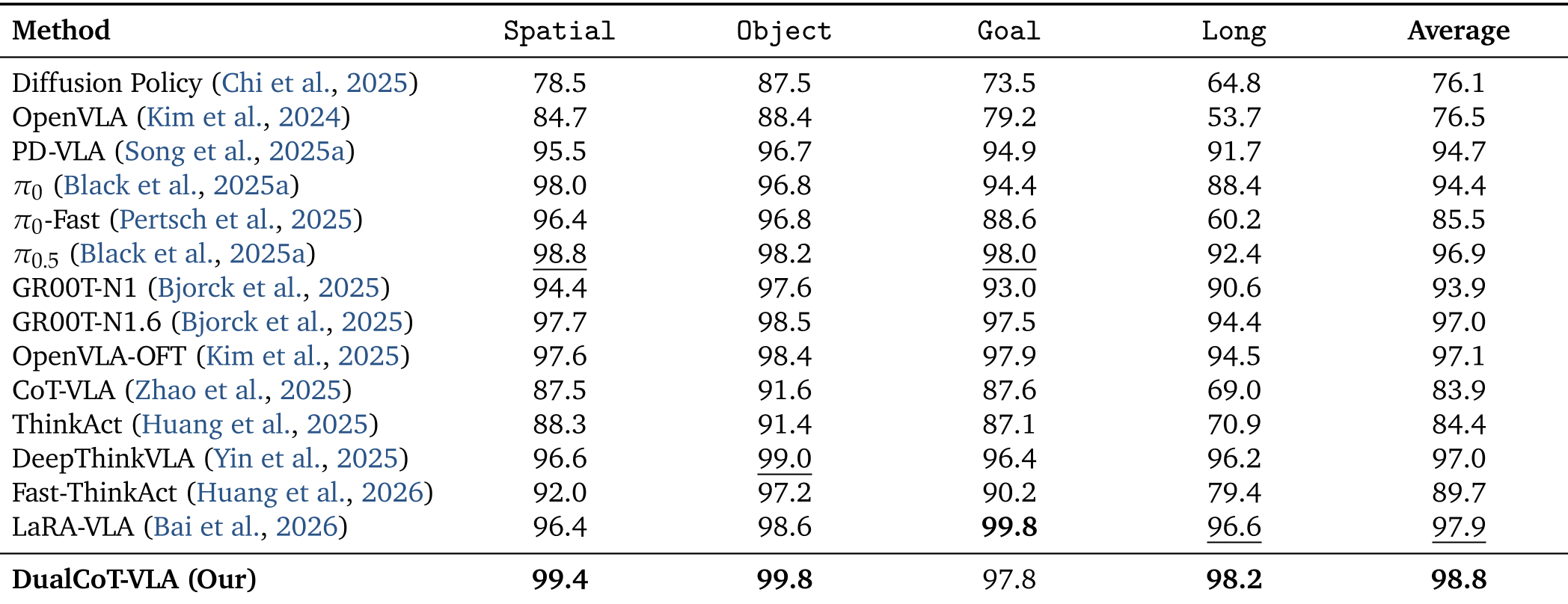
On the LIBERO-Long suite (tasks requiring long-term memory), DualCoT-VLA reached a 98.2% success rate, outperforming specialized models like and OpenVLA. On RoboCasa, which involves 29-DoF humanoid hands, the model's spatial perception allowed it to dominate tasks like "Cuttingboard to Pan."
Efficiency: The 4ms Difference
The table below shows the revolutionary speed of this approach. While standard Autoregressive (AR) CoT models take over 3 seconds to process a single frame, DualCoT-VLA adds only 4.4ms of overhead compared to a model that doesn't "think" at all.
| Metric | Non-CoT | AR CoT (Old) | DualCoT-VLA (Our) |
|---|---|---|---|
| VLM Forward | 53.7 ms | 3156.0 ms | 58.1 ms |
| Total Time | 76.2 ms | 3178.5 ms | 83.2 ms |
Critical Insight: Why This Matters
The core achievement of DualCoT-VLA is proving that explicit output is the enemy of real-time robotics. By supervising the latent space rather than the text output, the authors have found a way to give robots the "wisdom" of a large language model and the "eyes" of a depth-perception model, all without the lag.
Limitations & Future Work
While DualCoT-VLA is highly efficient, it still relies on high-quality CoT annotations for training the linguistic stream. Future research might look into Self-Generated CoT where the robot learns to optimize its own latent reasoning tokens based on task success rather than human-provided text.
Conclusion
DualCoT-VLA represents a shift toward "Implicit Intelligence" in robotics. It suggests that the future of generalist robots lies not in models that talk to us about what they are doing, but in models that internalize that logic to act with precision and speed.