
[ECCV 2024] DynFlowDrive: Bridging Planning and Physics with Flow-Based Dynamic World Modeling
DynFlowDrive: Flow-Based Dynamic World Modeling for Autonomous Driving
DynFlowDrive is a latent world model for autonomous driving that uses a flow-based formulation (Rectified Flow) to explicitly model the progressive transition of world states. It achieves SOTA performance on the NavSim benchmark with 88.7% PDMS and significantly reduces L2 displacement errors on nuScenes by modeling trajectory-conditioned dynamics.
TL;DR
DynFlowDrive introduces a paradigm shift in autonomous driving world models by replacing static, one-step latent regression with a continuous flow-based dynamical system. By leveraging the Rectified Flow formulation, the model learns the "velocity" of scene transitions conditioned on driving actions. It achieves state-of-the-art (SOTA) results on nuScenes and NavSim benchmarks, proving that modeling the process of evolution is just as important as predicting the endpoint.
Problem & Motivation: The Gap in Latent Foresight
In end-to-end autonomous driving, a world model is the "imagination" of the car. Most existing latent world models act as simple functions: . This is one-step regression.
The authors argue that this is insufficient for safety-critical reasoning. Consider two scenarios: a car slowing down smoothly vs. a car braking abruptly. Both might end up at the same coordinate, but the internal dynamics and safety implications are worlds apart. Static models ignore the transition path, making them "blind" to the physical plausibility and stability of the driving behavior.
Methodology: The Core of DynFlowDrive
1. Flow-based Latent Dynamics
Instead of jumping to the next state, DynFlowDrive models the transition as a velocity field. Using the Rectified Flow formulation, it defines an interpolation between the current state (perturbed with noise) and the future state.
The core objective is to learn a transformer-based flow model that predicts the direction and speed of state changes in the latent space, conditioned on a specific trajectory .
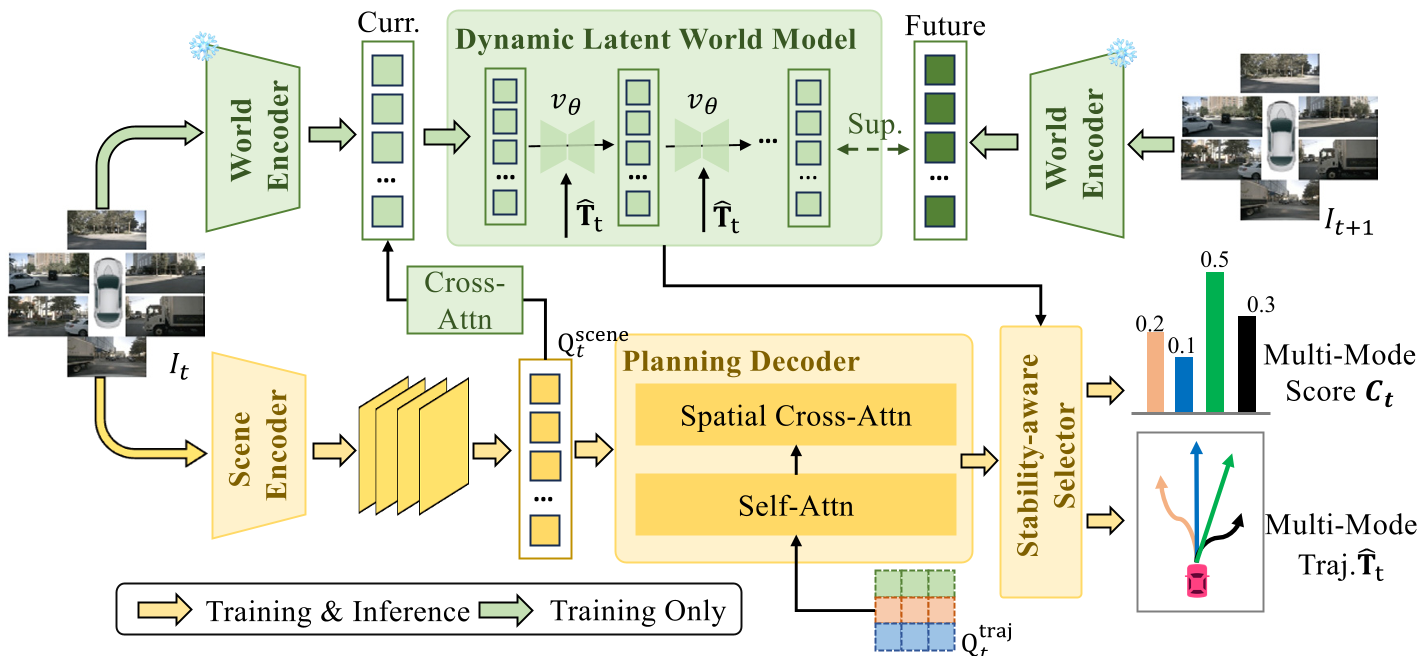
2. Stability-aware Trajectory Selection
Since the model now produces a sequence of velocities for any given action, we can measure the consistency of the plan. If the predicted latent velocities for a trajectory vary wildly in direction, the resulting world evolution is likely "unstable" or physically nonsensical.
The authors derive a Stability Measure () by calculating the average angular deviation between consecutive velocity vectors. This metric is combined with geometric accuracy to select the safest and most realistic trajectory among multiple candidates.
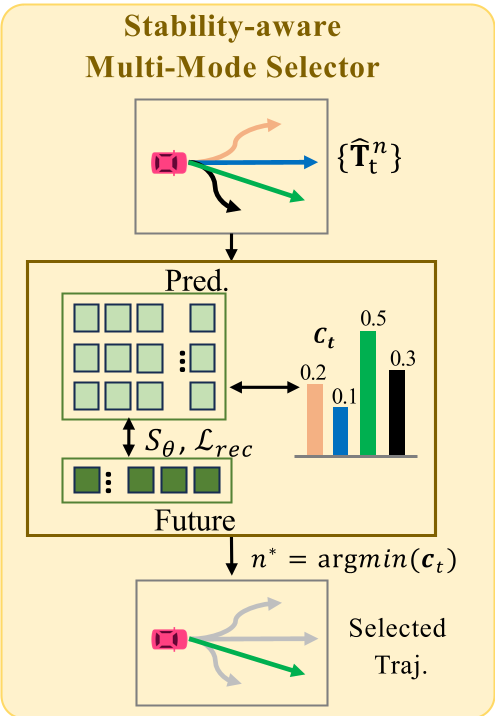
Experiments & Results: SOTA Efficiency
DynFlowDrive was tested on the nuScenes (open-loop) and NavSim (closed-loop) benchmarks.
- Accuracy: On nuScenes, it outperformed previous latent models (LAW, SSR) across all time horizons (1s, 2s, 3s). It reduced the average L2 error to 0.31m and cut collision rates significantly.
- Closed-loop Performance: On NavSim, it achieved a PDM Score of 88.7, setting a new high for world-model-based approaches.
- Efficiency Bonus: Notably, the flow model is used primarily during training to supervise the trajectory scoring head. During inference, the model maintains high FPS (approx. 13.6-13.8) since it only needs to execute the scoring head, not the full flow integration.

Critical Analysis & Conclusion
Takeaway
The genius of DynFlowDrive lies in borrowing Rectified Flow—usually a tool for image synthesis—and repurposing it to regularize the latent temporal logic of a driving agent. By forcing the model to understand the velocity of scene changes, the authors have implicitly injected "physics" into a neural network planner.
Limitations
- Feature Dependency: The performance relies heavily on the pretrained VAE encoder. If the foundation model's features don't capture specific nuances (like small debris on a road), the flow model will be equally blind to them.
- Integration Steps: Ablation shows that 5 steps are optimal, but more steps (10) can actually degrade performance due to numerical error accumulation. This suggests the "straightness" of the flow still has room for improvement.
Future Outlook
The move toward flow-based dynamics is a strong signal for the industry. Future iterations might integrate Vision-Language Models (VLMs) to explain why a certain velocity field is unstable (e.g., "The latent instability is due to a pedestrian's unpredictable movement"), combining high-level reasoning with low-level physical dynamics.