
EA-WM: Closing the Loop Between Kinematics and Pixels via Structured Action Fields
EA-WM: Event-Aware Generative World Model with Structured Kinematic-to-Visual Action Fields
EA-WM is an event-aware generative world model for robotics that introduces Structured Kinematic-to-Visual Action Fields (KVAFs) to align low-dimensional control signals with high-dimensional video synthesis. Built on the Wan2.2 diffusion backbone, it achieves SOTA performance on the WorldArena benchmark, significantly improving physical consistency and geometric accuracy in robot video rollouts.
TL;DR
EA-WM (Event-Aware Generative World Model) tackles the "hallucination" problem in robotic video generation. By projecting robot joint states and actions into Structured Kinematic-to-Visual Action Fields (KVAFs)—essentially drawing the robot’s skeleton and intent directly onto the camera’s perspective—it allows a Diffusion Transformer (DiT) to "see" exactly where the robot should be. Combined with a novel Event-Aware Fusion mechanism, it sets a new state-of-the-art on the WorldArena benchmark for physical adherence and 3D accuracy.
The Problem: The "Domain Gap" in World Models
In the quest to build "World Simulators" for robots, researchers often feed low-dimensional action vectors (like joint angles) into high-dimensional video generators. This creates a massive domain misalignment. The model is forced to implicitly learn the complex physics of how a list of numbers translates into a 3D arm moving in a 2D pixel space.
The result? Generated videos where the robot's arm detaches from its body, grippers pass through objects, or the task progress bears no resemblance to the commanded action.
Methodology: Action Fields as the Bridge
EA-WM's core insight is remarkably intuitive: Speak the language of the generator. Instead of feeding the model abstract tokens, the authors transform the action sequence into the image domain.
1. Structured Kinematic-to-Visual Action Fields (KVAFs)
Using forward kinematics and camera projection, the model renders:
- Depth-aware skeletons: Color-coded by distance to preserve 3D structure.
- End-effector heatmaps: Indicating the focus of the manipulation.
- Pose axes: Showing the orientation (roll, pitch, yaw) of the gripper.
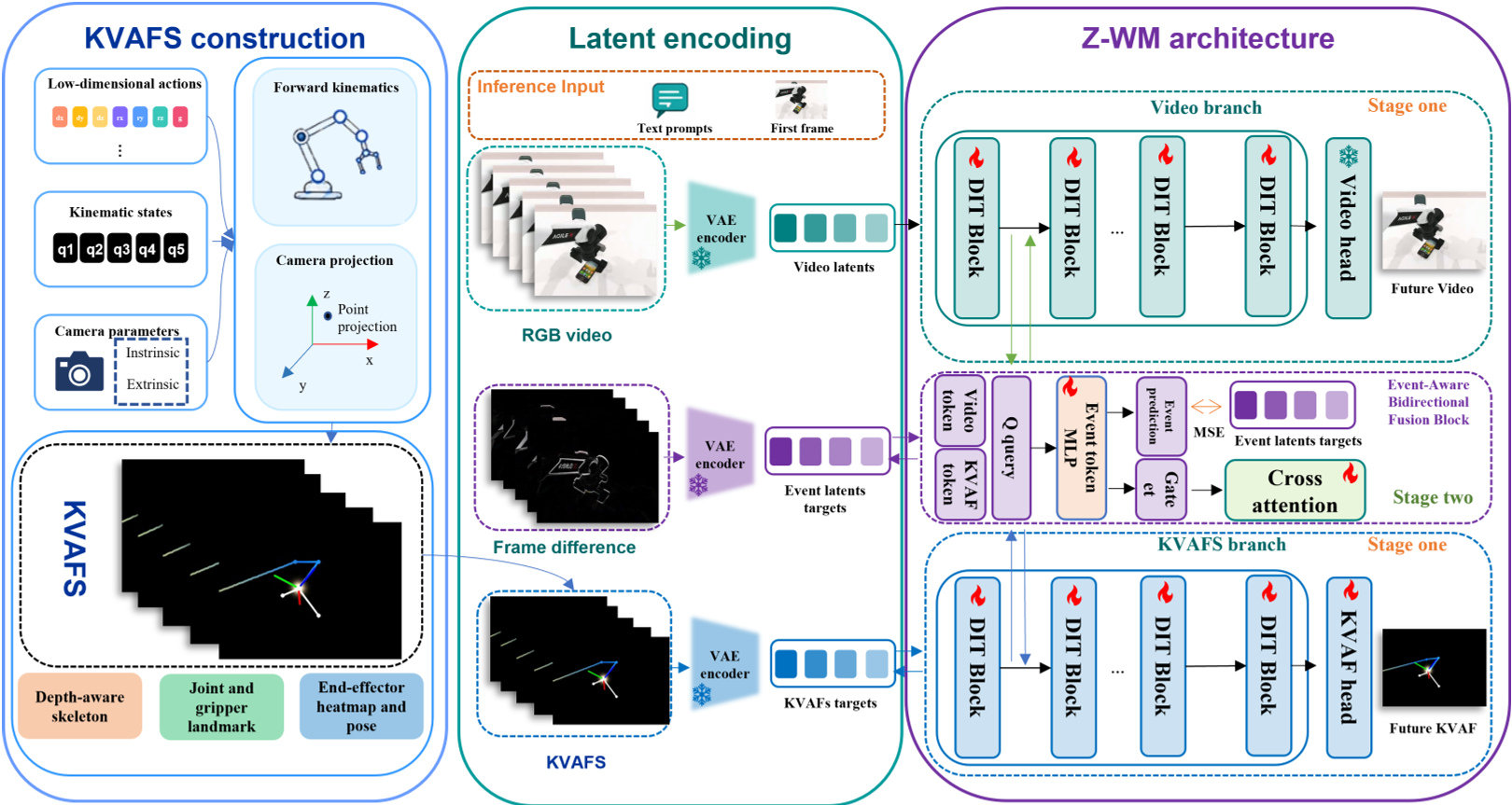 Figure 1: The EA-WM pipeline, showing how kinematic states are lifted into KVAFs and processed via dual-stream DiT blocks.
2. Event-Aware Bidirectional Fusion
To ensure the model doesn't just draw a pretty robot but actually understands interaction, the authors introduced Event-Difference Latent Supervision (EDLS).
- The Logic: It calculates the pixel difference between consecutive frames (the "event").
- The Supervision: It forces the model to predict these areas of change. This focuses the "attention" of the Transformer on the exact moment the gripper touches a block or an object starts to move.
Experimental Performance: SOTA Results
EA-WM was evaluated on the rigorous WorldArena benchmark, which tests Physics Adherence, 3D Accuracy, and Controllability.
| Metric | CogVideoX (Baseline) | EA-WM (Ours) | Improvement |
|---|---|---|---|
| Interaction Quality | 0.594 | 0.682 | +14.8% |
| Trajectory Accuracy | 0.353 | 0.430 | +21.8% |
| Depth Accuracy | 0.910 | 0.959 | +5.4% |
| P3CScore (Overall) | 71.08 | 76.60 | +5.52 pts |
The qualitative results are even more striking. In tasks like "ranking block size," standard models often lose the identity of the objects or fail to follow the trajectory. EA-WM maintains object permanence and follows the action field with high fidelity.
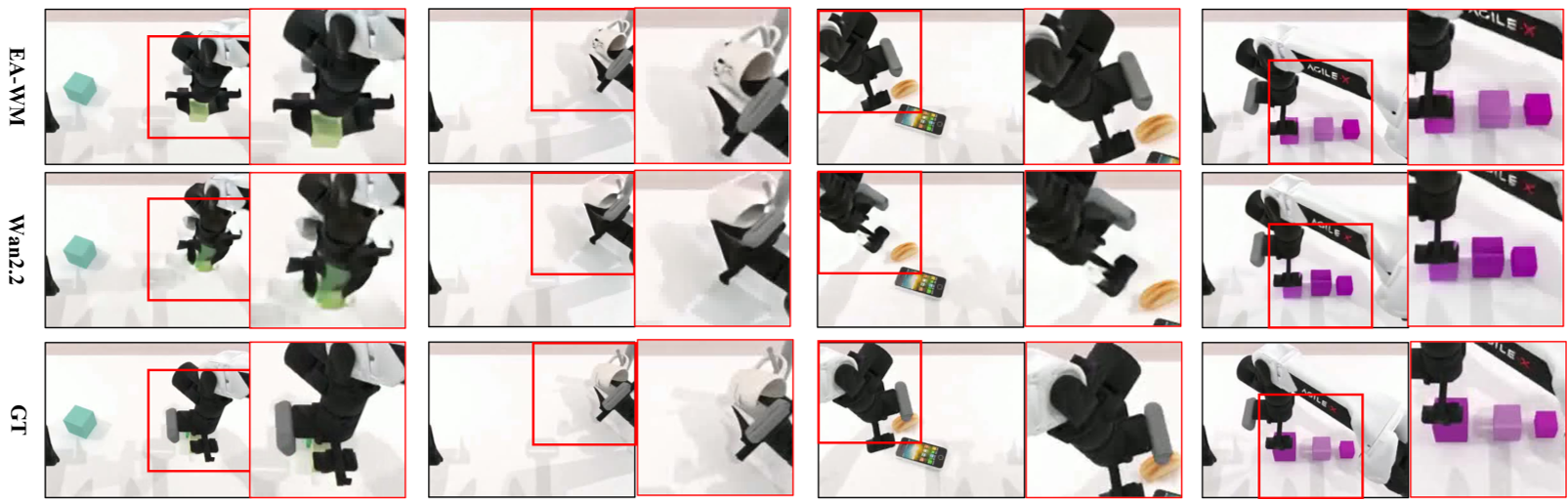 Figure 2: Visual comparison. Notice how EA-WM (bottom row) maintains precise gripper-to-object contact compared to the Wan2.2 baseline.
Critical Insight & Conclusion
The success of EA-WM suggests that the bottleneck in current robotic world models isn't necessarily the capacity of the diffusion model, but the interface between control and perception. By providing "geometric scaffolding" (KVAFs), we relieve the model of the burden of learning kinematics from scratch.
Limitations: The reliance on perfect kinematics and camera calibration means that "in-the-wild" performance might degrade if the robot's sensors are noisy. Future iterations will likely need to incorporate object-centric visual fields to handle complex, non-rigid objects better.
Final Takeaway: EA-WM turns world modeling from a guessing game into a guided synthesis task, marking a significant step toward simulators that can actually be used to train and evaluate future robot brains.