
Mechanistic Estimation: Surpassing Monte Carlo in Wide Random MLPs
Estimating the expected output of wide random MLPs more efficiently than sampling
The paper introduces a "sample-free" mechanistic estimation framework for calculating the expected output of wide random Multi-Layer Perceptrons (MLPs). By utilizing cumulant propagation and Hermite expansions, the method achieves target mean squared error (MSE) more efficiently than standard Monte Carlo sampling, particularly for rare event estimation and model training.
TL;DR
Researchers from the Alignment Research Center have challenged the status quo of Monte Carlo sampling. By treating neural networks as formal mathematical objects rather than black boxes, they developed Cumulant Propagation—an analytical method that estimates the expected output of an MLP significantly faster than sampling, especially for high-width networks and rare "tail" events.
Context: Why Sampling is the "Default" (But Suboptimal)
In machine learning, we almost always approximate an expectation by taking the empirical average of samples. While intuitive, this is the numerical equivalent of using a Riemann sum for an integral that might have a closed-form solution. In high-dimensional spaces, sampling requires an immense budget to capture the "long tails" of a distribution—the rare events that often define catastrophic failures in AI safety.
The Core Insight: Distributions as Tensors
The authors observe that for wide, random MLPs, the distribution of activations at each layer remains "well-behaved" (nearly Gaussian). Instead of passing individual points through the network, they propagate the cumulants (mean, variance, skewness, etc.) of the distribution itself.
The Methodology
The algorithm is built on two pillars:
- Linear Step (Symmetric Contraction): Propagating cumulants through weight matrices using multilinearity.
- Non-linear Step (Hermite Expansion): Handling activation functions like ReLU by projecting them onto a basis of Hermite polynomials. This allows the method to calculate how the non-linearity "skews" the Gaussian distribution of the previous layer.
Note: The paper utilizes a Diagram Summation Formula (Theorem A.2) to map input cumulants to output cumulants via combinatorial objects called "diagrams."
Experimental Results: Breaking the Barrier
The mathematical "magic" happens in the large-width limit. While Monte Carlo's cost scales with the square of the width (), the Factorized version of this analytical estimator scales linearly ().
Key Metrics:
- Rare Event Estimation: For events with a probability of , the mechanistic estimator maintained high accuracy while Monte Carlo sampling produced zero-result guesses.
- Efficiency: In a 4-layer ReLU MLP (width 256), the method was up to 100 times more FLOP-efficient than sampling.
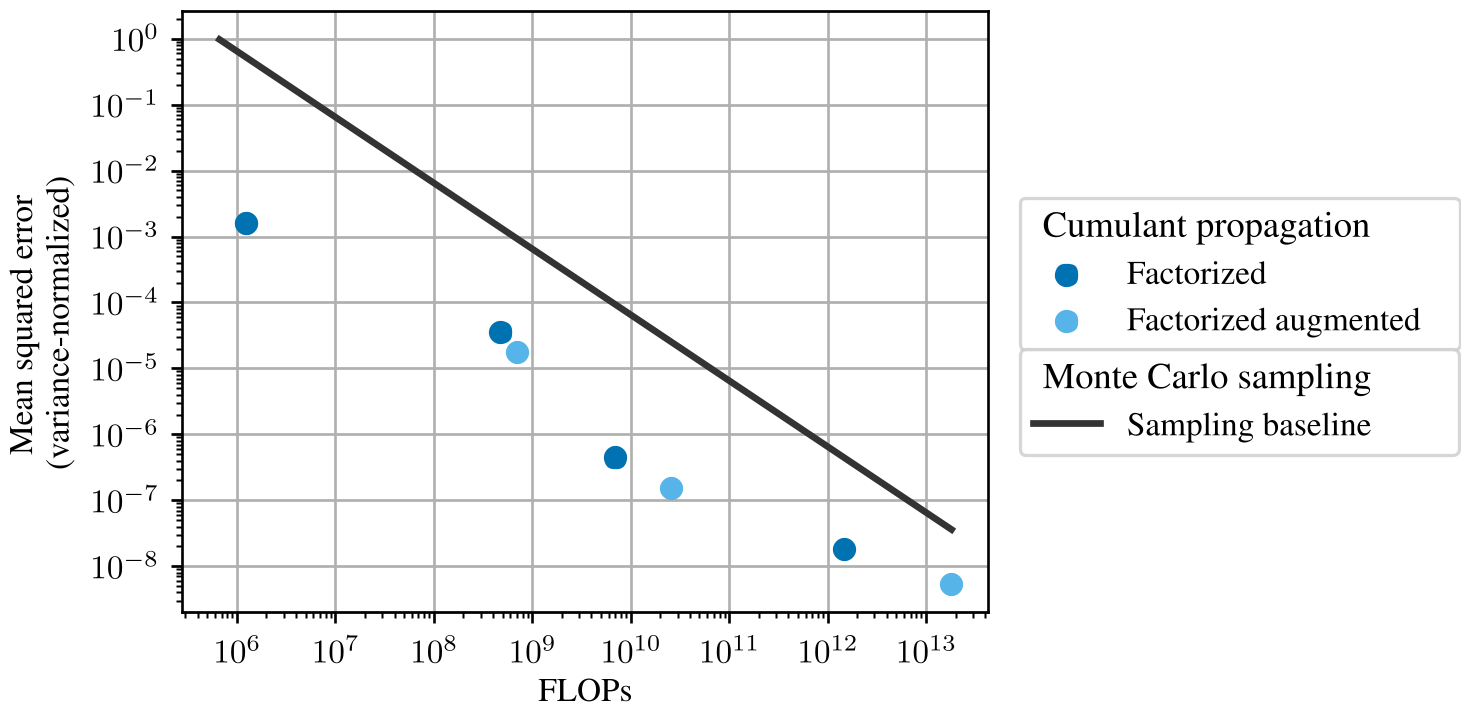 Figure 1: The analytical estimator (lower lines) consistently stays below the Monte Carlo baseline (top line) across a vast range of computational budgets.
Mechanistic Training and Distillation
The paper doesn't just stop at estimation; it introduces Mechanistic Distillation. Because the cumulant estimates are differentiable, you can perform gradient descent directly on the analytical estimate of the loss. This opens the door to training models on "imaginary" distributions or rare edge cases that a sampler might never see during traditional training.
Critical Perspective & Future Work
While a breakthrough, the method currently has constraints:
- Initialization Bias: It works best for networks at initialization (random weights). Partially-trained networks have "structure" that breaks some Gaussian assumptions.
- Complexity: Implementing symmetric tensor contractions efficiently in modern frameworks like PyTorch remains a software engineering challenge (as shown by the wall-clock time gap).
Conclusion
The transition from "sampling" to "reasoning" about network outputs represents a paradigm shift. If we can understand how a network's mechanism produces its final output, we can build AI that is not just statistically likely to be safe, but analytically proven to avoid tail-end catastrophes.
Reference: Wu et al. (2025). Estimating the expected output of wide random MLPs more efficiently than sampling.