
Token Superposition: Slashing Pre-training Costs by 2.5x Without Changing Your Architecture
Efficient Pre-Training with Token Superposition
The paper introduces Token-Superposition Training (TST), a two-phase pre-training method that increases data throughput by combining contiguous tokens into "bags." By using multi-hot cross-entropy (MCE) loss during an initial efficient phase followed by a standard recovery phase, TST achieves state-of-the-art efficiency, including a 2.5x reduction in training time for a 10B MoE model.
TL;DR
Researchers from Nous Research have unveiled Token-Superposition Training (TST), a simple yet transformative modification to the LLM pre-training pipeline. By "superposing" multiple tokens into a single representation during the initial phase of training, they've demonstrated a 2.5x reduction in total pre-training time for a 10B parameter model while achieving superior downstream performance. Best of all? It requires zero changes to the model architecture used at inference.
Background: The Compute-Bound Wall
The current LLM paradigm is defined by "overtraining"—feeding models trillions of tokens far beyond the Chinchilla-optimal point to extract every bit of performance. However, this creates a massive compute bottleneck. While methods like Mixture-of-Experts (MoE) or Multi-Token Prediction (MTP) exist, they often add architectural complexity or fail to address the core problem: how many raw data tokens can we process per FLOP?
The Insight: Information Density over Precision
The authors' central intuition is that a model doesn't need to learn the exact, granular sequence of every token from step one. Instead, it can first learn the "coarse statistical structure" of language.
By treating a sequence as a series of "bags of tokens," the model sees the same amount of information with significantly fewer computational steps. This is mathematically realized through two mechanisms:
- Input Superposition: Averaging embeddings of tokens into one "s-token."
- Output Superposition: Using a Multi-hot Cross-Entropy (MCE) Loss to predict the next bag of tokens, rather than just the next single token.
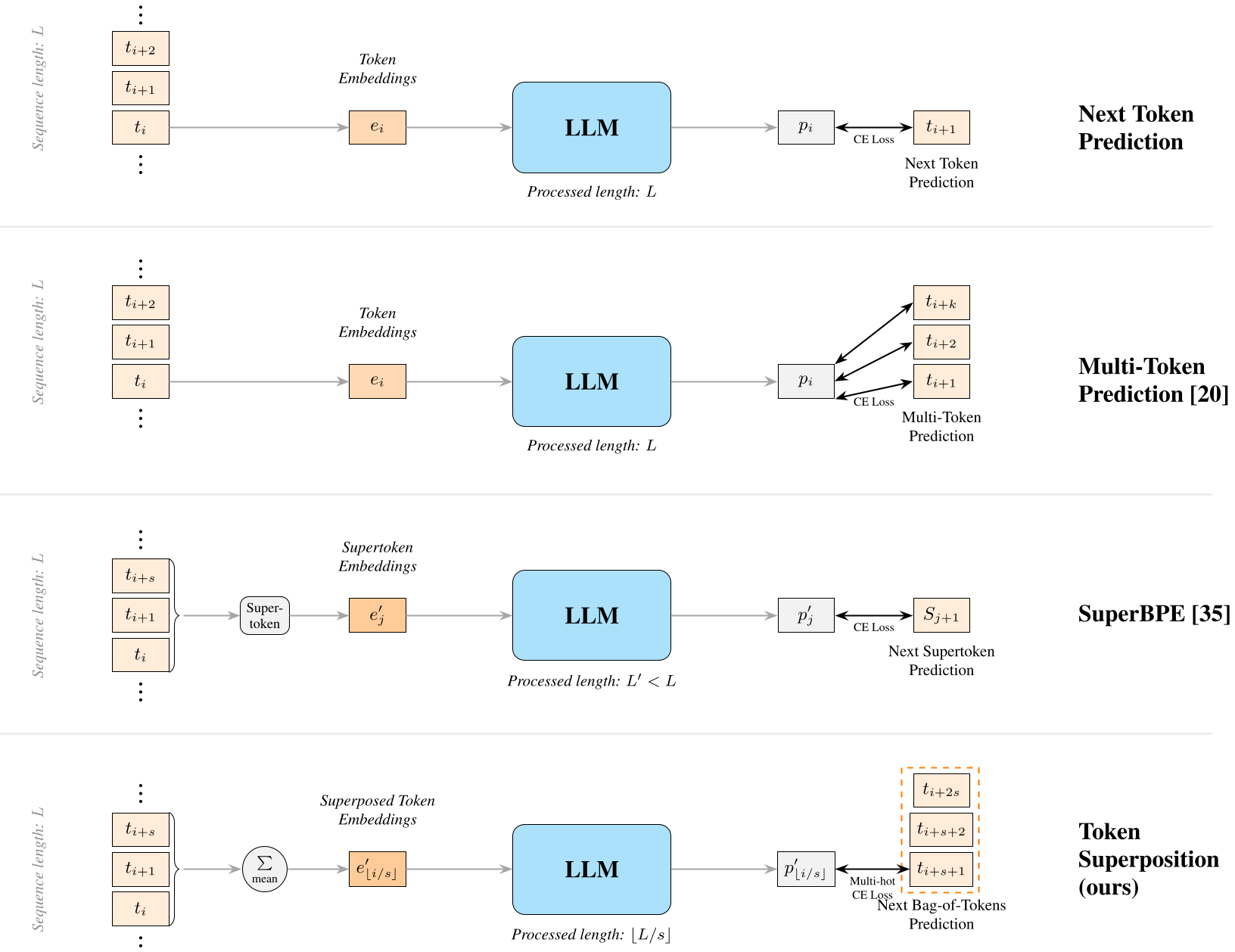 Figure 1: TST vs. Standard Training. Note how TST compresses the sequence length internally, allowing for higher data throughput.
Two-Phase Strategy: Superposition & Recovery
A model trained solely on TST would produce "nonsensical" outputs because it loses the specific order of tokens within a bag. To solve this, the authors utilize a two-phase schedule:
- Phase 1 (TST): High-speed ingestion of data using coarse-grained bags.
- Phase 2 (Recovery): Reverting to standard next-token prediction to "refine" the model's causal understanding and sampling capability.
Crucially, because the input embeddings and output heads are shared across both phases, the model experiences no "representational mismatch," allowing it to recover and surpass baseline performance almost immediately after switching.
Hard Evidence: 2.5x Speedup at Scale
The experimental results are striking. Across various model sizes (270M, 600M, 3B, and 10B), TST models reached lower perplexity and higher downstream benchmark scores (ARC, HellaSwag, MMLU) than equal-compute baselines.
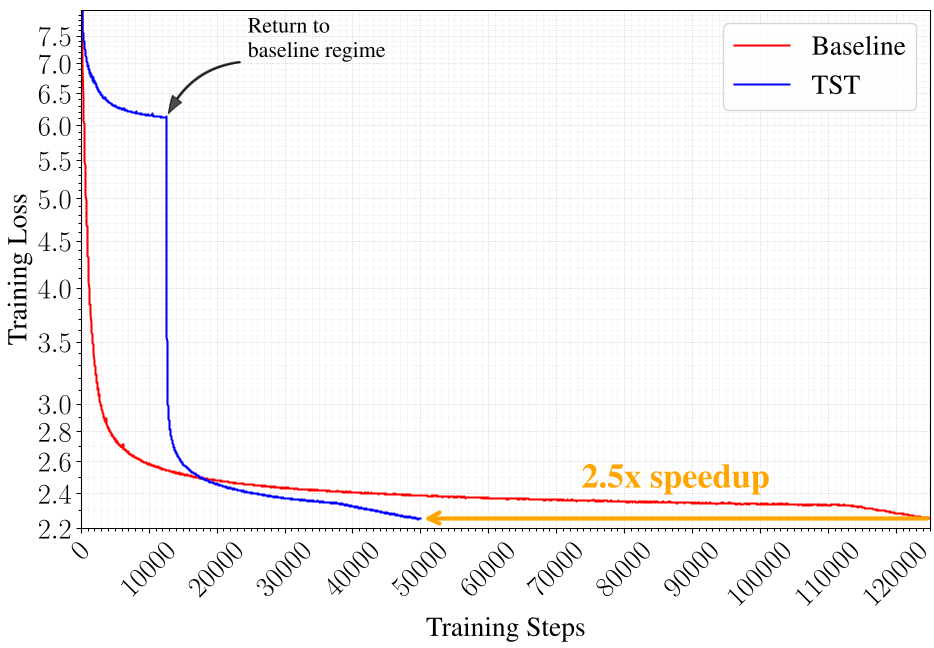 Figure 2: At the 10B scale, TST (green) reaches the baseline's final loss in less than half the steps.
In the 10B parameter Mixture-of-Experts (MoE) validation run:
- Data Throughput: The TST model saw 2 trillion tokens in the time the baseline saw 1.05 trillion.
- Benchmarks: TST showed gains across the board, including a nearly 2-point jump in MMLU (39.0 vs 37.4).
Why Does It Work?
The authors suggest two primary reasons:
- Pre-pre-training: The first phase acts as a simplified curriculum, exposing the model to local topic and co-occurrence statistics before it has to worry about exact syntax.
- Implicit Regularization: Averaging in the embedding space may force the model to learn more robust, linearly separable representations.
Critical Perspective & Future Work
TST effectively trades more data for better efficiency. While it assumes we are "compute-bound" (plenty of data, not enough GPUs), the world may eventually become "data-bound." However, the authors note that Output-only Superposition still provides gains without increasing data consumption.
Looking forward, combining TST with Multi-Token Prediction (MTP) or applying it to Long-Context data (where sequence compression is vital) could yield even more dramatic results.
Conclusion
Token-Superposition Training is a rare find in modern AI research: a method that is conceptually simple, easy to implement in existing frameworks (like PyTorch FSDP), and delivers massive efficiency gains without the "tax" of architectural changes. For labs looking to train larger models with fewer resources, TST might just be the new standard entry point for pre-training.