
[Qualcomm AI] Reasoning on the Edge: Practical Blueprints for Efficient Mobile LLMs
Efficient Reasoning on the Edge
This paper introduces an end-to-end framework to enable complex LLM reasoning on resource-constrained mobile devices using the Qwen2.5 series. The core approach utilizes modular LoRA adapters, budget-forced reinforcement learning (RL), and parallel test-time scaling to achieve high reasoning accuracy with reduced token overhead.
TL;DR
Researchers have developed an end-to-end framework to bring powerful "Chain-of-Thought" (CoT) reasoning to mobile devices. By combining modular LoRA adapters, a dynamic switcher, and budget-forced RL, they reduced reasoning traces by 2.4x and achieved performance comparable to massive distilled models like DeepSeek-R1-7B, all while running within the strict 4-bit memory constraints of edge hardware.
Background: The Price of "Thinking"
Reasoning models have revolutionized AI by "thinking before they speak." However, this process is incredibly "wordy." For mobile devices, every extra token generated translates directly to drained battery, increased heat, and annoying latency. Prior attempts to squeeze these models onto phones either sacrificed accuracy through heavy quantization or suffered from "epistemic hesitation"—where the model spends thousands of tokens second-guessing itself.
The Core Architecture: Hybrid Reasoning
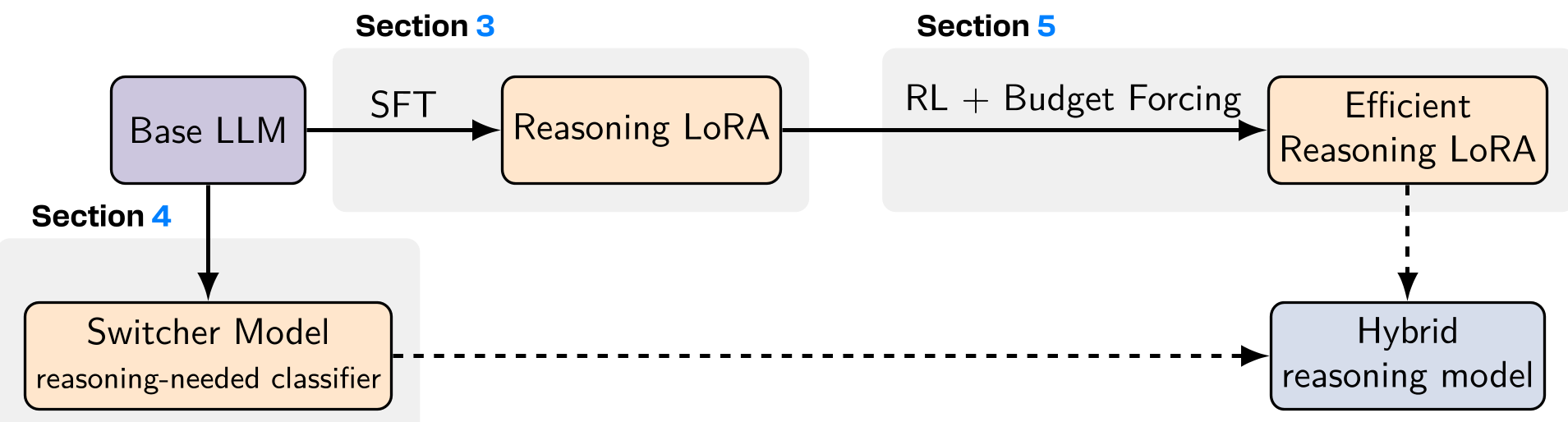
The researchers didn't just shrink a big model; they built a modular system. It starts with a compact base LLM (like Qwen2.5-7B) and adds "Reasoning Mode" via LoRA adapters.
1. The Switcher: Stop Overthinking
Not every prompt needs a 1,000-token internal monologue. The Switcher module acts as a traffic controller. It analyzes the hidden states of the prompt and decides: Is this a simple chat (route to base model) or a math/coding problem (activate LoRA)?
- Innovation: They used "Masked LoRA training" so the system doesn't have to re-read the prompt when switching, saving precious milliseconds.
2. Budget Forcing: Logic Without the Loops
To stop models from "looping" (re-calculating the same answer three times), the team used Reinforcement Learning (GRPO) with a multiplicative soft-barrier penalty. Unlike previous methods that just cut the model off, this encourages the model to be concise naturally.
- The Result: Reasoning traces shrunk by 2.4x on average without losing the "logical backbone."
Experimental Evidence: Success on Critical Benchmarks
The framework was tested against a battery of reasoning benchmarks (AIME, MATH500, GPQA).

The 7B model using LoRA rank 128 (updating only 4.24% of parameters) nearly matched the performance of full dense distillation. Even more impressively, their Parallel Test-Time Scaling—running multiple reasoning paths at once—boosted accuracy by up to 10% because the mobile NPU could handle the parallel compute during the usually slow memory-bound decoding phase.
Quantization: The Last Mile
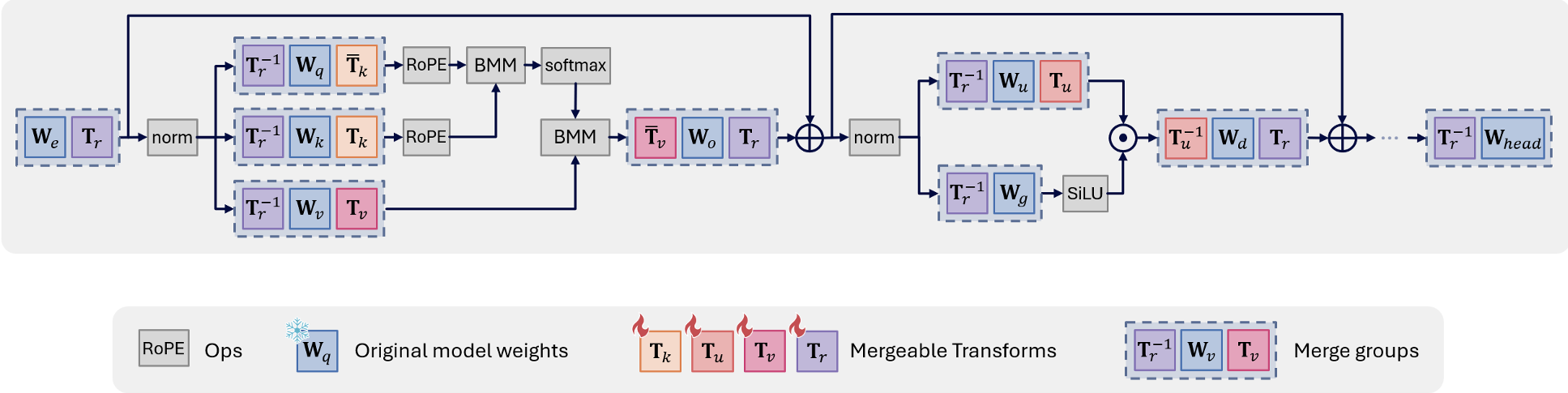
For on-device deployment, 4-bit quantization is a must. The team used FPTQuant (Function-Preserving Transformations) to smooth out outliers in the model's activations. By training the reasoning adapters on top of the already-quantized base model (Quantization-Aware Modular Reasoning), they kept accuracy within 2% of the high-precision versions.
Summary & Future Outlook
This work proves that "O1-style" reasoning doesn't have to be a cloud-only luxury. By co-designing the hardware-aware quantization with specialized RL training, mobile devices can now act as competent reasoning agents.
Future Directions:
- Semantic-aware budgets: Penalizing "filler" words (e.g., "Let me see...") more than actual logical steps.
- Continuous Latent Reasoning: Moving reasoning entirely into the model's internal "thought space" to bypass token generation altogether.
Deploying these models today is no longer a question of "if," but "how efficiently"—and this paper provides the map.