
[CVPR 2025] EgoTL: Why Your AI Assistant Needs to "Think Aloud" to Master Long-Horizon Tasks
EgoTL: Egocentric Think-Aloud Chains for Long-Horizon Tasks
The paper introduces EgoTL, a multimodal egocentric dataset and benchmark for long-horizon household tasks. It features a novel "say-before-act" think-aloud protocol and achieves a new SOTA in spatial reasoning and planning for VLMs and World Models through high-quality human intent alignment.
TL;DR
Current Embodied AI suffers from a "theory of mind" gap—they see what humans do, but don't understand why. EgoTL bridges this by introducing a Say-Before-Act protocol, creating a dataset of 400+ long-horizon household episodes where humans verbalize their internal Chain-of-Thought (CoT) before moving. The result? A massive jump in spatial reasoning and a benchmark that humbles even the likes of GPT-5.
Context: The Hallucination of Post-hoc Narrations
Most egocentric datasets (like Ego4D) use post-hoc narrations—someone watches a video and describes it after the fact. The problem? Post-hoc descriptions collapse complex reasoning. A human might move a chair because it blocks a path; a post-hoc label simply says "I moved the chair." This missing "Intentionality" is why current VLMs skip steps or fail when faced with unexpected obstacles.
Methodology: Say-Before-Act & Metric Calibration
EgoTL (Egocentric Think-Aloud) changes the data collection paradigm. Instead of just recording, the operator follows a strict protocol:
- Plan Announcement: "I will go to the kitchen to get milk."
- Say-Before-Act: Before every turn or reach, the actor states the intent (e.g., "I am turning left because the door is blocked").
- Metric Grounding: Unlike "vague" descriptions, EgoTL uses MapAnything to derive exact metric distances (), giving the AI a sense of "meters" rather than just "pixels."
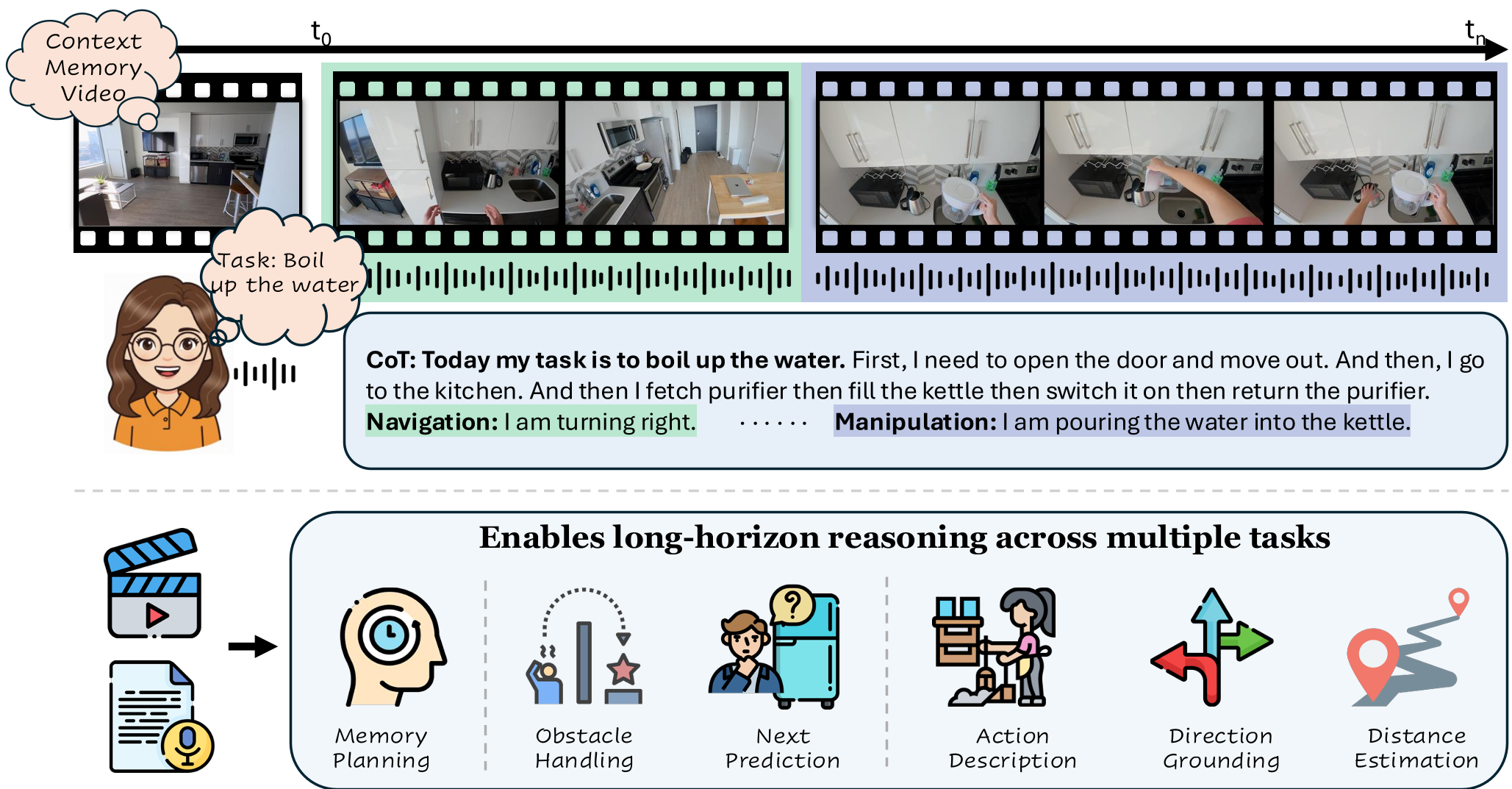 Figure 1: The EgoTL pipeline unifies high-level goals, real-time reasoning, and 3D metric reconstruction.
The EgoTL-Bench: A Reality Check for VLMs
The authors tested the world's leading models across three layers:
- Top Layer: Memory-conditioned planning (using a "pre-scan" video of the house).
- Middle Layer: Scene-aware action reasoning (handling clutter).
- Bottom Layer: Perceptual/Metric reasoning (did you walk 2 meters or 5?).
Key Experimental Results
The findings are stark: even GPT-5 and Gemini 2.5 Flash struggle with long-horizon consistency. However, models fine-tuned on EgoTL's specific "Think-Aloud" data showed dramatic improvements.
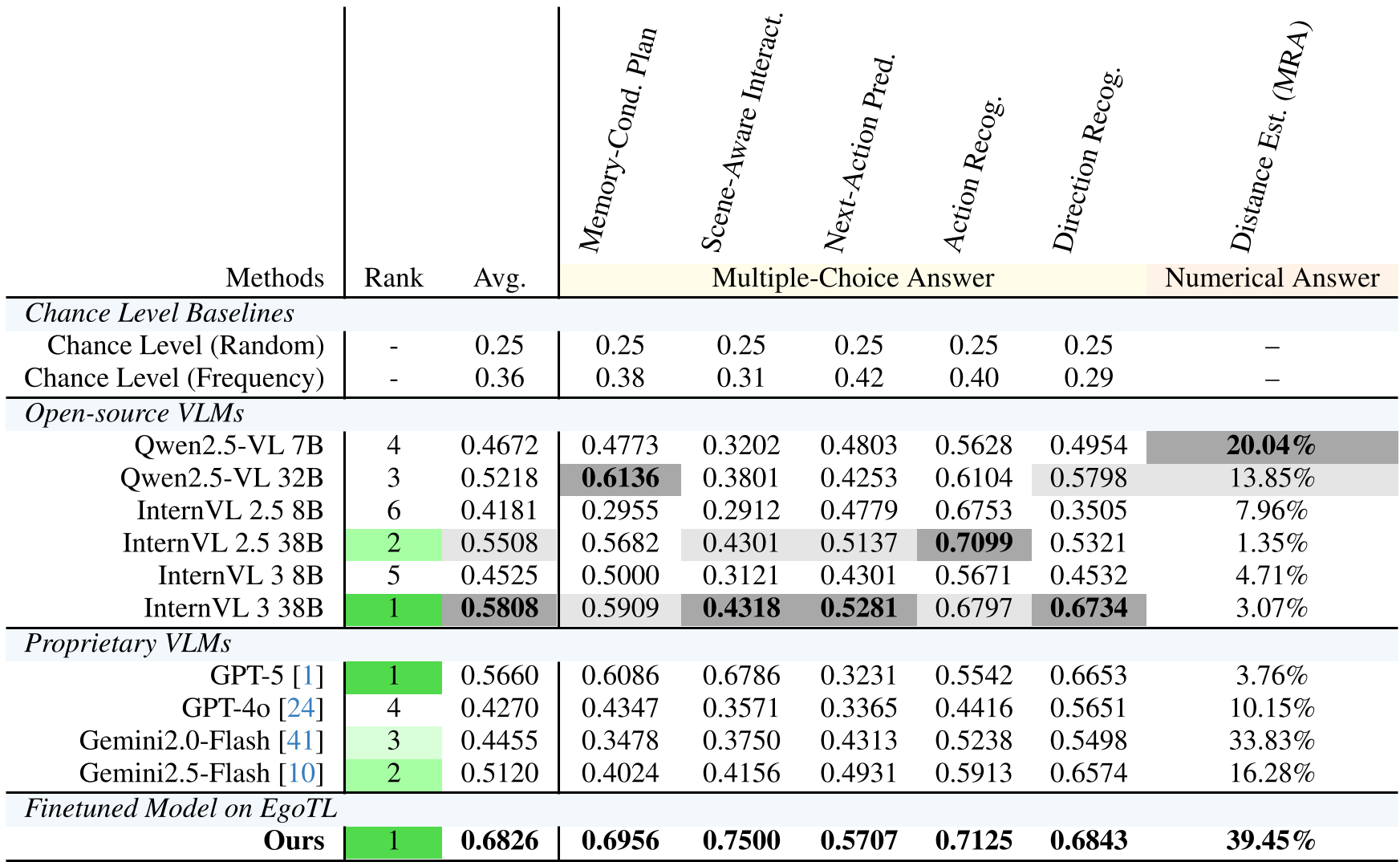 Table 1: Competitive analysis shows that EgoTL-finetuned models achieve 68.3% accuracy, significantly outperforming vanilla proprietary models.
Why it Works: The Power of Intent
The "Think-Aloud" protocol captures recovery behaviors. If a path is blocked, the human verbalizes the re-planning process. This provides the "Negative Samples" and "Decision Branches" that standard video-text pairs lack. By aligning word-level timestamps with specific metric movements, the model learns that "walking straight" corresponds to a specific optical flow and distance in 3D space.
Critical Analysis & Future Outlook
While EgoTL provides a superior supervision signal, the authors admit a substantial gap to human performance still remains. Current VLMs have an inherent bias toward "Move Forward" and often ignore fine-grained vertical motions (standing/sitting).
Future Impact: EgoTL suggests that for AI to move from "video chat" to "household robot," we need to stop feeding it passive observations and start feeding it the logic of action. The future of Embodied AI isn't just seeing—it's speaking the plan before taking the step.
Takeaway for Researchers
- Data Quality > Quantity: 400 high-intent episodes outperformed thousands of noisy automated labels.
- Metric Matters: Without explicit meter-scale supervision, LLMs cannot "guess" depth or distance accurately enough for robotics.