
[Journal of Number Theory] Eigenforms and Graphs of Hecke Operators with Wild Ramification: A Cusp-Geometry Breakthrough
Eigenforms and graphs of Hecke operators with wild ramification
The paper investigates Hecke operators on the moduli of bundles over global function fields in the presence of wild ramified level structures. It demonstrates that deep within the Harder-Narasimhan (HN) cone of BunG, the ramified Hecke graph stabilizes into a disjoint covering of the unramified case, allowing for explicit dimension formulas for Hecke eigenspaces of BunPGL2.
TL;DR
By diving deep into the Harder-Narasimhan (HN) cone of the moduli stack of bundles (), Kashyap and Zveryk discover that the seemingly chaotic complexity of wild ramification (level structures) stabilizes into a predictable, disjoint covering of the unramified Hecke graph. This allows for the first explicit dimension formulas for Hecke eigenspaces of with arbitrary ramification depth.
Background: Turning Geometry into Graph Theory
In the study of automorphic forms over function fields, Hecke operators are the central object of inquiry. Traditionally, these are viewed as correspondences on the moduli stack (bundles with level structure ). However, a more recent "shadow" of this geometry is the Hecke Graph:
- Vertices: Isomorphism classes of bundles with level structure.
- Edges: Hecke modifications of a specific type at a point .
While unramified graphs (where ) have been well-studied, adding ramification usually makes the graph structure explode. This paper asks: Does this complexity eventually stabilize?
The Core Insight: Splitting in the Cusp
The authors' most profound observation lies in the "cusp" of the moduli space—the region where the "slopes" of the bundle's components are very far apart.
1. The Splitting Theorem
For , they prove that if the gaps in the HN filtration are large enough relative to the divisor , the filtration splits canonically: In this regime, automorphisms of the bundle become upper-triangular, which drastically simplifies the action of level structures.
2. The Propagation Formalism
The authors treat these infinite graphs as having a "nucleus" (complex center) and "layers" (the cusp). They define propagative decompositions, where the adjacency matrix acts as a surjective or isomorphic map between layers. This turns a high-dimensional spectral problem into a manageable combinatorial one.
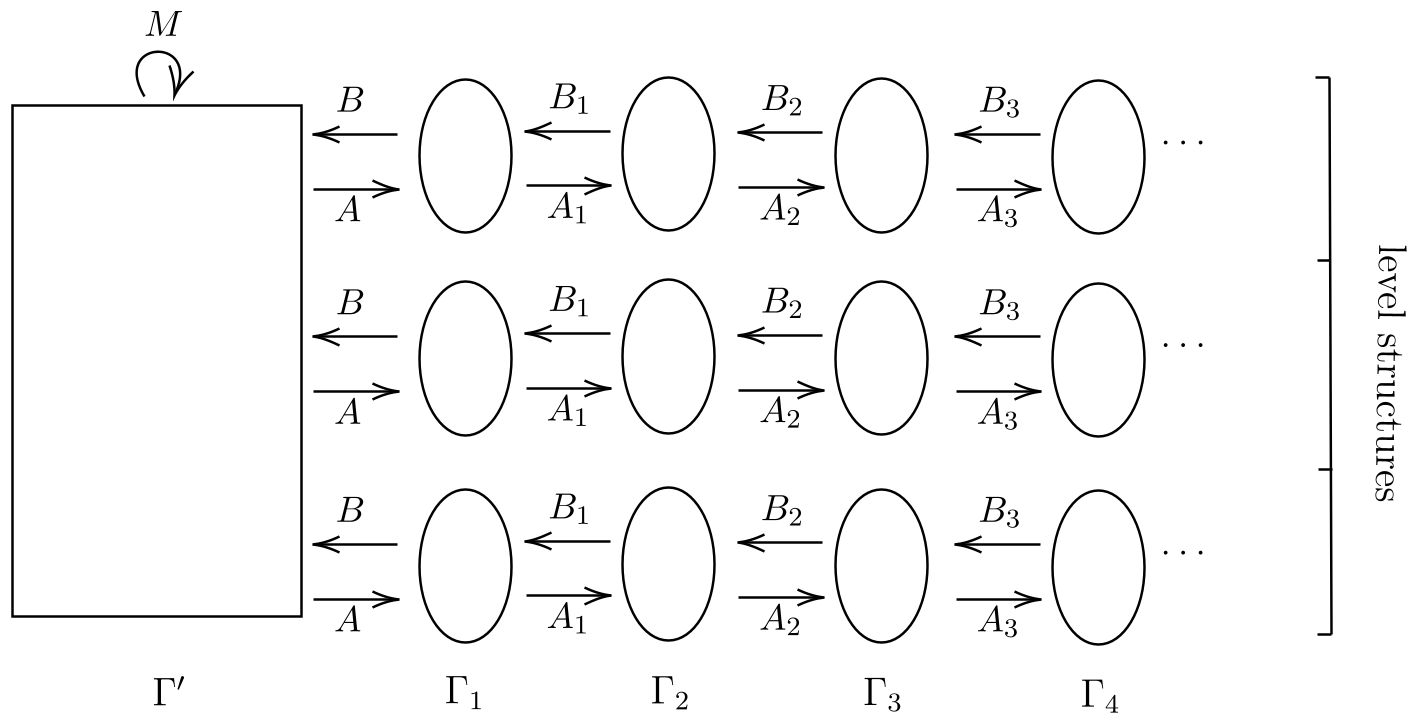 Figure 1: Visualizing the propagation deep in the cusp where edges move bundles from one HN layer to the next.
Methodology: From to Reductive Groups
The paper bridges the gap between concrete vector bundle calculations and abstract Lie-theoretic descriptions:
- Metric for the Cusp: They define -cusp loci by imposing lower bounds on the degrees of positive-root line bundles associated with the canonical B-reduction.
- Iwasawa Decomposition: By using the affine Grassmannian () and its intersection with Semi-infinite orbits (), they classify edges based on "relative position."
- Cusp Splitting Theorem: They prove that the forgetful map is a disjoint covering of constant degree .
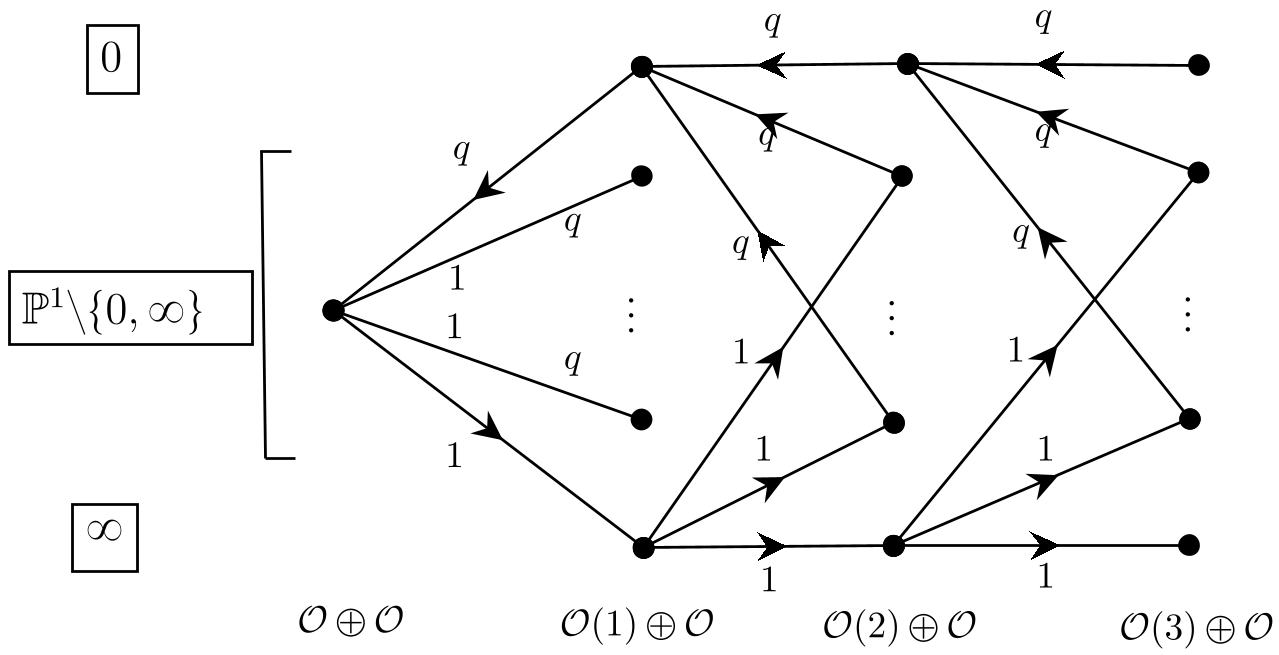 Figure 2: Example of a graph ramified at for . Note how edge multiplicities (q, q-1) emerge from the level structure geometry.
Key Results: Dimension Formulas
For , the authors provide explicit bounds (which are equalities for generic eigenvalues ):
- Unramified at x: The dimension is scaled by the number of flags over the level structure .
- Ramified at x: The complexity is captured by the term , where is the ramification depth.
Theorem 4.22 summarizes the "General Result," linking the dimension of -eigenforms directly to the Picard group and the degree of the ramified divisor.
Critical Analysis & Future Outlook
This work provides a rigorous foundation for what was previously only conjectured. By proving that ramification "duplicates" existing components in a controlled way, it simplifies the search for Hecke eigensheaves.
Limitations: The formulas are "generic," meaning they hold for all but finitely many eigenvalues. Identifying these "special" eigenvalues—often associated with Eisenstein series or specific geometric degenerations—remains an open challenge.
Future Work: The transition from these combinatorial graphs to the full Geometric Langlands eigensheaves is the next frontier. This paper provides the "automorphic model" that these sheaves must satisfy in the limit.