
Ellipsography: Shattering the "Trade-off" in Speckle-Free Holography
Ellipsography: Single-Shot Speckle-Free Holography via Vectorial Interference Shaping
The paper introduces Ellipsography, a novel single-shot holographic display technique that virtually eliminates speckle noise by jointly modulating the phase and polarization of light. By using a vectorial wave model and a pixel-wise polarization analyzer, it achieves 30dB PSNR reconstructions—a 10dB leap over current SOTAs—approaching the quality of modern 2D displays in a single frame.
TL;DR
Holography has long been hampered by speckle noise—that grainy "sand" that ruins image clarity. Until now, you either had to accept the noise or sacrifice image realism. Ellipsography changes the game by using polarization to "sculpt" light interference. It achieves crystal-clear, 30dB PSNR images in a single shot, providing the visual fidelity of a million averaged frames without the need for high-speed hardware.
The "Impossible" Trade-off: Phase vs. Speckle
In the world of holography, we use "Random Phase" to spread light evenly across our eyes (the eyebox) and create realistic depth. But there's a catch: when you mix random phases from coherent light, they interfere destructively at random spots, creating speckle.
Researchers usually pick their poison:
- Smooth Phase: No speckle, but the image only looks right from one tiny spot, and the depth looks "fake."
- Temporal Multiplexing: Rapidly flashing dozens of different speckle patterns to blur them out. This requires expensive, ultra-fast hardware and lots of compute.
Ellipsography asks: What if we could use polarization to make the unwanted interference terms disappear before they ever reach the eye?
The Core Insight: Vectorial Interference Shaping
Standard holography treats light as a scalar (a simple wave). Ellipsography treats it as a vector (using the Jones calculus).
When two light waves meet, if their polarizations are orthogonal (e.g., one vertical, one horizontal), they cannot interfere. The authors leverage this physics by:
- Joint Modulation: Using two SLMs to control the horizontal and vertical parts of light independently.
- Vector-to-Scalar Projection: Using a "polarization analyzer" (essentially a filter) to project this complex 3D light field back into a 2D image.
By optimizing the phase on both SLMs simultaneously, they ensure that the "useful" parts of the light combine to form the image, while the "noisy" interference terms are mathematically redirected into polarization states that the filter rejected.
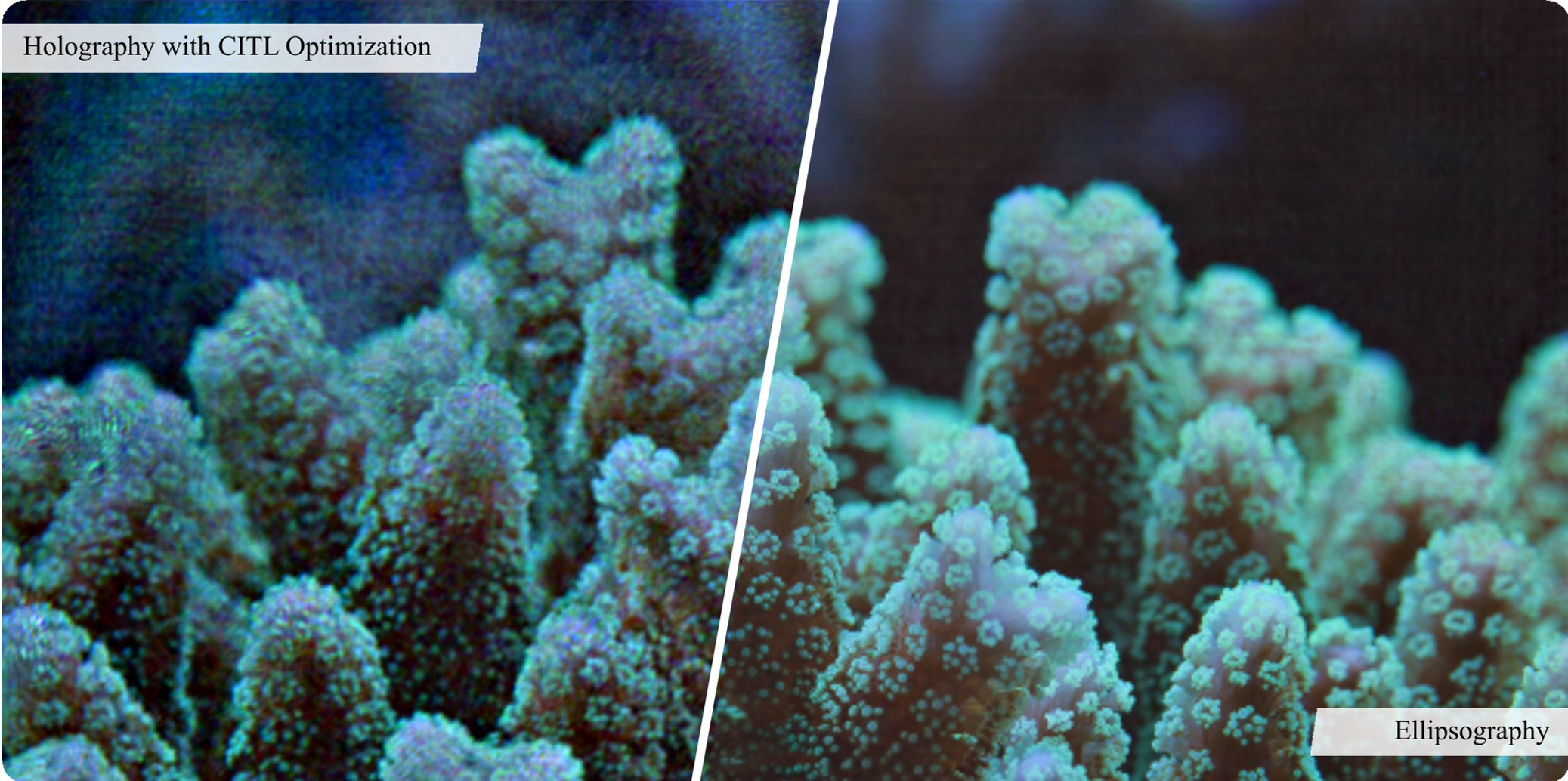 Fig 1: Comparison of traditional CITL (noisy) vs. Ellipsography (clean) on a real prototype.
Methodology: The Vector Wave Model
The authors integrated the Jones formalism into the standard Angular Spectrum Method (ASM). This allows the hologram synthesis algorithm to optimize not just where light goes, but also its "spin" (polarization) at every single pixel.
In the equation above, if the polarization difference is 90 degrees, the entire interference term (the part that causes speckle) becomes zero, regardless of the phase!
Results: Breaking the 20dB Barrier
In the world of holographic displays, hitting 30dB PSNR on a physical setup is a monumental achievement. Most state-of-the-art (SOTA) methods hover around 18-20dB.
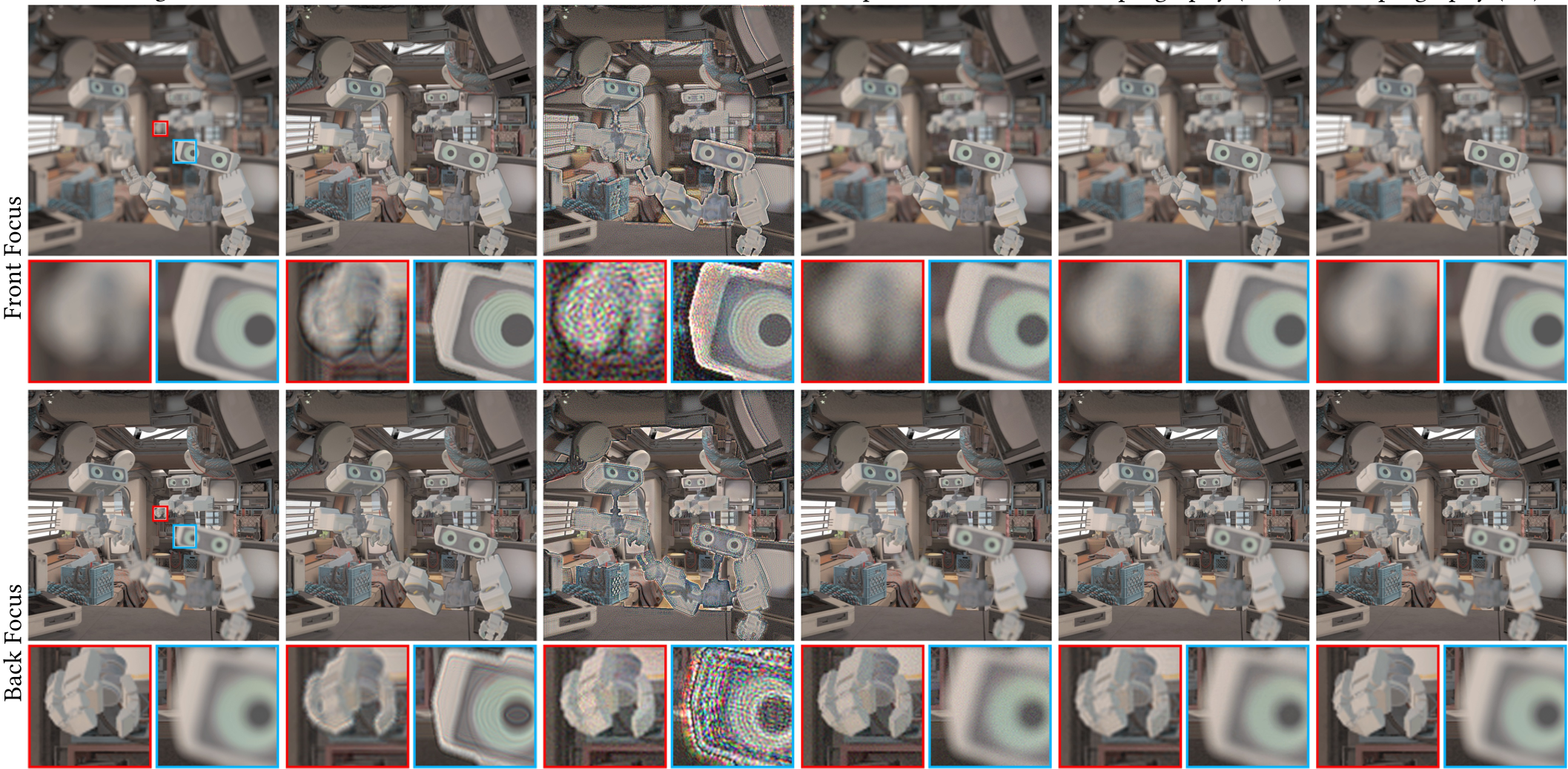 Fig 2: 3D Holography performance. Note the clean defocus blur in Ellipsography compared to the noisy artifacts in Neural 3D or Tensor Holography.
Key Breakthroughs:
- Single-Shot Efficiency: It achieves the same noise reduction in 1 exposure that temporal averaging takes 1,000,000 exposures to reach.
- Pupil Invariance: The image remains high-quality even if your eye moves around the eyebox, solving the "eye-box dropout" problem common in previous smooth-phase designs.
- Realistic Focus: Unlike "Smooth Phase" tricks, Ellipsography preserves the "Random Phase" properties, meaning your eye can focus naturally on different depths (accommodation cues) without being distracted by grainy noise.
The Future: Beyond Displays
While the authors focus on VR/AR headsets, the implications for coherent imaging are massive. This technique could potentially be applied to:
- Medical Imaging: Getting clearer images through scattering tissue.
- Microscopy: Removing speckle from laser-based biological scans in real-time.
- Next-Gen SLMs: This work practically begs hardware manufacturers to create "Vectorial SLMs" that handle phase and polarization in one unit.
Conclusion
Ellipsography proves that speckle isn't an "inevitable" curse of coherent light—it's just a byproduct of thinking in scalars. By embracing the vectorial nature of light, we can finally build holographic displays that look as sharp and natural as the screens on our smartphones.
Author's Note: As a senior editor, I find this work particularly elegant because it uses "old school" polarization physics to solve a "new school" deep-learning optimization problem. It’s a perfect marriage of physical intuition and computational power.