
[CVPR 2025] ELT: Elastic Looped Transformers—Breaking the Parameter-Compute Link in Visual Generation
ELT: Elastic Looped Transformers for Visual Generation
The paper introduces Elastic Looped Transformers (ELTs), a parameter-efficient recurrent architecture for image and video generation. By using weight-shared transformer blocks and a novel Intra-Loop Self Distillation (ILSD) training strategy, ELT achieves SOTA performance (e.g., FID 2.0 on ImageNet-1k) with up to 4x fewer parameters than standard models like MaskGIT and DiT.
Executive Summary
TL;DR: Elastic Looped Transformers (ELT) redefine efficiency in visual generation. By replacing deep stacks of unique layers with a single, weight-shared block that iterates recursively, ELT slashes parameter counts by 75% while maintaining SOTA quality. Its "secret sauce" is Intra-Loop Self Distillation (ILSD), which enables Any-Time inference—the ability to stop generation at any loop and still get a high-quality image.
Background: This work sits at the intersection of Recurrent Architectures and Generative Foundation Models. It moves beyond the brute-force scaling of "more layers = more parameters" toward a more biologically inspired, compute-intensive reuse of a compact "core" engine.
The "Memory Wall" and the Motivation for Recurrence
In modern AI, weights are often too large to fit in on-chip caches (SRAM), forcing constant, power-hungry data transfers from HBM. This is the Memory Wall.
Standard transformers are "feedforward": each layer has unique weights. Looped Transformers, however, reuse the same weights. The authors argue that recurrence isn't just a memory trick—it's how biological visual systems solve complexity. But there was a catch: traditional looped models are "black boxes" that only output something sensible at the very last iteration. If you stop early, the image is noise.
Methodology: Intra-Loop Self Distillation (ILSD)
How do you make the middle of a loop as smart as the end?
ELT introduces a dual-path training objective. During training, a single set of parameters executes two paths:
- Teacher Path: Performs the maximum number of loops ().
- Student Path: Exits early at .
The ILSD loss forces the student's intermediate representation to mimic the teacher's final, more mature output.
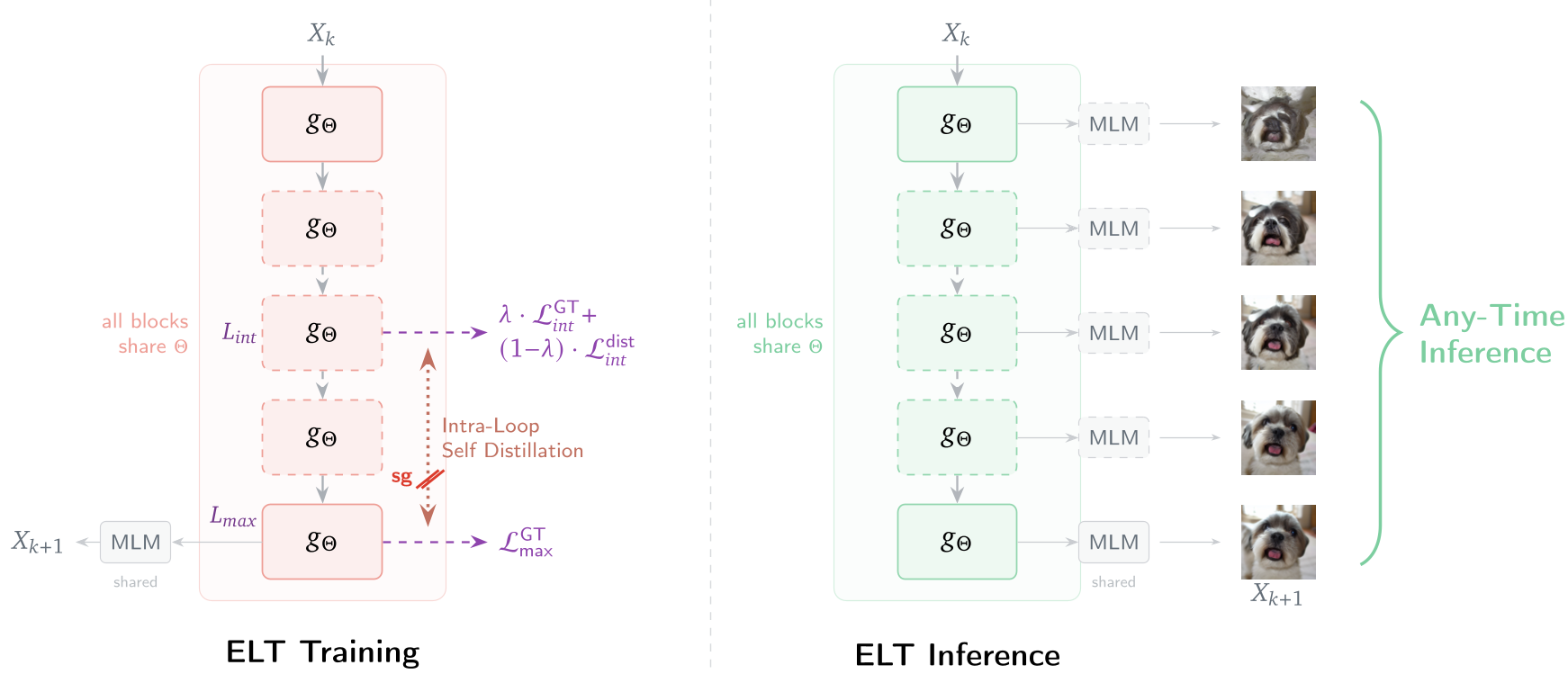 Figure 1: The ELT framework. Note how the shared parameters are updated by both the ground truth and the distillation signal from the teacher loop.
The Mathematical Intuition
The joint loss balances Ground Truth (GT) and Distillation (): By decaying from 1 to 0, the model first learns to hit the target, then learns to refine that target even in early loops.
Experimental Breakthroughs
ELT was tested across Masked Generative Transformers and Diffusion Transformers (DiT).
1. Extreme Parameter Efficiency
On ImageNet 256x256, ELT-XL achieved an FID of 2.0—matching the baseline MaskGIT-XL but with 4x fewer parameters. This moves the Pareto frontier of "Quality vs. Size" significantly to the left.
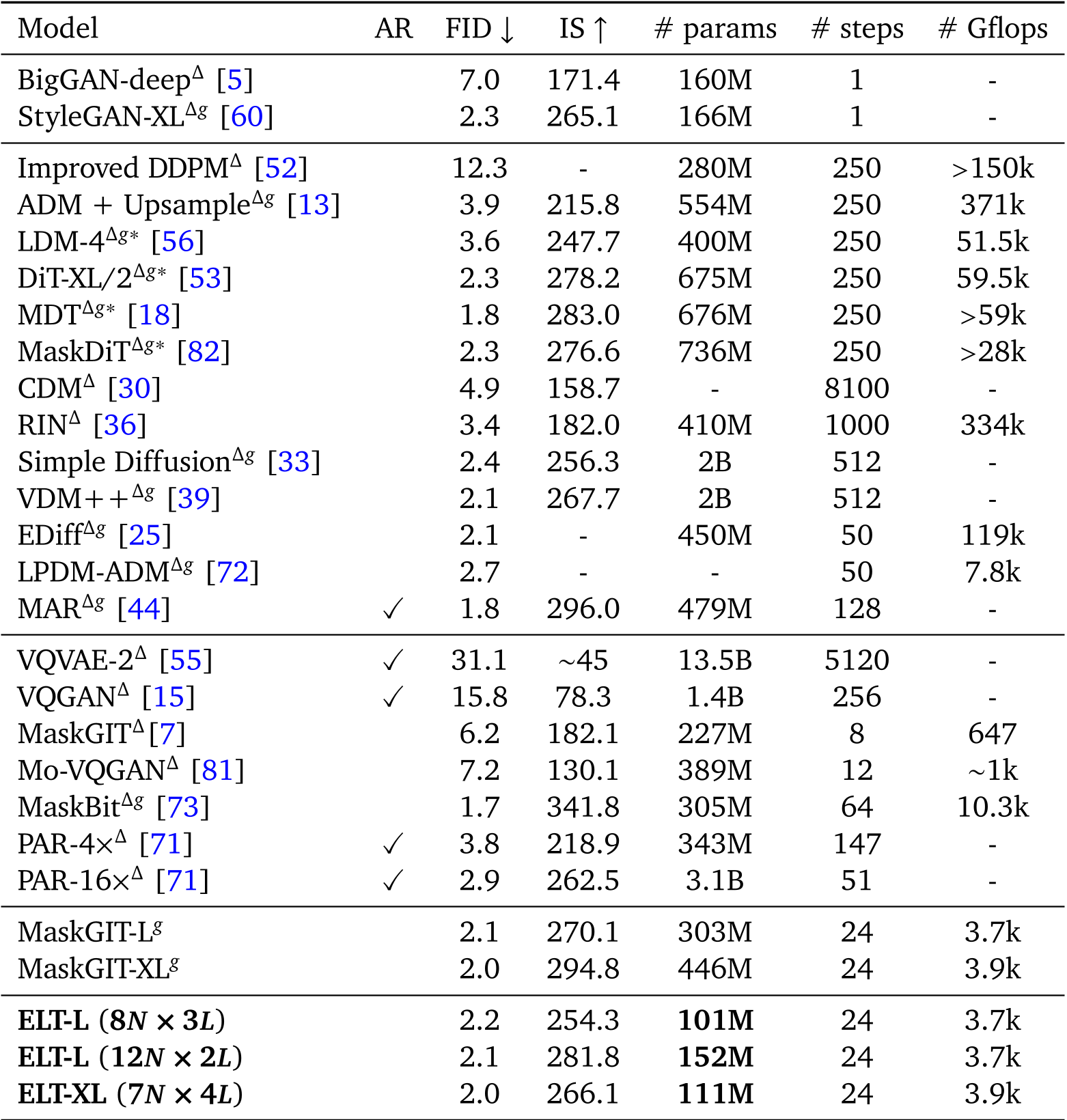 Table 1: ELT variants vs. SOTA Models. Notice ELT-XL (111M params) vs. MaskGIT-XL (446M params).
2. Any-Time Inference
Unlike vanilla looped transformers, ELT provides a smooth trade-off curve. You can run 2 loops for a quick preview or 8 loops for a final masterpiece, all using the same weights.
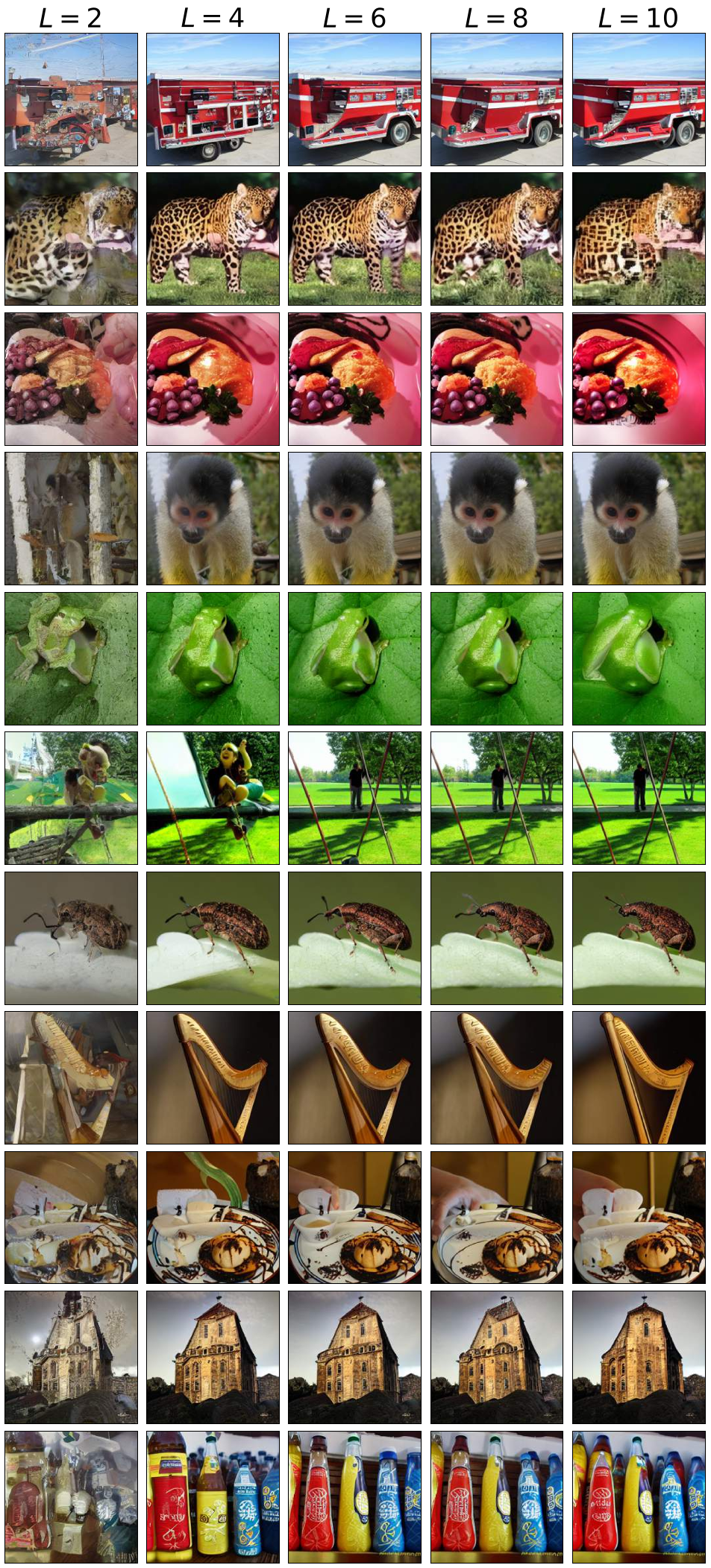 Figure 2: Comparing ELT (Left) to Vanilla Looping (Right). Vanilla models fail if the loop count doesn't match training (~L=8), while ELT remains coherent across all budgets.
Critical Insights & Future Outlook
Why does it work? Recurrence acts as a regularizer. In the UCF-101 video dataset (where data is scarce), ELT actually outperforms larger feedforward baselines because the weight-sharing prevents overfitting.
Limitations: There is a "lower bound" to efficiency. If the block size is too small (e.g., only 1 layer), the model lacks the representational capacity to benefit from recursion. It's like having a very fast cyclist on a tricycle—the hardware eventually limits the software.
Conclusion: ELT is a masterclass in "doing more with less." It proves that for generative AI, depth is a dynamic property we should control at inference time, not a fixed hardware cost we pay at training time. This is a massive step for deploying high-end GenAI on mobile devices and edge hardware.