
[CVPR 2025] Em-Garde: Decoupling "Thinking" from "Looking" for Proactive Video AI
Em-Garde: A Propose-Match Framework for Proactive Streaming Video Understanding
This paper introduces Em-Garde, a "Propose-Match" framework for proactive streaming video understanding that achieves State-of-the-Art (SOTA) accuracy and efficiency. It decouples high-level semantic reasoning from high-frequency perception, allowing models to monitor video streams and trigger responses (e.g., when a pot boils) in real-time.
TL;DR
Em-Garde is a novel framework that solves the efficiency-accuracy dilemma in proactive streaming video understanding. By shifting expensive semantic reasoning to a "query-time" parsing stage and using a lightweight embedding matcher for real-time monitoring, it achieves over 10 FPS while setting new records on benchmarks like StreamingBench and OVO-Bench.
The Motivation: Why Proactive AI is Hard
Imagine a household robot that needs to "remind me when the water boils." Current Video Large Language Models (VideoLLMs) struggle with this because they try to "re-think" the entire problem at every single frame. This leads to two failures:
- The Efficiency Wall: Thinking is slow. Processing every frame with a 7B+ parameter model makes real-time 30 FPS interaction impossible.
- The Accuracy Trap: To save speed, models compress data so much they miss the "bubbling water" (the fine-grained visual cue).
The authors of Em-Garde realized that we don't need to re-interpret the user's intent 30 times a second. We only need to define what the "target" looks like once, and then look for it.
Methodology: The Propose-Match Paradigm
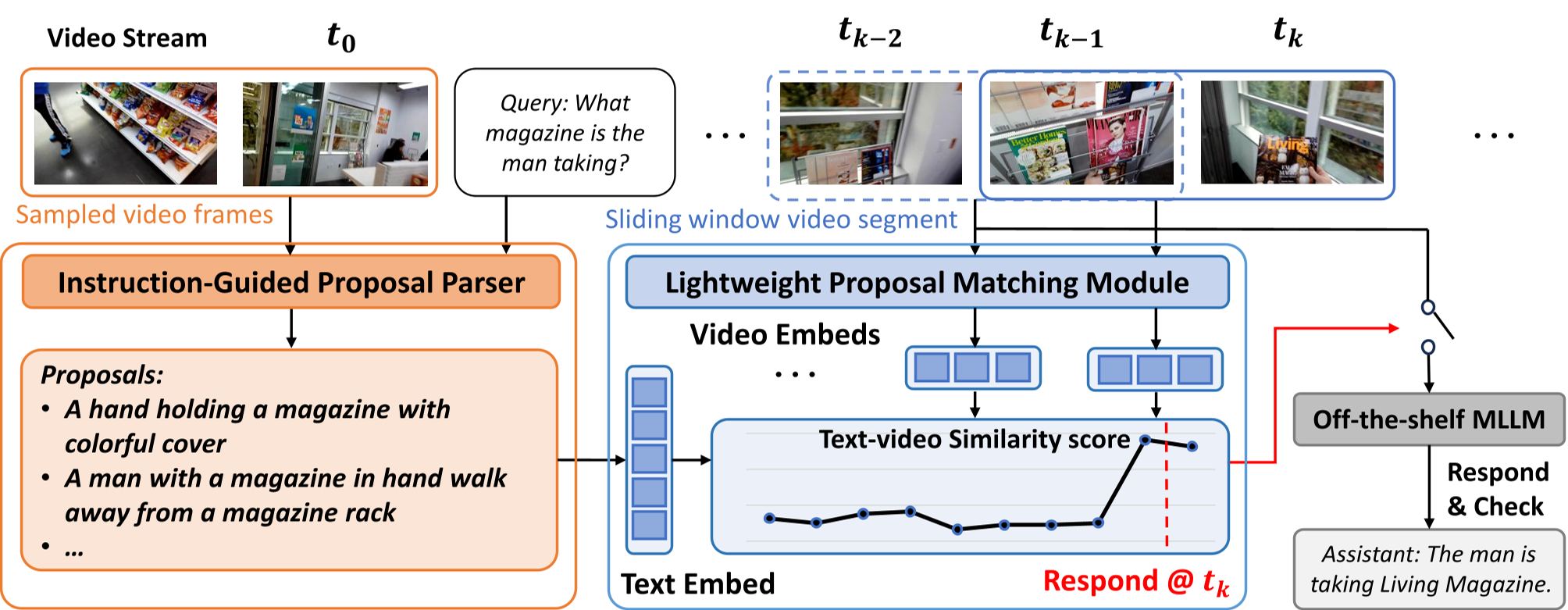
The framework consists of two distinct modules that separate semantic understanding from raw perception:
1. Instruction-Guided Proposal Parser (IGPP)
When a user asks a question, the IGPP (based on Qwen2.5-VL-7B) "imagines" the visual evidence. It breaks a high-level query into concrete, localizable cues.
- Query: "Tell me when the score changes to 24."
- Proposals: "A red number 24 appearing on the scoreboard," "A sudden change in the digits near the player's name."
2. Lightweight Proposal Matching Module (LPMM)
Once the proposals are set, the IGPP goes to sleep. The LPMM (a tiny 2B embedding model) takes over. It compares the current video frame's embedding with the proposal embeddings. If a "similarity surge" is detected, it wakes up the main model to respond.
Reinforcement Learning for Better "Visions"
One of the paper's key innovations is how they train the IGPP. They found that standard Supervised Fine-Tuning (SFT) produced proposals that were too abstract for the small matcher to understand.
By using Reinforcement Learning (GRPO), they rewarded the IGPP when its proposals led to successful triggers. This forced the model to generate "perception-friendly" cues—focusing on high-contrast objects and specific layouts that a lightweight model can actually distinguish.
Results & Efficiency
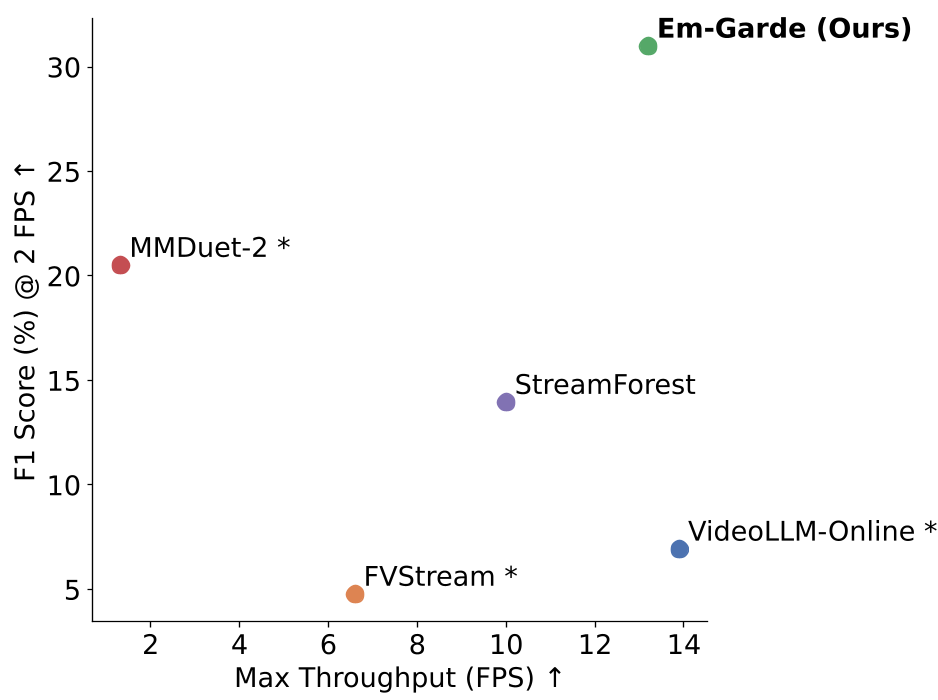
Em-Garde doesn't just work better; it works faster. Unlike models like MM-Duet-2, which see latency explode as the video gets longer, Em-Garde keeps a flat latency profile.
- Accuracy: +10% F1 improvement on OVO-Bench SSR and REC tasks.
- Speed: 13 FPS on A100—nearly 5x faster than prior "active interaction" models.

Critical Analysis & Conclusion
Em-Garde represents a shift from "Dense Reasoning" to "Sparse Triggering." Its greatest strength is its modularity; you can plug in any State-of-the-Art (SOTA) embedding model or LLM as they improve.
Limitations: The system still relies on a manual threshold () for triggering. If a camera shakes or a scene changes abruptly, it can cause "false positive" surges. Future work will likely need more robust temporal filtering to handle these "visual shocks."
Final Takeaway: For AI to live with us in the "always-on" world, it must learn to look without constantly thinking. Em-Garde provides the architectural blueprint for exactly that.