
Embody4D: Elevating Embodied AI from 2D Pixels to 4D World Models
Embody4D: A Generalist 4D World Model for Embodied AI
Embody4D is a specialized video-to-video world model designed to synthesize arbitrary novel views from monocular embodied videos. Leveraging a Flow Matching framework and a compositional 4D synthesis pipeline, it achieves state-of-the-art performance in generating view-consistent sequences for complex robotic tasks.
TL;DR
Embody4D is a transformative video-to-video world model that bridges the gap between 2D monocular observation and 4D (spatiotemporal 3D) reasoning. By combining a novel compositional data pipeline with geometric-aware diffusion refinements, it synthesizes photorealistic, multiview-consistent videos from a single camera feed. In real-world tests, it boosted robotic picking success rates from 32% to 74%, proving its value as a high-fidelity data engine for the next generation of spatial intelligence.
The "Dimensionality Gap" in Embodied AI
While the physical world is inherently 3D, most current world models operate in flat 2D pixel space. This limitation is not just visual; it is functional. Robots lacking multi-view perspective struggle with depth perception, occlusion handling, and precise contact point estimation.
The transition to 4D (3D + Time) has historically been blocked by three major hurdles:
- Data Scarcity: There is almost no paired, multi-view data of dynamic robotic manipulations across diverse environments.
- Geometric Drift: When generating new views, models often lose "texture lock," causing objects to warp or flicker.
- Hallucinated Physics: Generative models frequently fail at the "contact point," blurring the gripper or the object during critical interactions.
Methodology: Engineering Spatial Stability
Embody4D addresses these bottlenecks via a multi-pronged architectural approach.
1. Architectural Backbone: Refined Flow Matching
The model utilizes a Flow Matching framework (specifically Rectified Flow), which regresses a vector field to transport Gaussian noise to video latents along a straight-line trajectory. This provides more stable and efficient sampling compared to traditional stochastic diffusion.
2. Compositional 4D Synthesis
To solve the data problem, the authors built a pipeline that composites 30 different robot morphologies (from the MuJoCo Menagerie) into real-world backgrounds (from DL3DV). By using 3D anchor tracking and multi-frame consensus, they ensure that the virtual robot is physically and geometrically grounded in the real-world scene.
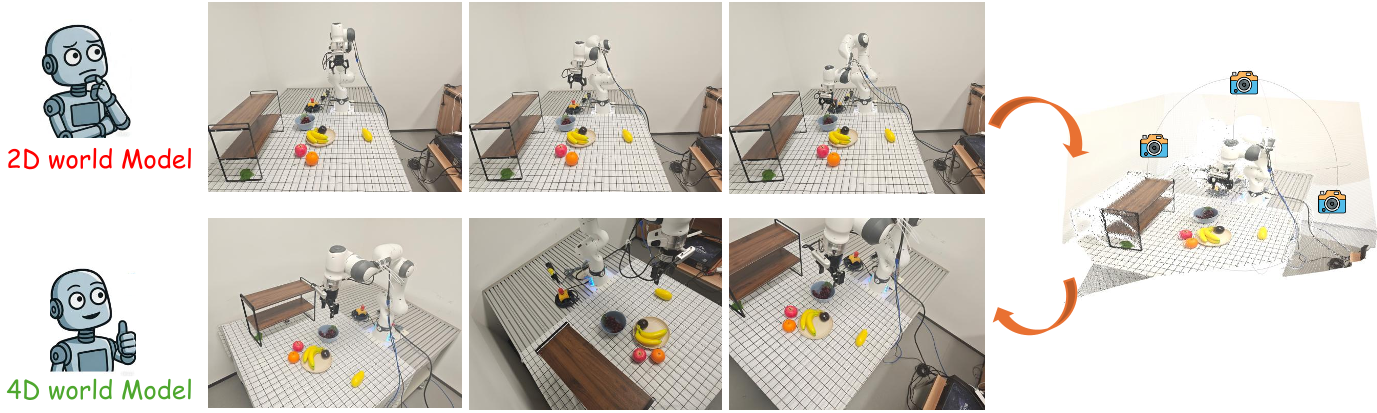 Figure 1: The Embody4D framework transforms 2D monocular videos into consistent 4D representations.
3. Confidence-aware Adaptive Noise Injection
Not all pixels are created equal. When warping a point cloud from a source to a target view, some regions (like occlusions) are essentially "unknown." Embody4D uses a Confidence Estimation Module to assign noise levels spatially:
- High Confidence Areas: Receive low noise to preserve sharp textures and rigid structures.
- Low Confidence Areas: Receive high noise, giving the model "generative freedom" to fill in holes plausibly.
4. Interaction-Aware Attention
To prevent the "melting" of robotic grippers, the authors introduced an attention mechanism that prioritizes dynamic regions. By using segmentation masks (SAM 3) as a motion inductive bias, the model explicitly decouples the manipulation foreground from the background, ensuring high fidelity where the robot meets the object.
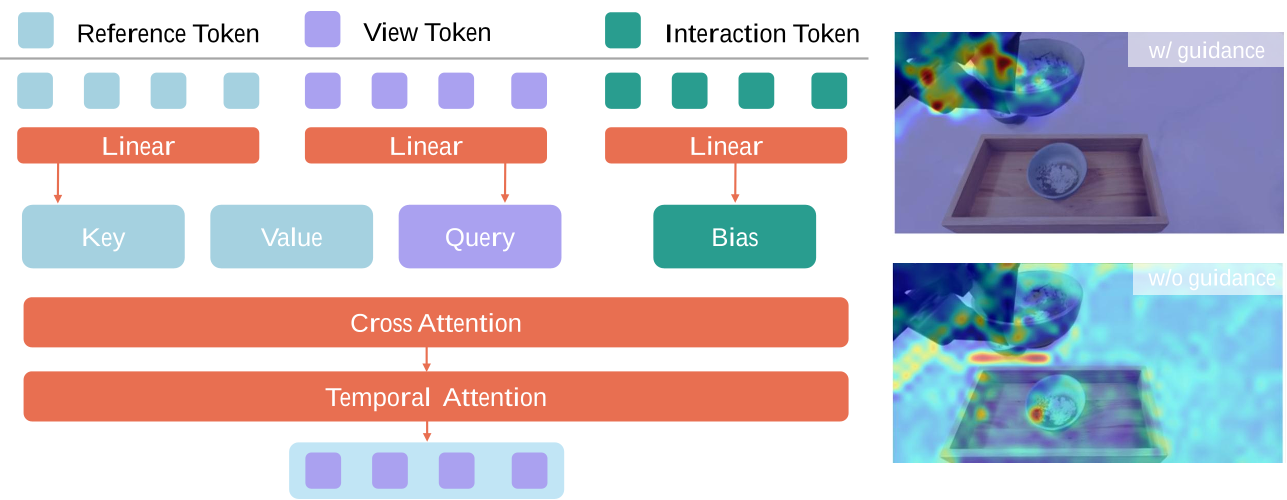 Figure 2: The attention mechanism boosts focus on the interaction zones to preserve structural integrity.
Experimental Performance & Real-Robot Results
Embody4D was benchmarked against leaders like TrajectoryCrafter and ReCamMaster. In qualitative comparisons, Embody4D was uniquely capable of maintaining the structure of the gripper and the object during complex rotations.
| Metric | TrajectoryCrafter | Embody4D (Ours) |
|---|---|---|
| Subject Consistency ↑ | 0.9202 | 0.9477 |
| Imaging Quality ↑ | 0.6257 | 0.6994 |
| Q-Align Visual Quality ↑ | 3.8954 | 3.9970 |
Empowering Policy Learning
The ultimate test was whether these generated videos could train better robots. By augmenting a small real-world dataset with Embody4D's novel views, the researchers trained a VLA policy.
- Single-view (Real Data Only): 32% success.
- Multi-view (Augmented with Embody4D): 74% success.
Remarkably, the model showed massive gains in Out-of-Distribution (OOD) tasks—handling objects and placements it had never seen in the original training set.
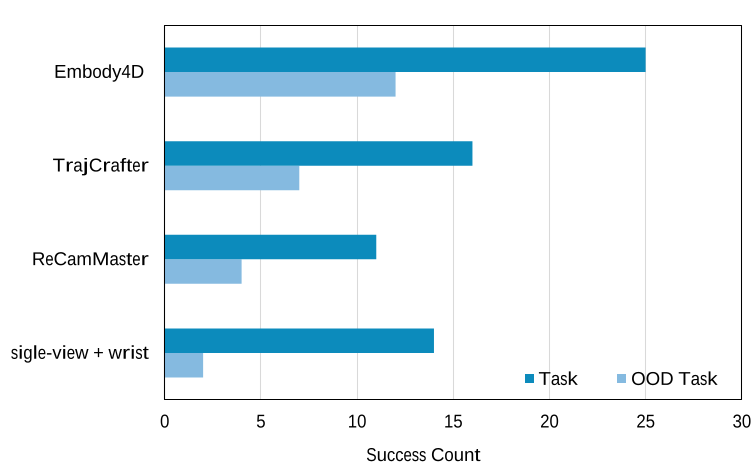 Figure 3: Success rates across different tasks, showing Embody4D's superior generalization in OOD scenarios.
Critical Insight & Conclusion
The success of Embody4D hinges on the realization that geometry is a constraint, not a suggestion. By explicitly modeling confidence levels and anchoring attention to interaction zones, the model moves beyond "hallucinating videos" toward "simulating physics."
Limitations: Despite its power, the model is currently slow (2 minutes for 49 frames) and can struggle with extreme 180-degree viewpoint shifts where information is totally missing.
Future Outlook: Embody4D sets a new precedent for using generative models as "Data Engines." As inference speeds improve, we may see these models running in the loop, allowing robots to "imagine" the scene from a better angle before every grasp.