
EMO: Breaking the MoE Monolith with Emergent Modularity
EMO: Pretraining Mixture of Experts for Emergent Modularity
EMO (Emergent Modularity) is a novel Mixture-of-Experts (MoE) pretraining strategy that induces functional modularity without human-defined domain labels. By constraining tokens within a document to route through a shared expert pool, the model achieves SOTA-level performance while allowing users to deploy only 12.5% of experts with minimal accuracy loss.
TL;DR
Large Language Models (LLMs) are usually monolithic: you either load the whole thing or nothing at all. Even Mixture-of-Experts (MoE) models, which only activate a few parameters per token, still require the entire model to be in VRAM because their experts are scattered and unspecialized. EMO (Emergent Modularity) changes this by forcing experts to organize into semantic groups during pretraining. The result? A model where you can "keep the math experts" and "discard the rest" to save 87.5% memory with only a 3% performance hit.
The Problem: The High Cost of "Syntax Experts"
In a standard MoE (like Mixtral or DeepSeek), routers are purely local. One token might use Expert A to predict a comma, and the next token uses Expert B to predict a noun. Consequently, over a single paragraph, the model ends up touching almost every expert in its library.
Academic research shows these experts don't specialize in "Math" or "Biology"; they specialize in low-level lexical patterns like prepositions and punctuation. This makes it impossible to prune the model for a specific task. If you delete 75% of a standard MoE, the remaining 25% "syntax-only" experts can't form a coherent thought.
Methodology: High-Level Intuition
The authors' core insight is simple yet profound: Tokens within a single document usually belong to the same domain.
Instead of letting every token choose experts independently, EMO introduces a "Document-Level Constraint":
- Pool Selection: For every document, the model identifies a shared "Expert Pool" (subset ).
- Constrained Routing: Every token in that document is forced to route to experts only within that pool.
- Emergence: Because different documents (e.g., a Python script vs. a medical paper) use different pools, experts are naturally incentivized to group together based on high-level semantics to minimize loss.
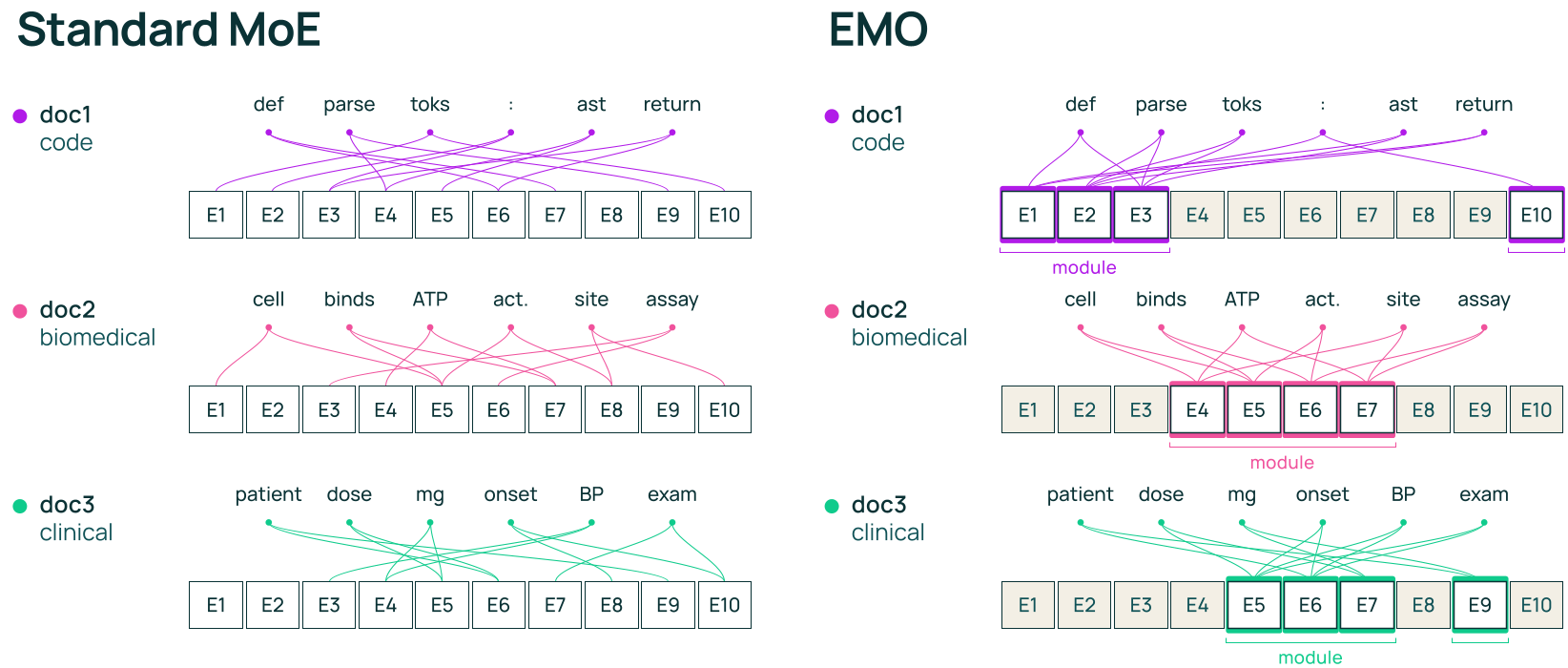 Figure 1: EMO constrains routing at the document level, whereas standard MoEs route independently per token.
Key Technical Polish:
- Dynamic : During training, the size of the expert pool () is randomized. This prevents the model from "overfitting" to a specific subset size, allowing it to work whether you load 8, 32, or 128 experts at inference time.
- Global Load Balancing: To avoid "lazy" experts, EMO uses global statistics across data groups to ensure all experts are eventually trained effectively.
Results: Efficiency Without Compromise
The evaluation of EMO focuses on Selective Expert Use. When the model is asked to solve math problems, can we load only the "Math experts"?
- Full Model Performance: EMO matches the performance of standard MoEs trained on 1 Trillion tokens. There is no "modularity tax."
- The Pareto Frontier: EMO creates a new standard for memory-accuracy trade-offs. Even when reduced to 12.5% of its original size, EMO's performance on MMLU and GSM8K remains robust, while standard MoEs collapse.
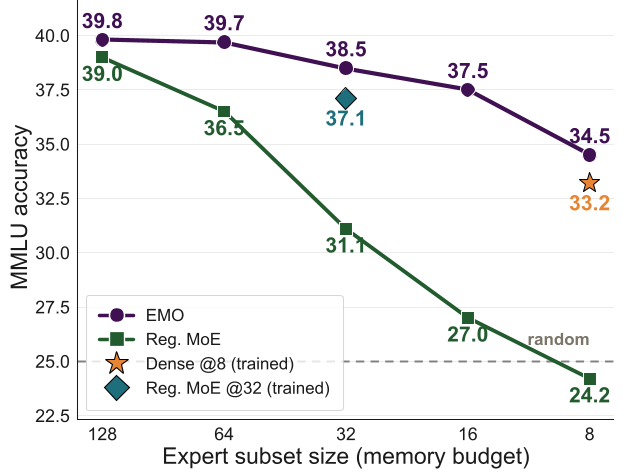 Figure 2: EMO pushes the Pareto frontier, significantly outperforming regular MoEs and even dense models trained from scratch at the same memory budget.
Deep Insight: Visualizing the Semantic Shift
The most striking part of the EMO paper is the visualization of expert specialization.
- Standard MoE: Clusters correspond to "Proper Names," "Definite Articles," and "Verbs."
- EMO: Clusters correspond to "Film & Music Reviews," "Health & Wellness," and "US Politics."
EMO has effectively moved the "routing logic" from the syntactic level to the semantic level. This makes the model inherently more interpretable. You can literally see the model switching to its "politics experts" when you change the topic.
Critical Analysis & Conclusion
EMO represents a shift toward Composable Architectures.
Value: It solves the "VRAM wall" for MoEs. Developers can now distribute domain-specific "expert packs" that users can plug into a base model, rather than downloading a new 100GB weights file for every task.
Limitations: While EMO works exceptionally well on domain-specific tasks, it struggles slightly on "General" categories where the topic is intentionally blurred. Furthermore, selecting the "correct" experts still requires a tiny validation set (though the authors show as few as 5 examples work).
In conclusion, EMO proves that modularity is not a human-imposed constraint we must force on models with labels; it is an emergent property of structured data that, when properly harnessed, leads to significantly more efficient AI.