
[arXiv 2026] ETCH-X: Robustify Expressive Body Fitting to Clothed Humans with Composable Datasets
ETCH-X: Robustify Expressive Body Fitting to Clothed Humans with Composable Datasets
ETCH-X is a robust human body fitting framework that aligns the expressive SMPL-X parametric model to raw, clothed 3D point clouds. It introduces a "undress first, then dense fit" paradigm, achieving state-of-the-art performance on datasets like 4D-Dress and BEDLAM2.0 (reducing MPJPE by up to 80.8% on unseen data).
TL;DR
Human body fitting—the process of aligning a digital skeleton like SMPL-X to a 3D scan—is often "broken" by loose clothing or missing sensor data. ETCH-X fixes this by adopting a modular "Undress then Dense Fit" strategy. By first predicting how much "slack" is in the clothing (tightness vectors) and then using implicit neural fields for dense matching, it achieves a massive 80% error reduction on unseen datasets and captures fine-grained hand gestures that previous methods missed.
The Core Tension: Expressiveness vs. Robustness
In the world of 3D human capture, we face a classic trade-off:
- Sparse Markers are robust to noise but "blind" to details. They can't tell if a hand is a fist or an open palm because they only track a few points.
- Dense Correspondences capture every wrinkle and finger movement but are easily "fooled" by loose clothing (e.g., a baggy hoodie makes the model think the person is overweight).
- Incomplete Scans (partial data) often cause optimization to diverge because key landmarks are simply missing from the sensor's field of view.
The authors argue that the only way to win is to disentangle the clothing from the body before attempting the final fit.
Methodology: The "Undress and Fit" Pipeline
ETCH-X breaks the problem into two distinct, scalable modules.
1. Masked Undress (Clothing to Body)
Instead of fitting to the "outer" surface, ETCH-X predicts a Tightness Vector () for every point. This vector points from the clothing surface to the estimated skin surface.
- SE(3) Equivariance: By using Equivariant Point Networks (EPN), the model understands that if the human rotates in space, the "clothing-to-body" relationship should rotate accordingly.
- Tightness Masking: A new addition that forces the tightness value to zero on exposed skin (head, hands), preventing the model from "shrinking" parts of the body that aren't covered by cloth.
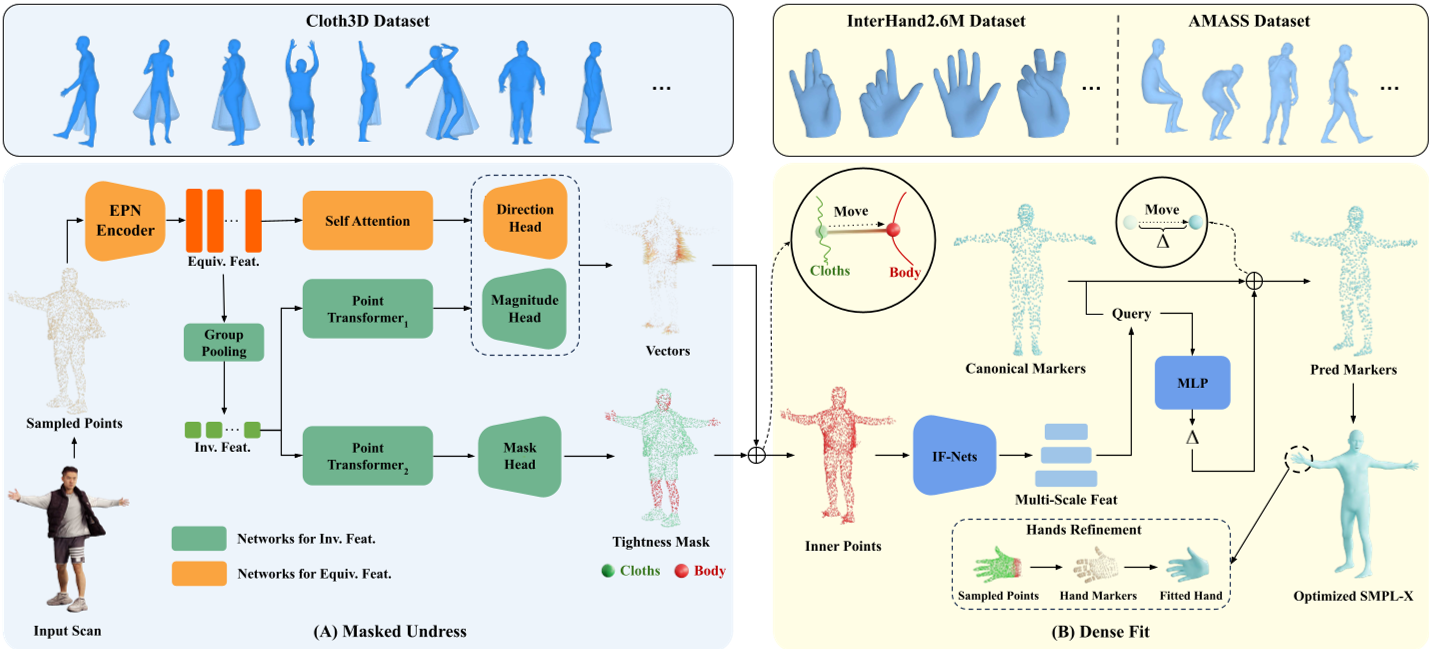 The two-stage pipeline: First, stripping away clothing dynamics, then performing implicit dense fitting.
2. Dense Fit via Neural ICP
Once we have "inner body points," ETCH-X uses an implicit neural field to map these points to a template.
- Implicit Representation: Unlike explicit markers, an implicit field can be queried anywhere. If half the body is missing, the feature volume still encodes enough context to "hallucinate" the correct correspondences for the missing side.
- Hand Refinement: Hand poses are notoriously difficult in full-body scans. ETCH-X introduces a secondary "zoom-in" step, re-sampling points around the hands and running a specialized classifier to remove "noise" (like points from the torso that the hand is touching).
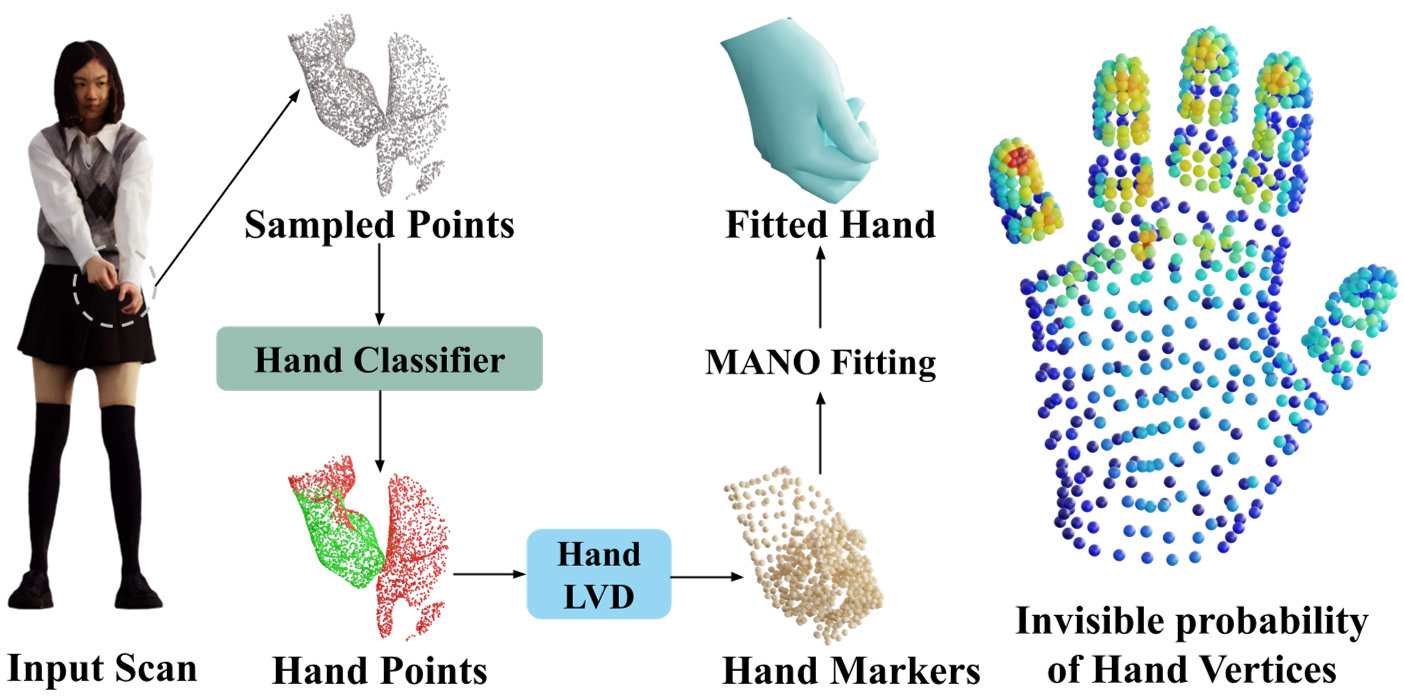 Hand Refinement: Re-sampling and specialized classification ensure that even in self-contact poses, the hand remains expressive and accurate.
Experimental Breakthroughs
The modularity of ETCH-X allows it to be trained on Composable Datasets. It learns "clothing" from CLOTH3D and "pose" from AMASS/InterHand2.6M. This data-driven scaling results in incredible generalization:
- Zero-Shot Generalization: When tested on the BEDLAM2.0 dataset (which the model never saw during training), ETCH-X outperformed the original ETCH by 80.8% in positional accuracy (MPJPE).
- Partial Scan Robustness: Even with single-view scans where the back of the person is entirely missing, the error only increases slightly, whereas traditional methods typically fail.
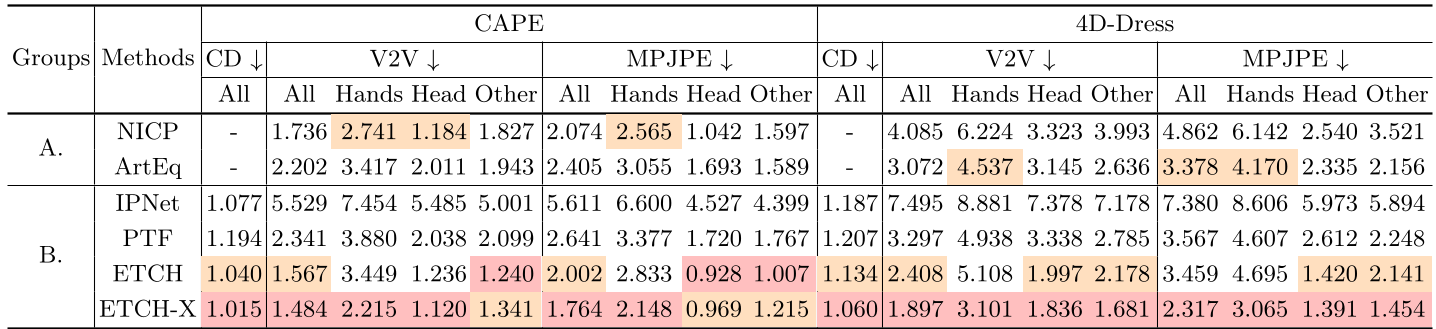 Quantitative comparison showing ETCH-X consistently leading across CAPE and 4D-Dress benchmarks.
Critical Insight: Why it Works
The "magic" isn't just in the neural network architecture, but in the scaling philosophy. By decoupling "Undress" and "Fit," the researchers can feed the model millions of diverse simulated garments without needing those garments to be on complex poses. Conversely, they can feed it complex hand-gesture data without needing that data to be "clothed." This "mix-and-match" data strategy is likely the future of robust 3D vision.
Conclusion & Limitations
ETCH-X represents a significant leap toward a general-purpose body fitting "foundation" tool. However, it still takes about 10 seconds to process a single frame, making it too slow for real-time applications like AR/VR. Additionally, while it handles loose clothing well, extremely complex layering (e.g., a heavy winter coat over a dress) remains a frontier for future research.
Final Takeaway: ETCH-X proves that if you want to understand the body, you must first understand the "tightness" of the world around it.