
Euclid's Cosmic Hunters: Finding High-Redshift "Little Red Dots" in the Big Picture
Euclid: Scaled-up little red dots and other sources with v-shaped spectral energy distributions at z>4
The study utilizes Euclid near-infrared imaging and Spitzer/IRAC data to identify 233 sources with "V-shaped" spectral energy distributions (SEDs) at z > 4 in the COSMOS field. It specifically highlights 16 "scaled-up" Little Red Dot (LRD) and Little Blue Dot (LBD) candidates that are 1-sigma more compact than typical galaxies at that redshift, marking a significant step in identifying rare, luminous counterparts to JWST-discovered populations.
TL;DR
Astronomers using the newly released Euclid space telescope data, combined with Spitzer/IRAC, have identified a rare population of "scaled-up" Little Red Dots (LRDs) at . These sources are the massive, luminous cousins of the faint objects recently discovered by JWST. The study finds 16 robust compact candidates that might bridge the evolutionary gap between obscured star-forming galaxies and classical, luminous quasars.
Context: The JWST Mini-Revolution
Since its launch, JWST has revolutionized our view of the early Universe, discovering a surprisingly large number of compact, "V-shaped" sources—spectrally blue in the ultraviolet but very red in the optical. These "Little Red Dots" typically host overmassive black holes relative to their host galaxies. However, JWST's "pencil-beam" surveys are too small to find the rarest, most luminous members of this family.
Enter Euclid. With its massive field of view and deep near-infrared capabilities, Euclid is uniquely positioned to find the "scaled-up" versions of these mysterious dots.
Methodology: Hunting for the "V"
The research team targeted the COSMOS field (0.75 deg²), looking for the characteristic double-power-law SED.
- Blue Slope (): Measured using Euclid probes (Y, J, H bands).
- Red Slope (): Measured using Euclid H and Spitzer/IRAC channels.
The team defined two tiers of selection: "Cut 1" (strict LRD-like redness) and "Cut 2" (more inclusive LBD-like sources). Crucially, they used Euclid’s superior resolution in the band to measure compactness, ensuring that the selected dots were not just distant, extended galaxies.
 The team used Equation 1 to fit the slopes, effectively capturing the light "break" that defines these exotic sources.
Key Results: Massive and Old
The findings challenge the notion that all LRDs are young, small objects:
- Massive Analogue: The Euclid-selected LRDs have stellar masses up to , roughly 1-2 orders of magnitude more massive than typical JWST LRDs.
- Cosmic Seniors: Surprisingly, half of the Euclid LRDs have best-fit ages approaching the total age of the Universe at their respective redshifts, suggesting a very early and rapid formation period.
- Luminosity Function (LF): As seen in the figure below, at the bright end, the number density of these sources converges with standard Quasars (QSOs).
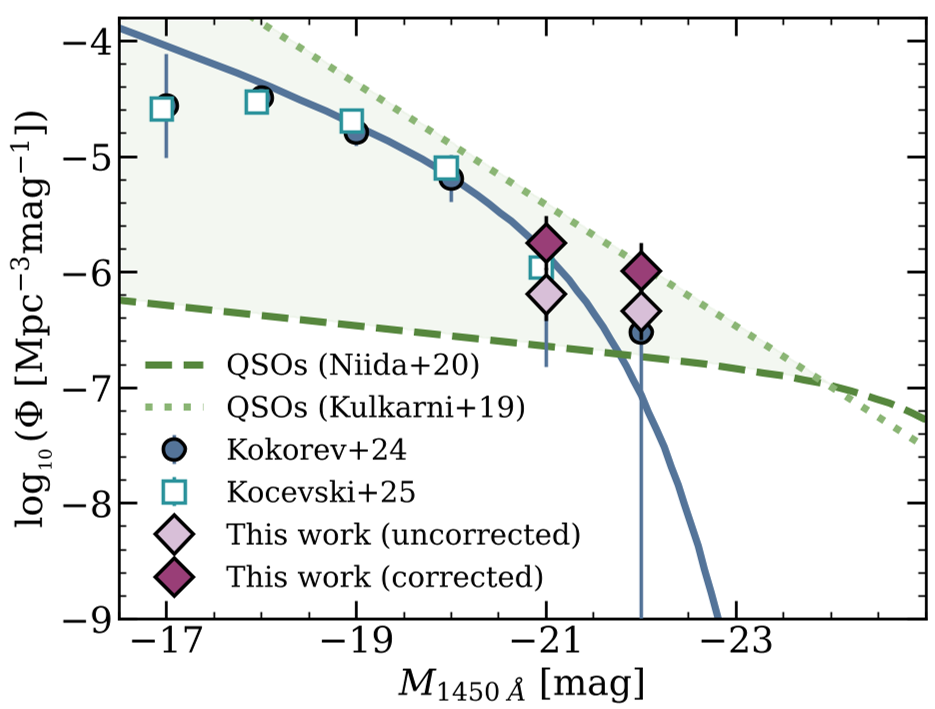 Figure: The Euclid LRD/LBD luminosity function (stars) compared to JWST results (circles/squares) and standard QSOs (shaded areas).
The "Missing Link" to BlueDOGs?
The study highlights a striking similarity between these Euclid sources and BlueDOGs (Blue-Excess Dust-Obscured Galaxies) found at . BlueDOGs are thought to be transition objects—dust-obscured quasars that are in the process of blowing out their dust cocoons to become clear, optical quasars. The Euclid LRDs appear to be the high-redshift progenitors of this phase.
Critical Insight: Disjoint Populations
Perhaps the most intriguing takeaway is that these V-shaped sources are disjoint from "Standard" AGN. Less than 10% of the sample was previously identified in X-ray or 24μm surveys. This confirms that LRDs represent a unique "X-ray weak" phase of AGN evolution that traditional surveys have largely missed.
Future Outlook
While the photometry is compelling, the authors emphasize that spectroscopy is the next frontier. We need to confirm if these scaled-up dots host Broad-Line AGN (BLAGN) and measure their black hole masses. If Euclid continues to find these "missing links" across its full 15,000 deg² survey, our understanding of how supermassive black holes and galaxies co-evolve will be fundamentally rewritten.
Takeaways for the Field:
- LRDs are not just a "faint" phenomenon; they exist at high masses.
- Compactness is a vital filter to separate true LRDs from star-forming interlopers.
- Euclid is the ideal machine for bridging the gap between JWST deep-fields and Wide-area sky surveys.