
Aspen: Sharpening LLMs for the High-Stakes World of Drug Discovery
Evaluating the Progression of Large Language Model Capabilities for Small-Molecule Drug Design
This paper introduces a comprehensive benchmark for evaluating Large Language Models (LLMs) in small-molecule drug design, featuring tasks in property prediction, representation transformation, and molecular design. By formulating these as Reinforcement Learning (RL) environments, the authors develop Aspen, a 30B parameter model that achieves performance competitive with frontier models like GPT-5 and Claude 4.6 through targeted post-training.
TL;DR
Researchers have demonstrated that while "frontier" models like GPT-5 are increasingly capable of chemical reasoning, they still struggle with the precision required for drug design. By repurposing chemical tasks as Reinforcement Learning (RL) environments, the authors developed Aspen, a 30B parameter model that rivals the industry's giants in molecular optimization, proving that targeted post-training is the key to unlocking "expert-level" performance in niche scientific domains.
The "Jagged Frontier" of Chemical Intelligence
In the current AI landscape, we often see a "jagged frontier": a model might pass the Bar Exam but fail to count the atoms in a simple benzene ring. In medicine, this inconsistency is a dealbreaker. Current LLMs often treat chemistry as a translation task between strings (SMILES) rather than understanding the underlying three-dimensional physics and biological activity.
The authors identify two primary bottlenecks:
- Data Scarcity: Experimental data (like DMPK or potency) is sparse and noisy.
- Latent Knowledge vs. Sharp Skills: Base models often "know" chemistry from their training data but haven't been "incentivized" to apply that knowledge with the rigor needed for drug-like molecule generation.
Methodology: From Generalist to Specialist via RL
Instead of traditional supervised fine-tuning (SFT)—which is limited by the quality of available human labels—the team used Group Relative Policy Optimization (GRPO). This approach samples multiple answers for a single prompt and rewards the model based on its relative performance against its own group.
The Task Suite
The researchers didn't just ask the model to "be smart." They created environments including:
- RDKit Property Prediction: Calculating molecular weight or LogP.
- Representation Transformation: Converting SMILES to IUPAC names or molecular formulas.
- Constrained Generation: Designing molecules that satisfy 5+ competing medicinal chemistry rules simultaneously.
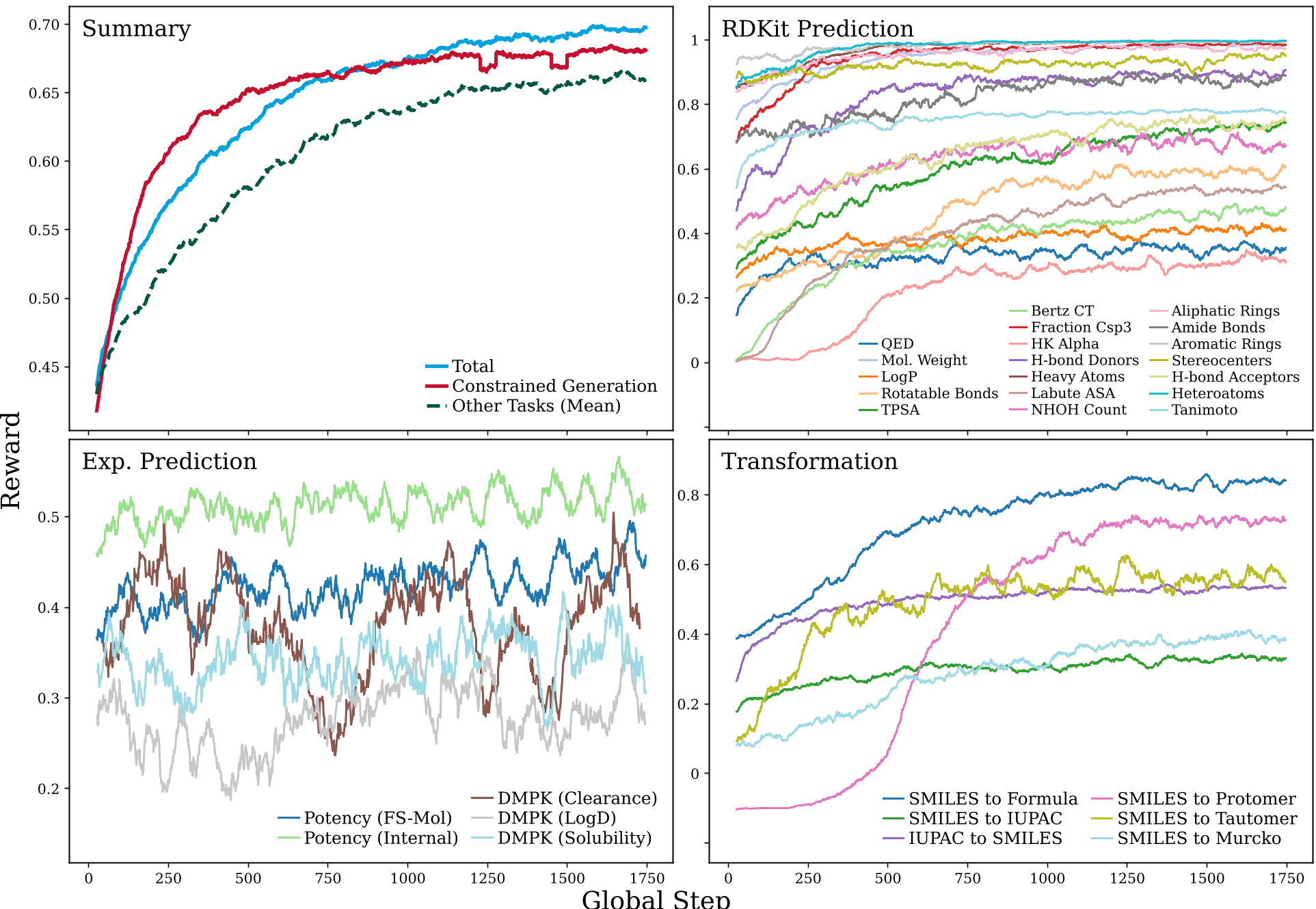 Figure 1: Reward trajectories during RL training. Notice the sigmoidal learning curves for complex tasks like SMILES-to-Protomer translation.
Real-World Simulation: Lead Optimization
The most impressive part of the study is the Simulated Lead Optimization. The models were put in a 20-turn "loop":
- Draft: Model proposes a molecule.
- Test: An external "oracle" (docking tool) provides a score.
- Refine: Model adjusts the molecule based on feedback.
Aspen (the RL-tuned 30B model) showed incredible efficiency, finding high-potency molecules with better "ligand efficiency" (potency per atom) than even the larger closed-source models.
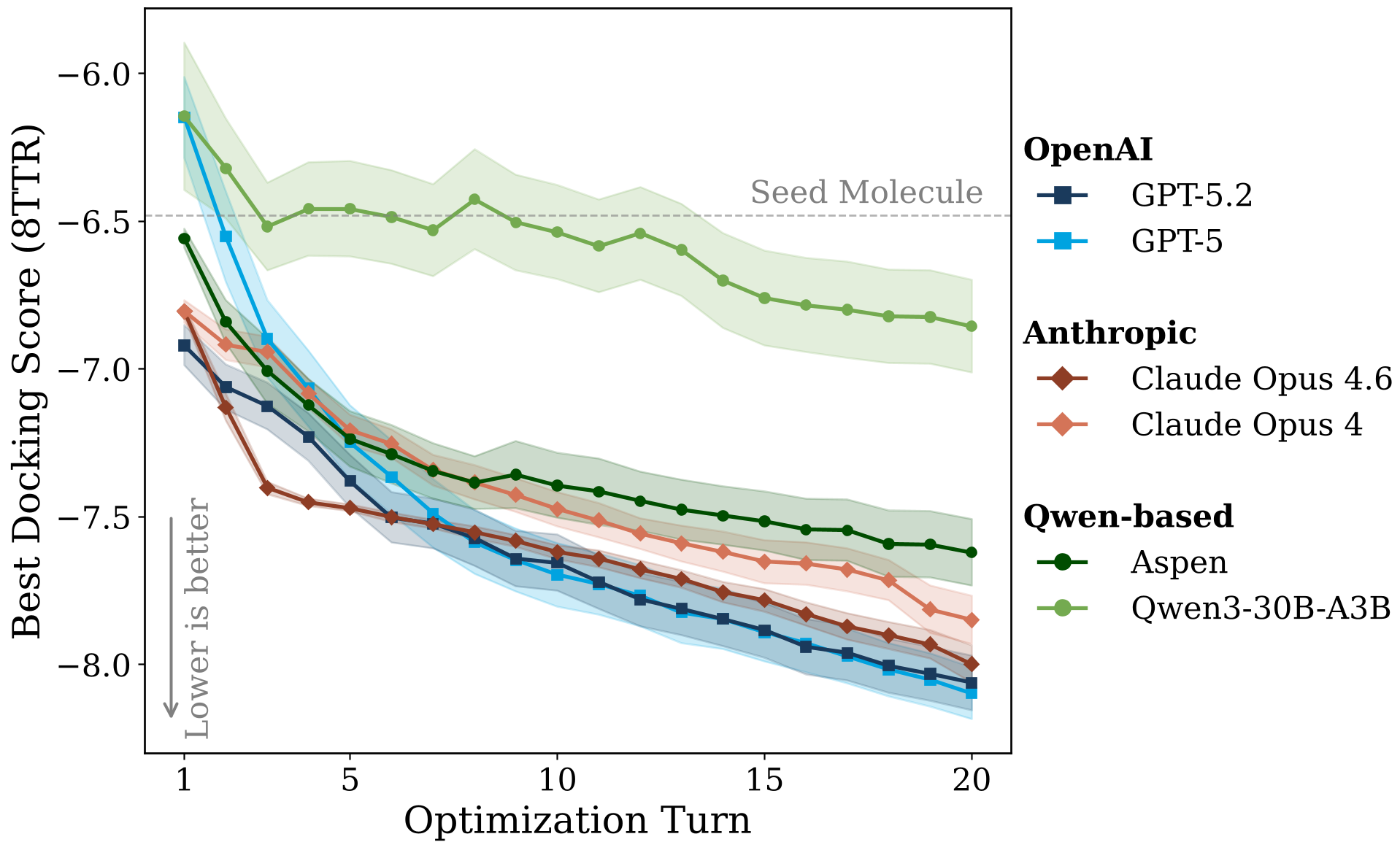 Figure 2: Aspen (red) rapidly outpaces its base model (Qwen, purple) and matches the performance of frontier models in docking score optimization.
Critical Insight: The Limits of RL
The study provides a sobering reality check: RL can only "sharpen" what is already there. For tasks where the base model was a total "zero" (like complex IUPAC-to-SMILES translation), RL failed to move the needle. This suggests that for the most difficult chemical languages, we still need midtraining—injecting raw chemical data during the model's primary training phase—before RL can take over.
Conclusion
Aspen represents a shift in how we build AI for science. We don't necessarily need trillion-parameter models to discover the next blockbuster drug; we need cleverly designed environments that allow smaller, more efficient models to "practice" the art of medicinal chemistry.
Takeaways for the Industry:
- Post-training is a superpower: You can "rescue" a mid-tier model and make it a specialist SOTA.
- Structure matters: Framing chemistry as an RL environment provides a much denser learning signal than simple text completion.
- The "Base" matters: If the model doesn't understand the "alphabet" of chemistry (SMILES/IUPAC) during pre-training, no amount of RL will make it a "poet."
Disclaimer: This analysis is based on the technical paper "Evaluating the Progression of Large Language Model Capabilities for Small-Molecule Drug Design" (2026).