
EvoLM: Breaking the Supervised Ceiling with Co-Evolving Discriminative Rubrics
EvoLM: Self-Evolving Language Models through Co-Evolved Discriminative Rubrics
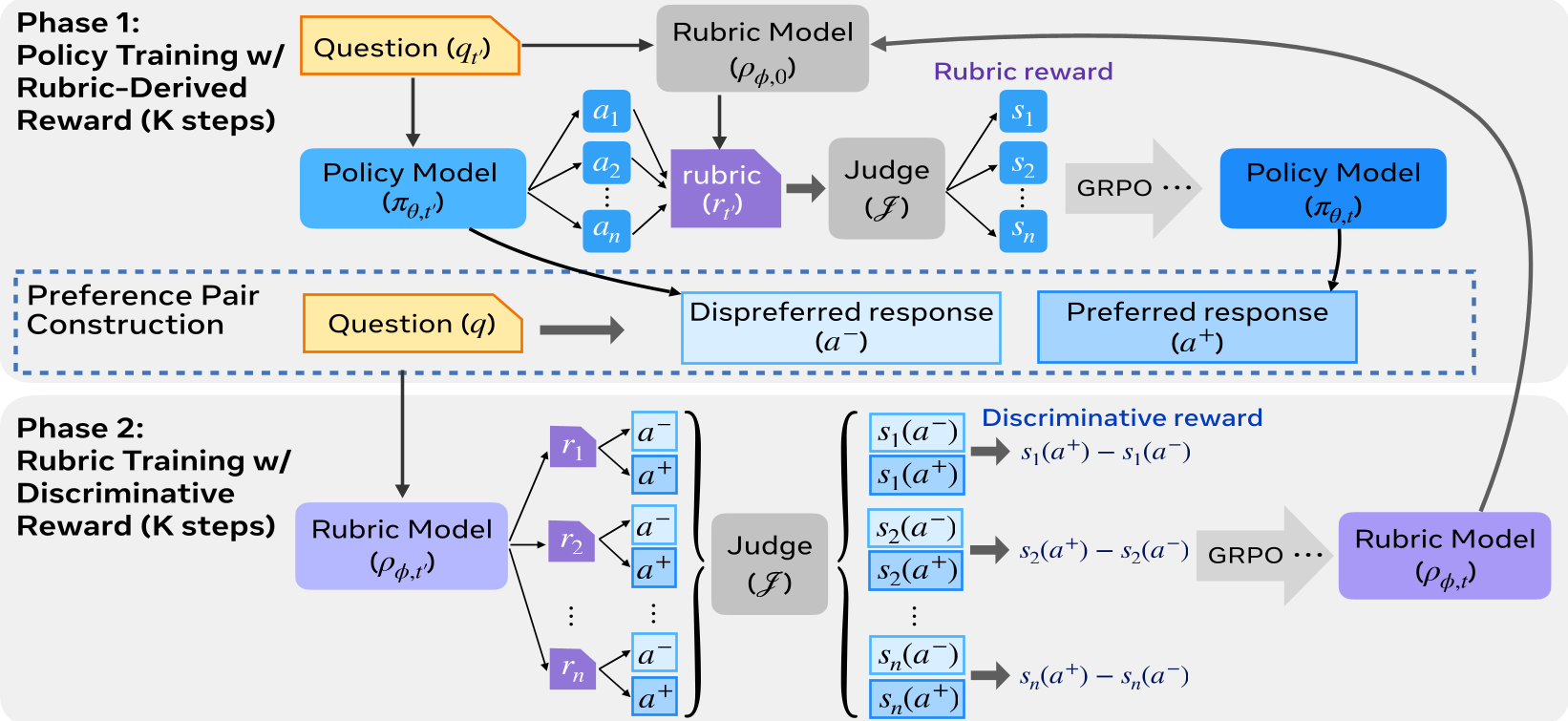
The paper introduces EvoLM, a self-evolving post-training framework where a single language model co-develops its generation policy and instance-specific discriminative rubrics. It eliminates the need for external supervision (human labels or proprietary APIs) and achieves a 69.3% average on the OLMo3-Adapt suite, outperforming GPT-4.1-prompted rubrics and state-of-the-art reward models.
TL;DR
The reliance on external teachers—whether humans or GPT-4—is the "glass ceiling" of AI alignment. EvoLM smashes this ceiling by allowing a model to become its own instructor. By co-evolving a generation policy with a rubric generator, the model learns to define what "good" looks like in natural language. Even a tiny 1.7B parameter judge, when armed with these evolved rubrics, provides a training signal that beats GPT-4 and state-of-the-art reward models.
Context: The Trap of Static Rewards
In the current Reinforcement Learning from Human Feedback (RLHF) landscape, we typically freeze a Reward Model (RM). However, as the policy improves, it eventually finds "holes" in the RM’s logic, leading to reward hacking. The RM says the answer is perfect, but the actual quality is terrible.
The authors of EvoLM argue that the model already contains the knowledge needed to evaluate itself; it just needs a way to structure it. Instead of a "black-box" scalar score, they propose natural language rubrics that evolve as the model gets smarter.
Methodology: The Co-Evolution Loop
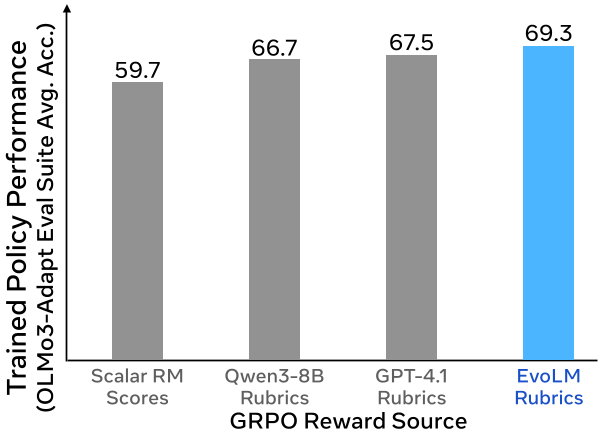
EvoLM operates on a principled variational inference objective, treating rubrics as latent variables that explain why one answer is better than another.
1. The Architecture
The system consists of a single model (e.g., Qwen3-8B) playing two roles:
- The Policy: Generates answers to questions.
- The Rubric Generator: Produces instance-specific criteria (e.g., "Must include the value 144").
- The Judge (Frozen): A small 1.7B model that simply checks if the answer meets the rubric.
2. Temporal Contrast: The Secret Sauce
To train without human labels, EvoLM uses Temporal Contrast. It pairs the model’s current (stronger) output against its own output from 50 steps ago (weaker). The Rubric Generator is then tasked: "Write a rubric that makes our small judge prefer the current answer over the old one."
From Abstract Labels to Verifiable Checks
The most fascinating discovery in the paper is how the rubrics evolve.
- Early Stage: Rubrics are vague (e.g., "Ensure mathematical accuracy").
- Late Stage: Rubrics pack specific, verifiable facts (e.g., "The answer is 144, derived from a perimeter of 48").
This "enrichment" process offloads the cognitive burden from the judge. The tiny 1.7B judge doesn't need to know advanced calculus anymore; it just needs to see if the number "144" appears in the text. This allows weak supervision to scale to strong capabilities.
Experimental Potency
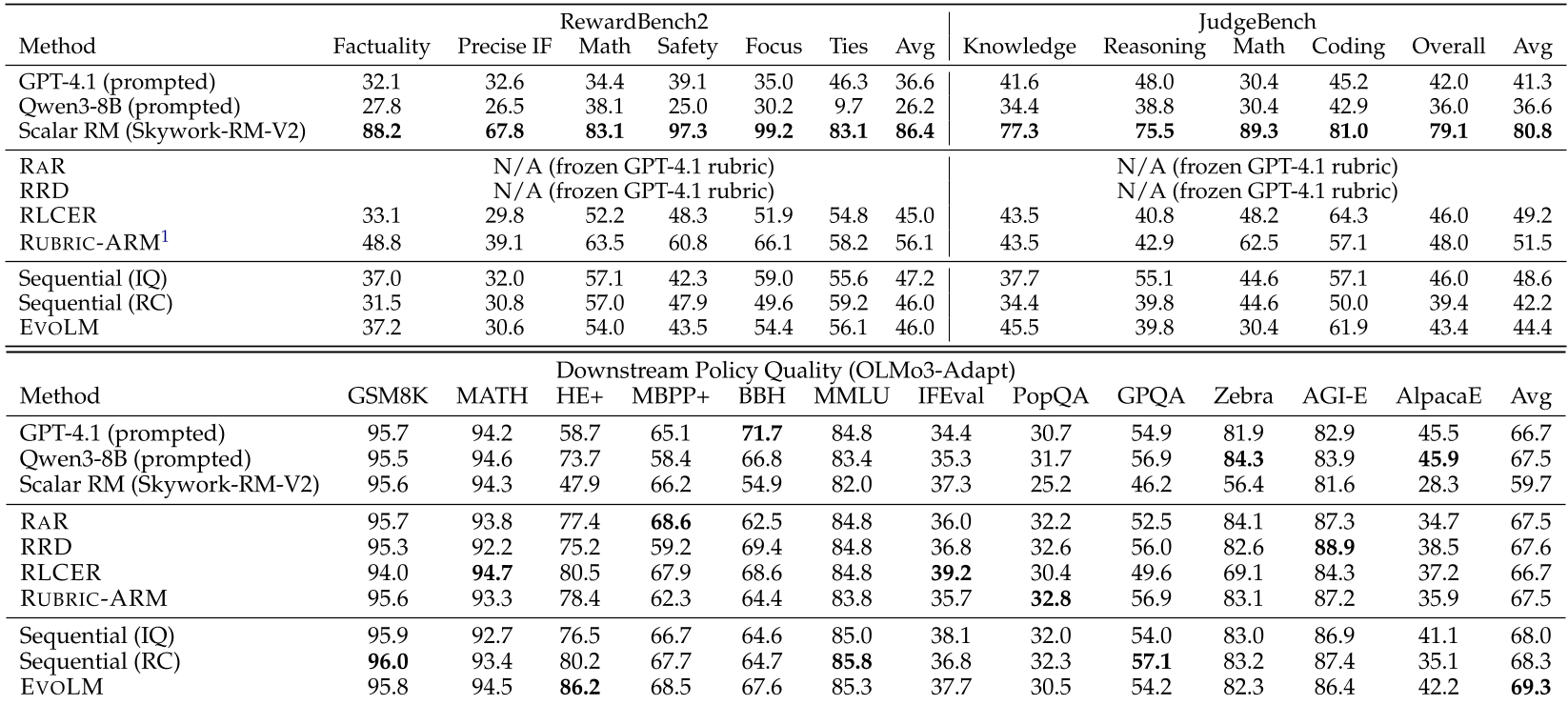
EvoLM was tested across 12 benchmarks including math, code, and general reasoning.
- Policy Quality: It achieved a 69.3% average, crushing the SkyWork-RM-V2 baseline (59.7%). This proves that a state-of-the-art scalar RM can be a poor teacher compared to an evolving rubric.
- Out-of-Distribution Generalization: Even though it was trained on general chat data, the rubrics it generated for Deep Research tasks (Health/Science) were better aligned with expert human rubrics than GPT-4's.
Critical Insight: The "Judge Paradox"
A striking result from the ablations was that larger judges (up to 32B) actually produced weaker downstream policies than the 1.7B judge. Why? The researchers suggest that larger judges are "too smart"—they are tolerant of vague rubrics. A "dumb" 1.7B judge forces the Rubric Generator to be incredibly precise and explicit, which in turn provides a much sharper and more useful training signal for the policy.
Conclusion
EvoLM demonstrates that the path to Superalignment isn't necessarily through larger external reward models, but through structured self-reflection. By forcing a model to explain why it is improving in the form of discriminative rubrics, we create an autonomous feedback loop that keeps pace with the model's own growth.
This work paves the way for "Self-Evolving" agents that can specialize in complex, non-verifiable domains (like creative writing or empathy) where no ground-truth "Gold Standard" exists.