
[Physics Insights] Restoring the Modular Symphony: Exact SL(2, Z) Duality on the Lattice
Exact SL(2,Z)-Structure of Lattice Maxwell Theory with $θ$-term in Modified Villain Formulation
This paper establishes the exact SL(2, Z)-duality of 4D lattice Maxwell theory within a modified Villain formulation. By employing an ultra-local action with a θ-term and incorporating a non-local transformation procedure to handle lattice zero modes, the authors demonstrate that the theory preserves the full modular symmetry characteristic of its continuum counterpart.
TL;DR
The quest to reconcile the discrete nature of the lattice with the continuous elegance of S-duality has long been plagued by "non-locality" contamination. A new paper by Aoki, Kikukawa, and Takemoto solves this by leveraging the modified Villain formulation, proving that a carefully constructed ultra-local lattice Maxwell theory can possess the exact SL(2, Z) symmetry found in continuum physics.
The Problem: The "Staggered" Obstacle
In continuum Maxwell theory, S-duality () and T-duality () generate the modular group . However, mapping this to a 4D hypercubic lattice is notoriously difficult. When you apply the Poisson summation (the engine of S-duality) to a lattice action with a -term, the "zero modes" associated with the lattice topological charge typically "infect" the kinetic term, turning a simple local interaction into a messy, non-local one.
Physicists were left with a Choice of Evils:
- Accept a non-local theory.
- Sacrifice exact duality.
The Breakthrough: The Modified Villain Approach
The authors sidestep this by using the modified Villain formulation. In this setup, we use non-compact gauge fields but keep track of integer-valued plaquette variables () that represent magnetic flux. By imposing a "no-monopole" constraint (), the topological charge becomes well-behaved.
The Mathematical Intuition
The core insight lies in the decomposition of the topological charge using projection operators (). The authors found that the non-locality arises from the interaction between these operators. By defining a "non-local" intermediate charge that is physically identical to the local charge in the absence of monopoles, they can "cancel out" the non-locality generated by the Poisson summation.
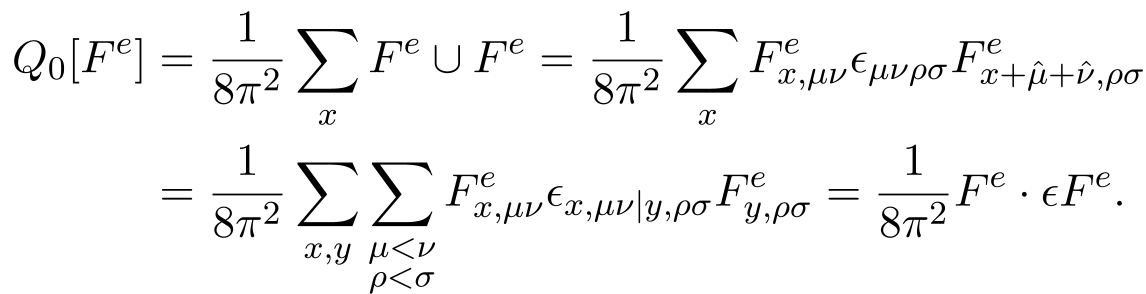 Equation 2.6: The lattice definition of topological charge using the cup product and the matrix.
From Dyons to Wilson Loops
The paper doesn't just stop at the vacuum; it explores Dyonic Wilson loops. A dyon is a particle carrying both electric () and magnetic () charges. On the lattice, these are represented by loops on the original lattice and its dual.
The authors reveal that under an S-transformation, these loops acquire a non-trivial phase factor. This phase is rooted in the Witten Effect, where a -term induces an electric charge on a magnetic monopole.
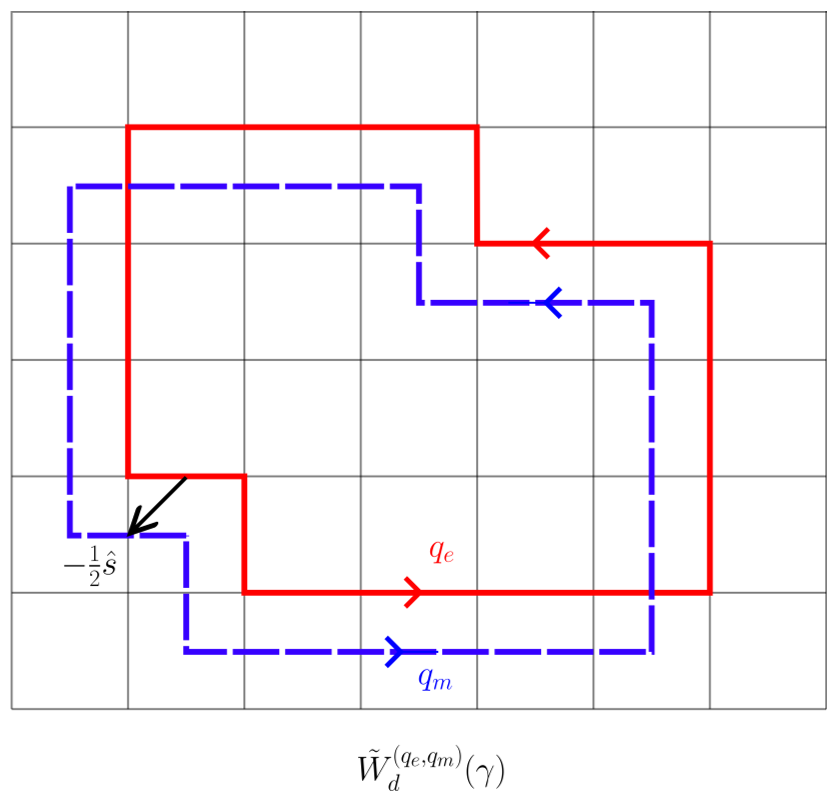 Figure 1: Visualization of the dyonic Wilson loop, showing the interplay between the electric (red) and magnetic (blue) contours.
Why This Matters: Topological Phases and Non-Invertible Symmetries
This isn't just a mathematical exercise. The SL(2, Z) structure discovered here closely resembles non-spin Maxwell theory. Specifically, the emergence of the Pontryagin square in the action shift suggests that the lattice theory naturally captures phases.
Key Achievements:
- Exact Partition Function: Calculated analytically using theta functions, proving modular invariance.
- Statistical Transmutation: The phase factors suggest that these lattice Wilson loops can exhibit bosonic or fermionic statistics depending on the topological background.
- Aharonov-Bohm Consistency: The framing of the loops correctly reproduces the complex Aharonov-Bohm phase between dyons.
Critical Analysis & Future Outlook
While the proof is robust for Abelian theories, the "elephant in the room" remains Non-Abelian Yang-Mills. The authors suggest this methodology could be the key to testing S-duality in lattice versions of SYM, a theory central to the AdS/CFT correspondence and quantum gravity.
However, the current model relies on the modified Villain formulation's ability to suppress monopoles. In a real-world simulation where monopoles might be physical, the "zero-mode" problem might return in a different guise.
Ultimately, this paper serves as a bridge, showing that the most fundamental dualities of our universe can survive the translation onto a discrete computer-simulated grid.
Keywords: Lattice Gauge Theory, S-Duality, Modified Villain Formulation, Theta Functions, Topological Charge, Dyons.