
[ICLR 2025] HeRL: Why "Experience" is the Secret Sauce for LLM Exploration
Experience is the Best Teacher: Motivating Effective Exploration in Reinforcement Learning for LLMs
HeRL (Hindsight experience guided Reinforcement Learning) is a novel RL framework designed to improve the reasoning capabilities of LLMs by treating failed trajectories and unmet rubrics as language-based "hindsight experience." It achieves superior performance across instruction-following (IFEval), writing, and medical domains, effectively extending the model's capability boundary beyond standard RLVR (Reinforcement Learning with Verifiable Rewards).
TL;DR
Reinforcement Learning (RL) has become the de facto standard for aligning Large Language Models (LLMs). However, most RL methods suffer from "blind exploration"—the model just guesses until it hits a reward. HeRL (Hindsight experience guided RL) changes this by turning every failure into a lesson. By feeding unmet rubrics back into the model as in-context guidance, HeRL allows models to explore beyond their current distribution, leading to massive gains in instruction-following and medical reasoning.
The Problem: The "Blind Guessing" Bottleneck
In standard Reinforcement Learning with Verifiable Rewards (RLVR), a model gets a high score if it follows instructions and a low score if it doesn't.
The issue? A scalar reward (e.g., "0.4") doesn't tell the model why it failed. Is the word count wrong? Did it forget a keyword? Without specific feedback, the model's exploration is confined to its "safe zone," often leading to exploration collapse—where the model stops trying new things and settles for mediocre results.
The Insight: Failure is a Teacher
The authors of HeRL realized that rubrics (checklist-style criteria) contain rich language priors. If a model fails a "Medical QA" task because it missed a specific safety constraint, we can explicitly tell it: "You failed rubric X; now try again using this failure as a reference."
The HeRL Workflow:
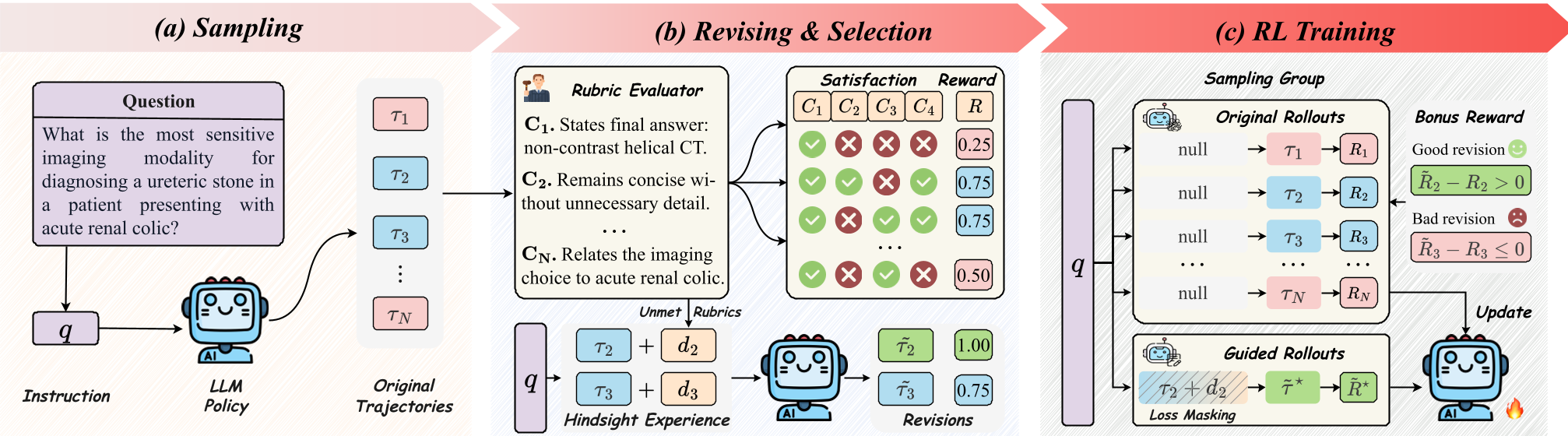
- Rollout: Sample multiple responses.
- Evaluate: Use an "LLM-as-a-Judge" to check rubrics.
- Hindsight Guidance: Take the "best of the failed" responses and ask the model to fix them based on the unmet rubrics.
- Optimized Learning: Train on both the original attempts and the successful "fixed" versions.
Methodology: Beyond Simple Updates
HeRL isn't just about "re-trying." It introduces two critical technical innovations:
- Bonus Reward (): The model is rewarded not just for being right, but for showing potential. If an initial failure serves as a great "stepping stone" to a perfect revised answer, that initial attempt gets a bonus.
- Policy Shaping: To help the model learn from "unfamiliar" but high-quality improvements, the authors use a regularized importance sampling ratio. This ensures the model doesn't ignore the new, better behaviors it discovered through guidance.
Experimental Results: Breaking the Capability Boundary
HeRL was tested against SFT (Supervised Fine-Tuning), DPO, and standard RLVR across several architectures (Qwen2.5, Llama 3.2).
1. Superior Performance
On IFEval, HeRL pushed Qwen2.5-7B performance from 72.6 to 82.4, a nearly 10-point jump. In the Medical domain, it achieved a 9.9% gain over the baseline.
| Method | IFEval | HealthBench-500 |
|---|---|---|
| Base Model | 72.6 | 24.4 |
| RLVR (Baseline) | 77.3 | 30.5 |
| HeRL (Ours) | 82.4 | 34.3 |
2. Sustained Diversity
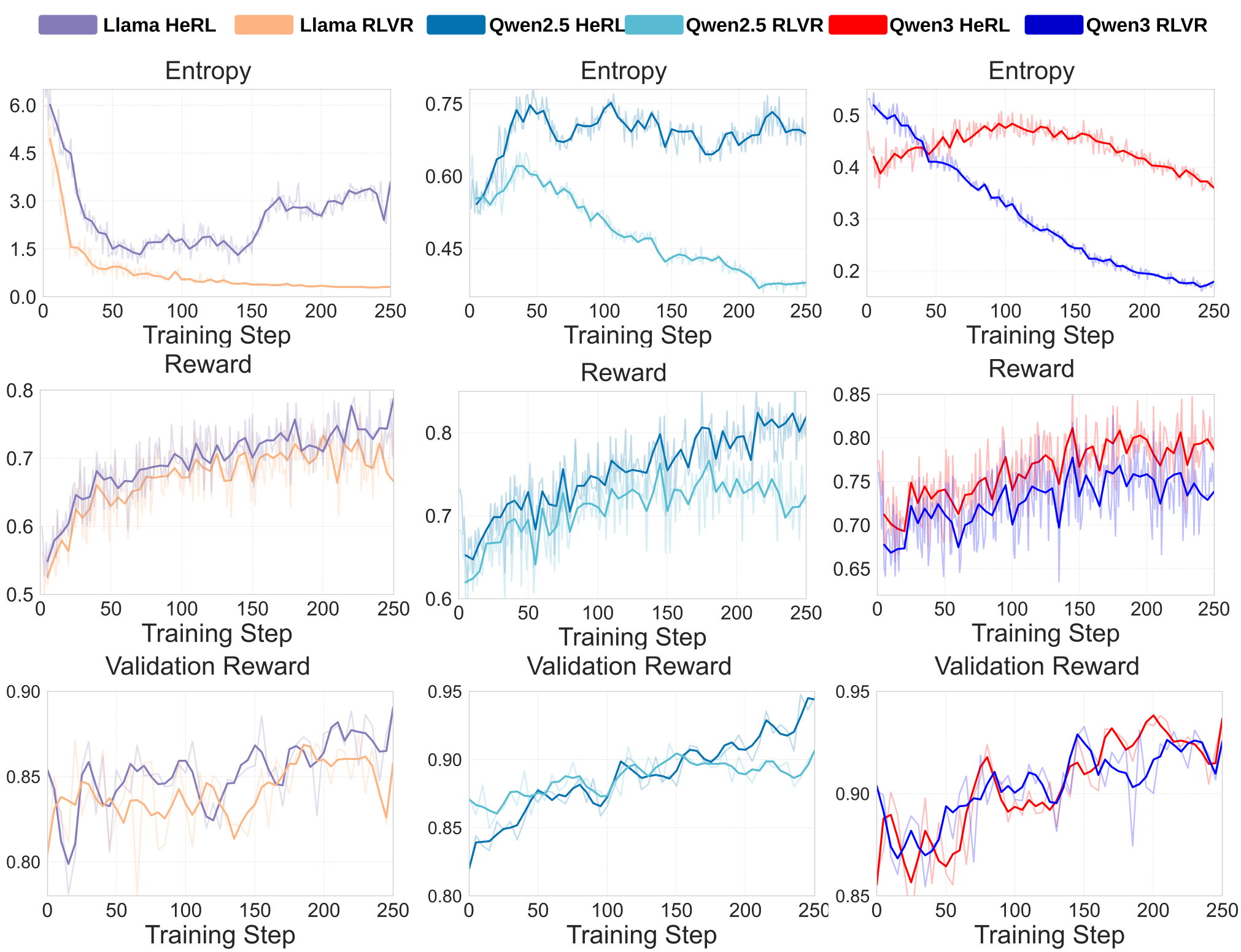
One of the most striking findings is in the Training Dynamics. While standard RLVR often sees "entropy collapse" (the model becomes repetitive), HeRL maintains high entropy. It stays "curious" longer, leading to better final validation rewards.
Deep Insight: Test-Time Scaling
Perhaps the most exciting takeaway is that HeRL models learn to self-correct at test time. Because the model was trained to improve based on hindsight experience, you can give it a rubric at inference time, and it will iteratively refine its answer, achieving even higher scores (Pass@k) than it could through simple random sampling.
Conclusion & Future Work
HeRL proves that effective exploration is guided exploration. By leveraging the bridge between language (rubrics) and logic (RL), HeRL enables models to teach themselves.
Limitations: Currently, HeRL relies on high-quality, static rubrics. The authors suggest that the next frontier is Adaptive Rubrics—checklists that evolve and get harder as the model grows smarter.
#ReinforcementLearning #LLM #AIResearch #HeRL #MachineLearning