
Beyond Starobinsky: New $(\xi, n)$-Attractors Bridging the CMB-DESI Gap
New Exponential and Polynomial $ξ$-attractors
The paper introduces a new family of cosmological -attractors characterized by non-minimal gravity coupling and non-canonical kinetic terms. These models efficiently map to exponential and polynomial -attractors in the Einstein frame, providing a flexible framework to match the latest CMB and DESI data by spanning a wide range of spectral indices ().
TL;DR
The landscape of inflationary cosmology is shifting. While the Starobinsky and Higgs models have long been the gold standard, new data from DESI and ACT suggest a slightly "bluer" spectral index () than previously predicted. Kallosh and Linde (2026) introduce -attractors, a generalized class of models that use non-minimal gravity coupling to allow to climb higher, perfectly aligning with the latest datasets while providing discrete targets for future -mode (gravitational wave) detection.
The "Tension" Motivation: Why Old Attractors Are Feeling the Heat
For years, the formula was the safe bet, leading to the celebrated prediction of . However, the 2025-2026 data releases from the Dark Energy Spectroscopic Instrument (DESI) and high-resolution CMB experiments (ACT/SPT) have introduced a fascinating tension. They favor .
Standard exponential attractors (where the potential reaches its plateau as ) are stuck at the lower value. To solve this, we need polynomial attractors—models where the potential plateaus more slowly ().
Methodology: The Superconformal Bridge
The genius of this paper lies in its use of the superconformal frame. In this framework, the Jordan Frame (where scalars couple non-minimally to gravity) and the Einstein Frame (where gravity looks standard) are just different "gauges" of the same underlying theory.
By manipulating the Kahler potential , the authors define a kinetic term .
- When , we recover the hyperbolic geometry of classic -attractors.
- By varying and the potential power , the "speed" at which the inflaton approaches the plateau is tuned, directly controlling .
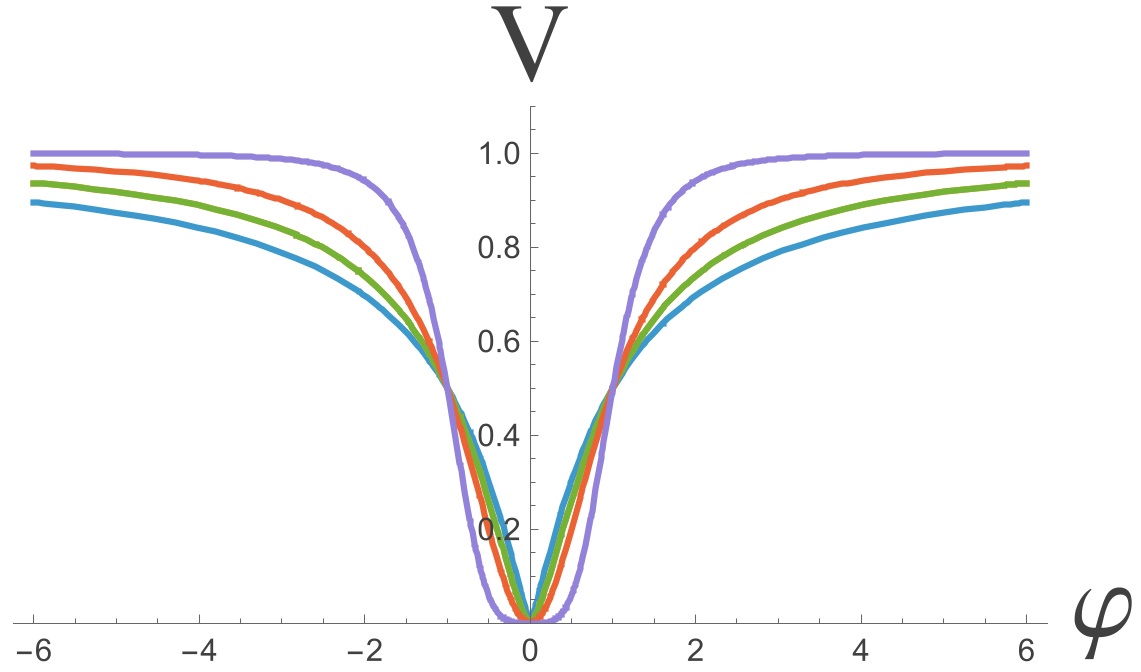 Figure 1: The KKLTI potential. Notice how different values of change the "flatness" of the plateau, which determines the spectral index.
Discrete Targets for B-Modes
One of the most exciting aspects for experimentalists is the "Discrete Targets." In supergravity models associated with 10D/11D string theory, the parameter (which scales the tensor-to-scalar ratio ) isn't just any number—it's often an integer.
The authors show that for polynomial attractors, these discrete targets () provide a roadmap for the next decade of -mode searches.
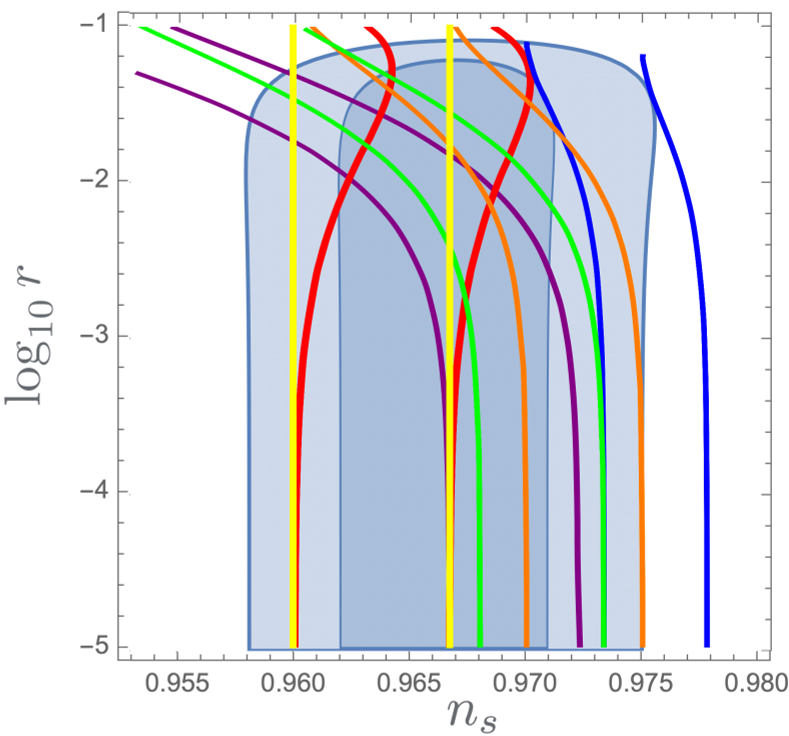 Figure 2: The vs plane. The new polynomial models (colored lines) shift the predictions into the higher region favored by DESI (right side of the plot).
Critical Insight: Why This Works
The "Attractor" property means that even if you change the starting potential slightly, the final cosmological predictions stay the same. In these new models, the "attractor" is determined by the pole in the kinetic term. By changing the pole order from exponential to polynomial, the authors have effectively expanded the "universality class" of inflation.
Conclusion and Future Outlook
Kallosh and Linde have provided a "Standard Model-like" flexibility to inflation. As the LiteBIRD mission and next-gen Ground-based observatories come online, we won't just be looking for "any" gravitational waves; we will be looking for the specific, discrete signatures of the Kahler curvature of our universe's early geometry.
Takeaway: The tension in current data isn't a crisis; it's a sign that our inflationary models are evolving from simple exponents to more nuanced polynomial structures.