
FAB: Solving the Bilevel Optimization Puzzle Over Dynamic Directed Networks
FAB: A First-Order AB-based Gradient Algorithm for Distributed Bilevel Optimization over Time-Varying Directed Graphs
The paper introduces FAB (First-order AB-based), the first fully first-order gradient algorithm for distributed bilevel optimization over time-varying directed graphs. It integrates the Push-Pull (AB) communication strategy with a value function-based penalty method to solve nested optimization tasks without second-order derivatives.
TL;DR
In modern decentralized machine learning, agents often face two hurdles: dynamic, asymmetric communication (directed graphs) and the need for nested optimization (like hyperparameter tuning). This paper presents FAB, the first algorithm to tackle both. By merging "Push-Pull" communication with a first-order penalty method, FAB avoids expensive Hessian computations and stays stable even as the network topology shifts under its feet.
Background Positioning: This work bridges the gap between decentralized optimization and bilevel programming. It is a "SOTA-enabler" that allows complex meta-learning and RL tasks to run on unreliable agent networks where information flow is one-way and time-variant.
The "Double Whammy": Consensus Bias & Nested Structures
Prior works in distributed optimization usually assume an undirected graph where information exchange is symmetric. In the real world (satellites, UAVs), communication is often directed and unbalanced.
When you add a bilevel structure—where an upper-level problem (e.g., training a meta-model) depends on the solution of a lower-level problem (e.g., individual agent training)—the math breaks.
- Consensus Bias: In time-varying directed graphs, there isn't a fixed "center" of the network, causing the consensus point to drift.
- The Penalty Trade-off: To solve bilevel problems without Hessians, authors use a penalty term. However, a large penalty amplifies consensus errors, potentially leading the whole system to diverge.
Methodology: The FAB Design
FAB (First-Order AB-based) solves this by reformulating the bilevel task into a single-level minimax problem: Here, tracks the lower-level solution .
1. The Push-Pull (AB) Secret Sauce
Standard algorithms use one matrix for communication. FAB uses two:
- Row-stochastic (A): Pulls decision variables to ensure agents agree on the model.
- Column-stochastic (B): Pushes gradient information to track the global average gradient without needing a central server.
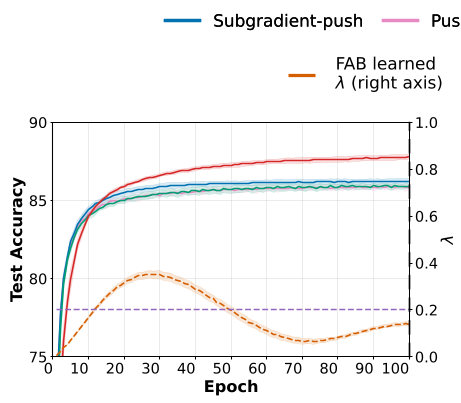 Figure: FAB's ability to maintain high test accuracy compared to single-level baselines across different corruption rates.
2. Fully First-Order
Unlike "SOBA" or other bilevel methods that require Hessian-inverse-vector products, FAB only asks for gradients. This makes it viable for high-dimensional models like BERT, where computing second-order derivatives is a memory nightmare.
Experimental Proof: From MNIST to BERT
The authors validated FAB across three domains: hyperparameter tuning, RL policy evaluation, and data hyper-cleaning.
Robustness to Data Heterogeneity
In tests on the IMDB dataset with BERT, FAB demonstrated superior resilience to label noise and data skew. While other algorithms oscillated wildly or converged to poor local minima, FAB's adaptive penalty approach effectively "cleaned" the training data by weight adjustment.
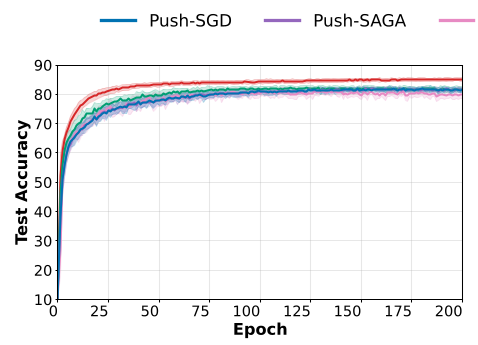 Figure: Performance of FAB vs. baselines. Note the faster convergence and higher final accuracy in sentiment analysis tasks.
Scaling with Network Size
One of the most impressive results is the scalability. The authors scaled the system up to 1000 agents. While performance naturally degrades as increases (a common trait in worst-case analysis for directed graphs), FAB's runtime and memory footprint remained linear relative to model size.
Critical Insight & Outlook
FAB achieves a convergence rate of . For a single-level problem, the rate is . That "missing" power is the price we pay for being "fully first-order" and decentralized.
Limitations: The current proof relies on the lower-level objective being strongly convex. If the lower level is general nonconvex, the convergence guarantees aren't yet there.
Future Impact: FAB opens the door for Decentralized Meta-Learning. Imagine a swarm of robots learning a task where they not only share data (low-level) but also learn how to learn from each other (upper-level hyperparameter tuning)—all while moving through a network with fluctuating signals. That's the future FAB is building towards.
Conclusion
FAB represents a significant theoretical and practical leap. It resolves the open question of how "Push-Pull" algorithms converge in nonconvex settings over dynamic graphs and provides a robust framework for complex, nested optimization in the wild.