
Beyond Classical Limits: 120-Qubit Simulation of the Fermi-Hubbard Model
Fast, accurate, high-resolution simulation of large-scale Fermi-Hubbard models on a digital quantum processor
This paper presents a large-scale digital quantum simulation of the 1D Fermi-Hubbard model using up to 120 qubits on a superconducting processor. By employing an efficient "pair-interleaved" fermion-to-qubit mapping and overheard-free error suppression, the authors achieve quantitatively accurate results for dynamical evolution that challenge state-of-the-art classical tensor-network methods (TDVP).
TL;DR
Researchers from Q-CTRL and IBM have successfully executed one of the largest and most accurate digital quantum simulations to date. By simulating the 1D Fermi-Hubbard model—the cornerstone of strongly correlated electron physics—on a 120-qubit superconducting processor, they achieved a 3000x wall-clock speedup over state-of-the-art classical tensor network methods (TDVP) while maintaining quantitative accuracy (RMSE ≲ 1%).
The Problem: The Entanglement Wall
In the world of materials science, the Fermi-Hubbard model is the "Standard Model" for understanding high-temperature superconductivity and quantum magnetism. However, simulating its dynamics is a nightmare for classical computers.
Why? Because of Entanglement. As a system evolves after a quantum quench, its entanglement entropy grows linearly with time. For classical methods like the Time-Dependent Variational Principle (TDVP), this means the "bond dimension" (a measure of the information stored in the simulation) must grow exponentially. Eventually, even the most powerful supercomputers hit a wall where the simulation either becomes too slow or loses accuracy.
Methodology: Application-Aware Compilation
The breakthrough in this paper isn't just "more qubits"; it's smarter software. The team used three core strategy pillars to bridge the gap between noisy hardware and physical reality.
1. The Pair-Interleaved Mapping
To map fermions to qubits, they moved away from standard Jordan-Wigner orderings. Instead, they used a pair-interleaved ordering (↓↑↑↓↓↑↑↓) specifically optimized for the heavy-hex topology of IBM processors. This trick ensures that almost all hopping and interaction gates stay local, drastically reducing the need for "routing" gates that introduce noise.
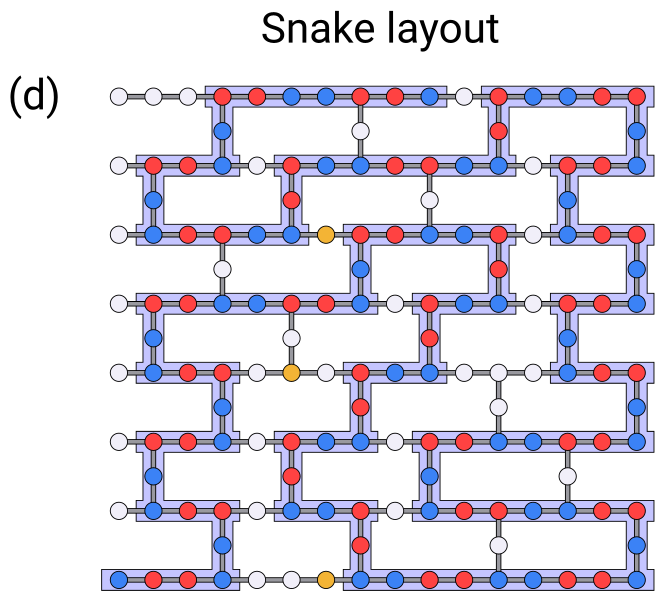 Figure 1: The application-aware compilation workflow, showing the mapping of fermionic sites to the heavy-hex hardware layout.
2. Radical Error Suppression
The team integrated Fire Opal, a suite of error-suppression tools. They used:
- Pauli Twirling: Turning systematic, coherent errors (which add up linearly) into random, stochastic noise (which cancels out).
- Dynamical Decoupling: Protecting idling qubits from environmental noise.
- Echo Circuits: Running the simulation forward and then backward to measure and correct for the natural "decay" of the hardware signal.
Experimental Milestones
Tracking Fractionalization
The team first used 62 qubits to observe spin-charge separation. When a defect is introduced in a Néel state, it splits into a "holon" (carrying charge) and a "spinon" (carrying spin). The quantum processor captured these two disturbances moving at different speeds ( vs ), matching theoretical predictions with high precision.
Scaling to 120 Qubits
Next, they pushed to the 120-qubit regime. At this scale, the quantum processor's runtime remains nearly constant as depth increases, whereas the classical TDVP solver's time explodes.
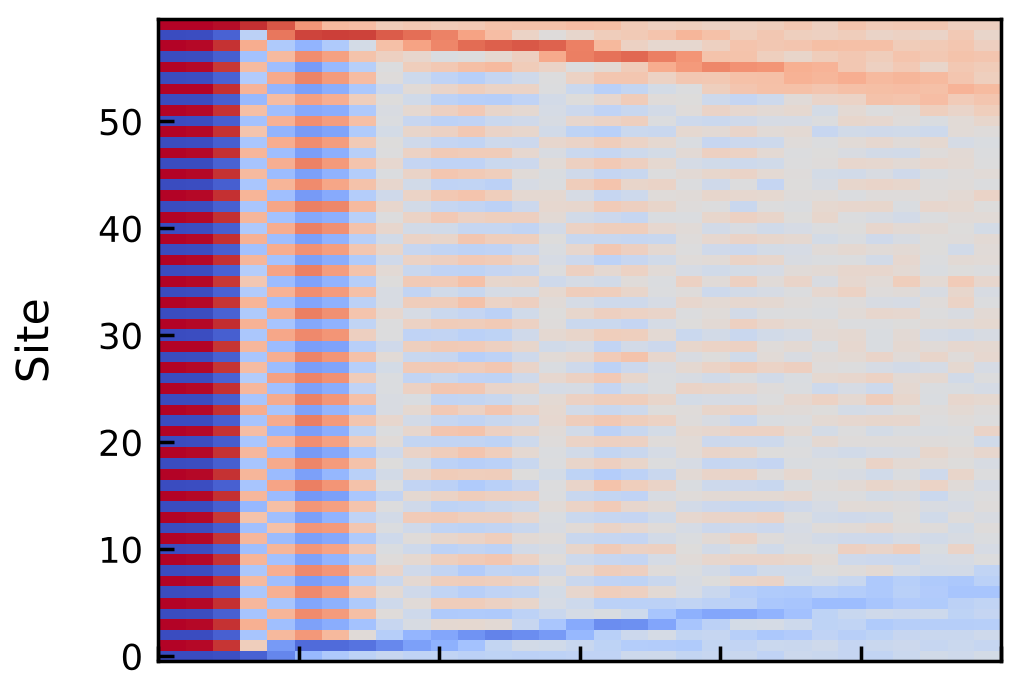 Figure 2: The widening gap between Quantum (purple) and Classical (black/blue lines) performance as evolution time increases.
Critical Insight: The "Indeterminate" Regime
The most fascinating part of the results occurs at . Here, the quantum and classical simulations begin to diverge. Because the classical TDVP is limited by its bond dimension (), we cannot be certain if the divergence is due to hardware noise in the quantum computer or approximation errors in the classical code.
However, the wall-clock comparison is staggering:
- Quantum Processor: ~2 minutes.
- Optimized TDVP (): 100+ hours.
Conclusion and Future Outlook
This work signals the end of the "toy model" era for digital quantum simulation. By moving beyond 100 qubits and achieving competitive accuracy, the authors have proven that quantum hardware is no longer just a laboratory curiosity—it is becoming a viable tool for condensed matter physics.
Limitations: The study remains in 1D, where classical methods are strongest. The next "holy grail" will be applying these same efficiency gains to 2D lattices, where classical methods face the "fermionic sign problem" and quantum advantage could be even more definitive.