
Fast Byte Latent Transformer: Accelerating the Path to a Tokenizer-Free Future
Fast Byte Latent Transformer
The paper introduces Fast Byte Latent Transformer (BLT), a tokenizer-free architecture that accelerates byte-level language modeling through BLT-Diffusion (BLT-D). It achieves SOTA-level byte-level performance while reducing memory-bandwidth costs by over 50% compared to standard BLT via parallel byte generation.
TL;DR
The Byte Latent Transformer (BLT) showed us that we don't need tokenizers, but it was slow. Fast BLT fixes this. By introducing BLT-Diffusion (BLT-D) and inventive self-verification methods, the researchers at Meta and Stanford have slashed the memory-bandwidth cost of byte-level generation by over 50% without sacrificing the model's ability to handle raw, noisy data.
The Motivation: Escape the Byte-by-Byte Bottleneck
Byte-level models are academically superior: they don't break on misspellings, they handle all languages equally, and they don't need complex subword vocabularies. However, they are "inference-poor." Generating a single word like "Transformer" might take 11 forward passes (one for each byte), whereas a subword model does it in 1 or 2.
The authors identified that the bottleneck isn't just raw compute—it’s memory bandwidth. Loading massive model weights for every single byte is inefficient. Fast BLT aims to generate blocks of bytes in parallel, bringing byte-level efficiency closer to token-level speeds.
Methodology: Diffusion Meets Hierarchy
The core innovation is BLT-Diffusion (BLT-D). Unlike standard Autoregressive (AR) models that only look backward, BLT-D's decoder is trained to perform "block-wise discrete diffusion."
1. The Architecture
BLT-D maintains the original hierarchical structure:
- Local Encoder: Groups bytes into dynamic "patches."
- Global Transformer: Processes latent patch representations (the "brain").
- Local Decoder: The workhorse that turns latent tokens back into bytes.
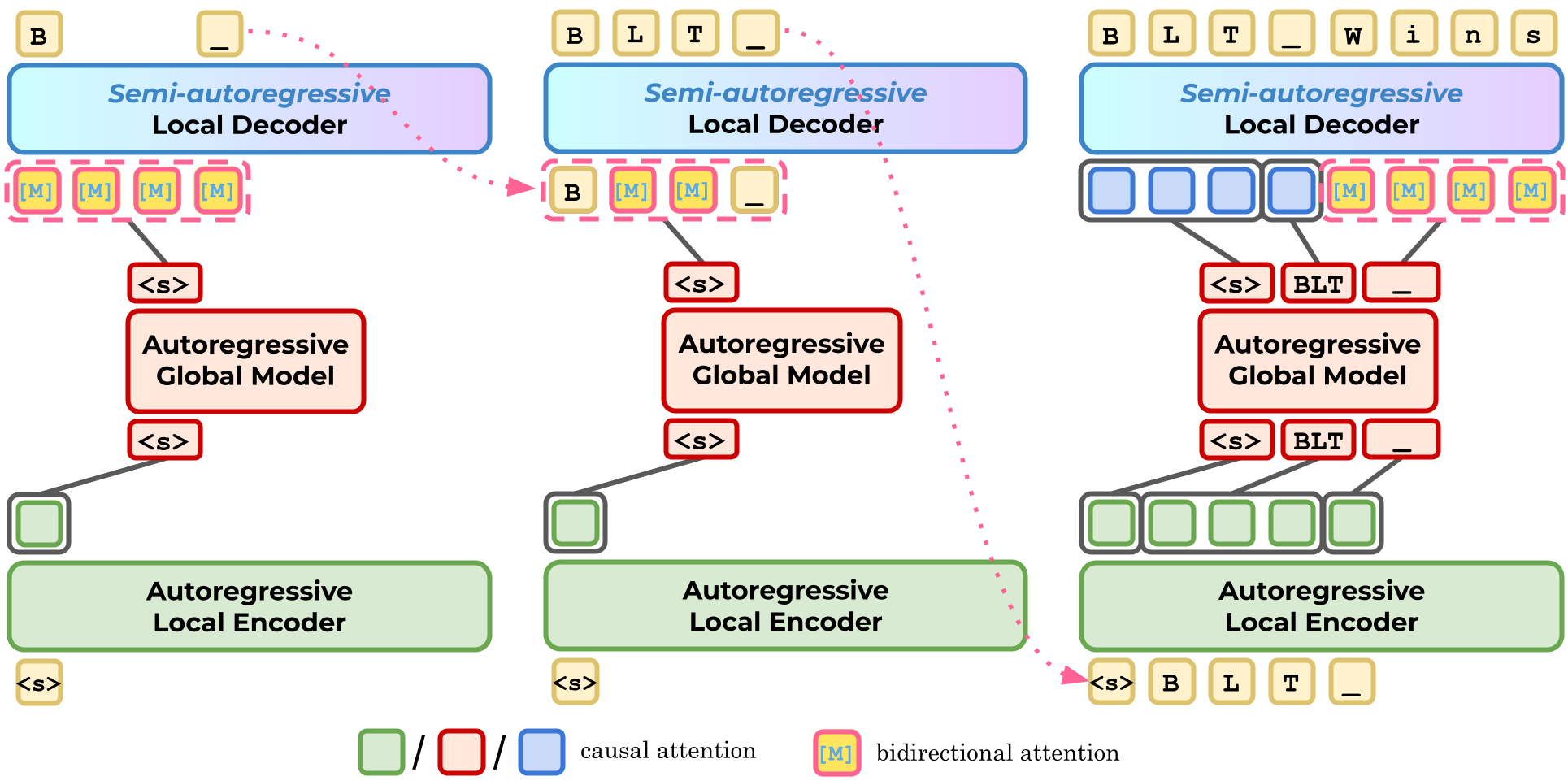
During inference, instead of asking "what is the next byte?", the model initializes a block of [MASK] tokens and uses diffusion to unmask several of them at once.
2. Speculative Extensions: BLT-S and BLT-DV
To ensure high quality, the authors introduced two speculative decoding variants:
- BLT-S (Self-speculation): The lightweight local decoder "guesses" bytes beyond the usual patch boundary. The big global model then verifies them in one go.
- BLT-DV (Diffusion + Verification): Uses the fast diffusion decoder to draft a block, then uses the model's AR capability to double-check the work.
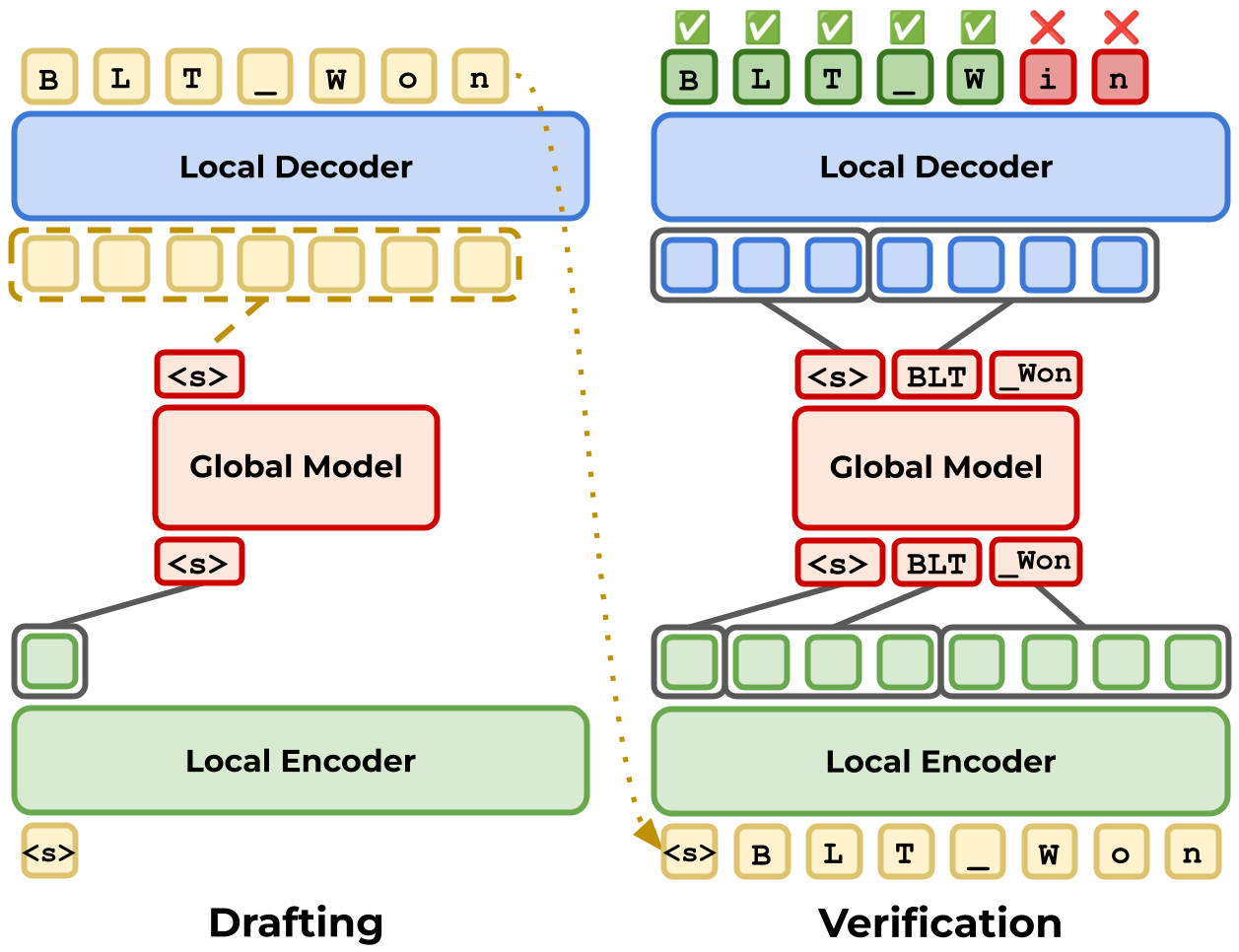
Experiments: Speed vs. Quality
The researchers tested these models at 1B and 3B scales on translation (FLORES-101) and coding (HumanEval) benchmarks.
- Ultimate Speed: BLT-D-16 (16-byte blocks) is the speed king, reducing memory bandwidth by up to 92%.
- Balanced Performance: BLT-S and BLT-DV provide a middle ground—they offer massive speedups (77-81%) while keeping task accuracy identical to the original slow BLT.

The "Diversity vs. Efficiency" analysis also showed that the model naturally spends more time (more decoder calls) on complex, unpredictable text and speeds through predictable patterns, mimicking human-like cognitive efficiency.
Critical Analysis & Future Outlook
The "Fast BLT" family effectively removes the primary excuse for not using tokenizer-free models: latency.
Strengths:
- No Extra Parameters: These speedups don't require adding a "drafting" model like traditional speculative decoding.
- Hardware Friendly: By reducing NFEs (Network Function Evaluations), the model spends less time waiting for memory loads.
Limitations:
- The current study relies on NFE proxies. While highly indicative of performance, a real-world C++ / CUDA implementation (like TensorRT-LLM) is needed to see the final "wall-clock" milliseconds.
- The high-speed variants (BLT-D-16) still show a slight quality dip in complex code generation compared to the slower AR versions.
Conclusion: Fast BLT marks a significant milestone. It proves that the future of NLP might not be written in tokens, but in raw, efficiently processed bytes.